

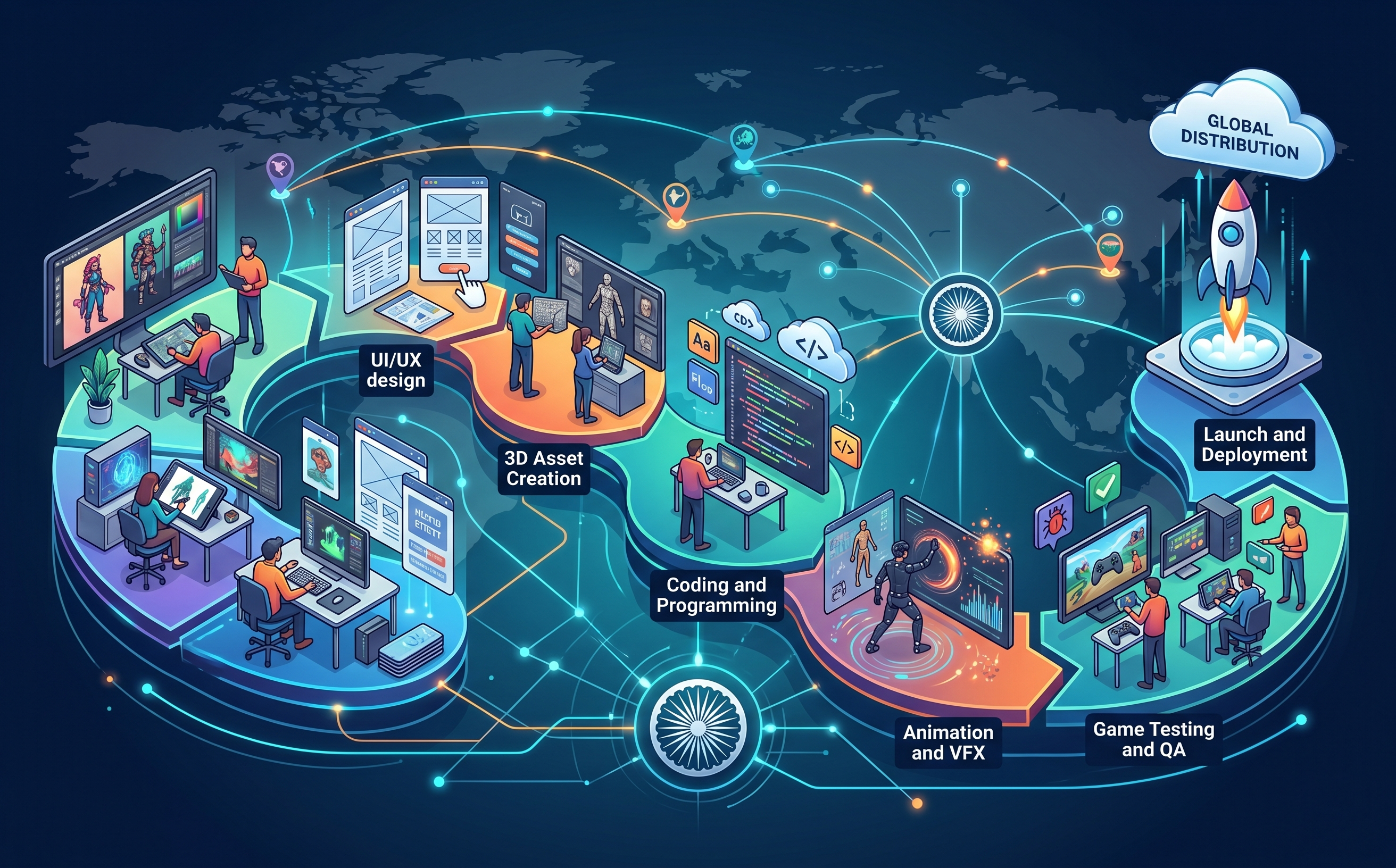
For US and UK publishers, the math on game development has gotten brutal. A full-cycle mobile game that cost $150,000 five years ago now runs $300,000+ in-house. A Unity developer in San Francisco bills $125 per hour. A mid-level 3D artist in London costs £70,000 per year before benefits. Meanwhile, launch windows are shrinking, player expectations are rising, and publishers are under pressure to ship more content with tighter margins.
This is why game development outsourcing to Indiahas moved from a cost-cutting tactic to a core production strategy for publishers from Los Angeles to London. Nearly 70% of game developers now use outsourcing in some capacity, and India has emerged as the dominant destination — not just for cost, but for scale, English fluency, and proven delivery on AAA franchises like Elden Ring, Hogwarts Legacy, and Baldur's Gate 3.
This guide gives US and UK publishers the complete picture: what outsourcing to India actually costs, how engagement models work, how to protect your IP, how timezone workflows operate in practice, and how to choose the right studio partner without getting burned.
50–70% typical cost savings vs US/UK studios
500+ game development studios across India
$16.7B projected India gaming market by 2034
175+ AAA titles delivered with Indian co-development
Why India Leads Game Development Outsourcing in 2026
A decade ago, outsourcing to India meant price arbitrage — cheap labor, basic asset work, limited ambition. That stereotype is thoroughly outdated. Today's Indian game studios deliver full-cycle AAA development, with credits on titles like Elden Ring, Destiny 2, Forza Motorsport, Final Fantasy XVI, Street Fighter 6, Baldur's Gate 3, and Alan Wake II. Rockstar Games operates its India studio on flagship franchises including GTA and Red Dead Redemption. Ubisoft, EA, 2K, Square Enix, and Sony all maintain long-standing Indian partnerships.
The Talent Depth Advantage
India produces over 1.5 million engineering graduates annually, with a growing percentage specializing in game development. Unlike smaller outsourcing regions, Indian studios can scale a 5-person team to a 50-person team within months — something Eastern European studios struggle with due to smaller talent pools.
English as a Native Business Language
India is the second-largest English-speaking country in the world. Game design documents, Slack messages, technical briefs, milestone reviews, and feedback loops all happen in English natively. For US and UK publishers, this eliminates the translation friction that plagues many offshore relationships.
Cultural & Creative Alignment
India's animation and VFX industry has served Hollywood, European broadcasters, and global game publishers for over two decades. That creative DNA carries into game development. Indian artists and designers understand Western storytelling conventions, visual aesthetics, and player expectations — because they've been helping build them.
Geopolitical & Infrastructure Stability
Unlike some outsourcing regions affected by political instability or infrastructure disruption, India's IT and creative sector has remained stable through every global upheaval of the past two decades. 5G coverage, fiber infrastructure, and cloud availability make distributed development seamless.
Cost Comparison: US vs UK vs India vs Eastern Europe
Let's get specific. Here's what game development actually costs in different regions in 2026, based on typical hourly rates for mid-to-senior level specialists:
| Role | United States | United Kingdom | Eastern Europe | India |
|---|---|---|---|---|
| Unity Developer (Mid) | $75–$110/hr | £55–£85/hr | $45–$65/hr | $25–$40/hr |
| Unreal Engine Developer (Sr) | $110–$150/hr | £75–£110/hr | $55–$80/hr | $35–$65/hr |
| 3D Artist / Modeler | $70–$100/hr | £50–£80/hr | $40–$60/hr | $20–$35/hr |
| Game Designer | $85–$120/hr | £60–£90/hr | $45–$70/hr | $25–$45/hr |
| QA Tester | $45–$70/hr | £35–£55/hr | $25–$40/hr | $15–$25/hr |
| Technical Lead | $130–$180/hr | £90–£130/hr | $70–$100/hr | $45–$75/hr |
Full Project Cost Comparisons
Let's translate those hourly rates into real project budgets:
US development: $120,000 – $180,000
UK development: £80,000 – £120,000 ($100K – $150K)
India development: $35,000 – $60,000
Typical savings: 60–70%
US development: $400,000 – $700,000
UK development: £280,000 – £480,000 ($350K – $600K)
India development: $120,000 – $220,000
Typical savings: 55–70%
US development: $2M – $5M+
UK development: £1.3M – £3.5M+ ($1.7M – $4.4M)
India development: $600K – $1.5M
Typical savings: 50–65%
These savings assume you work with an established Indian studio. Bargain-basement vendors charging $8–$15/hr exist, but they often lack the production maturity to deliver on deadline. The real value is getting $80/hr quality at $35/hr pricing — not finding the absolute cheapest option.
Engagement Models: Full-Cycle, Co-Dev, Staff Augmentation
One of the biggest advantages of working with Indian studios is flexibility. Unlike traditional vendor relationships, Indian studios offer multiple engagement models that let you choose the right level of control and involvement for each project.
Model 1: Full-Cycle Outsourcing
You hand over a game concept, design document, or prototype, and the Indian studio handles everything from that point forward — design, art, development, QA, platform certification, and launch support. You provide creative direction and approval at milestones; they handle execution.
Best for: Publishers with many projects, non-gaming companies entering gaming (brands, educational institutions), and founders without in-house dev teams.
Pricing: Usually fixed-price per milestone or fixed total project price with clearly defined scope.
Model 2: Co-Development
The Indian studio works alongside your internal team, owning specific modules or disciplines. For example, your US team handles game design and core gameplay programming while the Indian co-dev team handles all art production, UI development, and backend systems. Both teams sync daily and share tools, repos, and project management systems.
Best for: Mid-size studios scaling up production, AAA publishers needing overflow capacity, and games with specific vertical requirements (multiplayer infrastructure, porting, etc.).
Pricing: Typically monthly retainer based on team size, or time-and-materials.
Model 3: Staff Augmentation / Dedicated Teams
You essentially hire full-time developers through the Indian studio. They work exclusively on your project, attend your standups, use your tools and processes, and report to your leads. The Indian studio handles HR, payroll, office space, and retention — you get effective team members at a fraction of the fully-loaded cost of hiring locally.
Best for: Long-term projects, companies that want maximum management control, and studios that need ongoing LiveOps support after launch.
Pricing: Flat monthly rate per developer, typically $4,500–$9,000/month per mid-to-senior developer.
Start with co-development on a scoped module if you've never outsourced before — it's the lowest-risk way to validate the relationship. Scale up to full-cycle or staff augmentation once you trust the team.
What You Can Actually Outsource to India
Modern Indian studios handle the full game development spectrum. Here's a breakdown of what gets outsourced most successfully:
Development Services
Unity development, Unreal Engine 5, HTML5/WebGL, mobile (iOS/Android), console (PS5, Xbox, Switch), PC (Steam, Epic), multiplayer backend, porting and platform certification, and LiveOps support.
Art & Design Services
Concept art, 2D art and illustration, 3D modeling, character design, environment art, animation (2D/3D), cinematics and VFX, UI/UX design, and motion capture cleanup.
Specialized Verticals
Casino and slot games, VR/AR experiences, VR training simulators, blockchain and Web3 games, real-money gaming, and cross-platform builds.
Support & Operations
QA and testing, localization, customer support, game balancing and analytics, and community management.
How Timezone Workflows Actually Work
The most common concern US and UK publishers raise about Indian outsourcing is timezone friction. The reality is more favorable than you'd expect — when structured correctly, timezone differences become a productivity advantage, not a bottleneck.
The India–UK Overlap (4–5 Hours of Daily Sync Time)
India is GMT+5:30. UK business hours (9am–6pm GMT) overlap with Indian afternoon hours (2:30pm–11:30pm IST). That gives you roughly 5 hours of shared work time daily, which is more than enough for morning standups (9:30am UK / 3pm India), live reviews and workshops, and real-time collaboration through screen shares, code reviews, and design iterations.
The India–US Overlap (2–4 Hours of Daily Sync Time)
US East Coast early mornings (7am–10am ET) overlap with Indian evenings (5:30pm–8:30pm IST). US West Coast has a narrower window — early mornings (6am–9am PT) match late Indian evenings (6:30pm–9:30pm IST).
The Follow-the-Sun Advantage
Here's where outsourcing to India becomes a superpower: while your US team sleeps, the Indian team is working. When your US devs clock in at 9am, they find 6+ hours of completed work ready for review. This effectively doubles your daily output on any project with handoff-friendly tasks (art production, asset pipelines, QA cycles, bug fixing).
For US clients, ask your Indian studio to shift their hours slightly. Many Indian studios operate 2pm–11pm IST instead of standard 9–6, specifically to maximize overlap with US time zones. This is a common, well-established practice.
IP Protection, NDAs & Legal Framework
This is the concern that keeps publishers up at night: "What stops the Indian studio from stealing my game idea?"It's a fair question, and the answer involves legal structures, operational safeguards, and due diligence.
Legal Protections
- Mutual NDA — Every engagement starts with a signed mutual non-disclosure agreement covering confidentiality, trade secrets, and IP ownership. Enforceable under the Indian IT Act, which recognizes electronic contracts.
- Work-for-Hire / IP Assignment — The contract explicitly assigns all created IP (code, art, design documents, tools, assets) to you. This is standard practice for reputable studios.
- Non-Compete Clauses — For sensitive projects, you can require the studio not to work on directly competing titles for a defined period.
- Escrow Arrangements — For long-term projects, source code can be held in escrow, releasing to you automatically under defined conditions.
Operational Safeguards
Beyond contracts, look for studios that implement these practical security measures:
- Isolated dev environments — Code and assets stored on secure, access-controlled servers.
- VPN-only access — Developers work through corporate VPNs with monitoring.
- Controlled repository access — Only specific team members have repo access, with full audit trails.
- Physical security — USB/external drive restrictions, camera policies in sensitive areas.
- ISO 27001 certification — Information security management certification indicates mature security practices.
- Background checks — Reputable studios run background checks on developers handling sensitive IPs.
Lakshya Digital (now part of Keywords Studios) regularly works on unreleased AAA titles including Elden Ring and Baldur's Gate 3. Rockstar Games India develops for GTA and Red Dead. If enterprise-grade IP protection weren't achievable in India, these studios wouldn't exist.
How to Choose the Right Indian Studio (7 Criteria)
There are over 500 game development companies in India. Most are mediocre. Some are exceptional. Here's the evaluation framework we recommend US/UK publishers use:
- Portfolio Relevance — Does the studio have shipped work in your specific genre or platform? A studio with 50 hyper-casual titles may not be right for your AAA RPG. Ask for playable builds or live links to shipped games.
- Engine & Tech Expertise — Unity and Unreal certifications, experience with your specific tech stack (backend, multiplayer frameworks, VR SDKs, etc.). Ask to see code samples or have a technical lead interview their lead engineers.
- Client Reviews & Case Studies — Verify reviews on Clutch, GoodFirms, and DesignRush. Ask for direct references you can contact. Good studios will gladly connect you with past clients.
- Communication & English Fluency — Do a video call with the actual team members you'd work with (not just sales). Written communication clarity is even more important than spoken — ask them to respond in writing to a technical brief.
- IP Protection & Security Protocols — Request their standard NDA, ask about their security practices, ISO certifications, and how they handle sensitive client work.
- Engagement Flexibility — Will they work with your preferred engagement model? Are they willing to start with a small paid discovery sprint before committing to a full project?
- Post-Launch & LiveOps Capabilities — Games aren't "done" at launch. Can they handle ongoing updates, bug fixes, and content additions? What's their retention rate for developers (low turnover = knowledge preservation)?
The Paid Discovery Sprint Method
Before committing to a 6-month project, pay the studio for a 2-week discovery sprint. Have them scope the project, build a prototype module, or deliver a specific art asset. You'll learn more about the team in those two weeks than from any amount of sales calls.
Red Flags to Watch For
If a studio quotes $8–$12/hr for senior developers, something is wrong. Either the talent is junior, the quality will be poor, or the studio will load up concurrent projects and under-deliver on yours.
"We've worked with many AAA publishers" without any named titles or verifiable shipped work is a major red flag. Reputable studios are proud of their credits and share them freely (within NDA limits).
Any reputable studio signs NDAs the moment you request one — before receiving your game design documents. If they hesitate or try to negotiate the NDA aggressively, walk away.
Some studios insist all communication goes through project managers, blocking direct contact with the actual developers. This is a productivity killer and often masks weak technical talent.
If the sales team is trying to close you before a single technical discussion has happened, they're optimizing for volume, not quality. Good studios want to understand your project before committing.
The Outsourcing Project Lifecycle
Here's what a well-structured outsourcing engagement looks like, stage by stage:
- Discovery & Scoping (1–2 weeks) — NDA signed, project briefs shared, technical discussions with the studio's leads, preliminary scope and timeline estimate.
- Proposal & Contract (1 week) — Detailed project proposal with milestones, fixed costs or T&M terms, IP ownership clauses, and payment schedule.
- Kickoff & Team Formation (1 week) — Introduction to the specific team members, tool and repo access setup, communication channels established, sprint cadence defined.
- Production Sprints (ongoing) — Typically 2-week sprints with demos at the end of each. Daily standups, weekly reviews with client stakeholders, milestone deliverables every 4–6 weeks.
- Alpha & Beta Testing — Internal QA, then closed beta with your audience. Bug fixes, balance adjustments, and polish based on feedback.
- Certification & Launch Prep — Platform certification (App Store, Google Play, Steam, console platforms), launch build creation, store assets finalized.
- Launch & Post-Launch Support — Day-one support, hotfix capability, and transition into LiveOps phase if applicable.
Pricing Models & Contract Structures
Indian studios offer several contract structures. Choose based on project clarity and risk tolerance:
How it works: Agreed-upon total price for defined scope and deliverables.
Best for: Well-defined projects with stable scope — hyper-casual games, art asset packages, ports, and clearly specified features.
Risk: Scope creep costs you extra; changes require re-negotiation.
How it works: Hourly or daily rates billed based on actual time worked, with a ceiling/estimate.
Best for: Projects with evolving requirements, R&D work, prototyping, and longer engagements where scope shifts.
Risk: Less cost predictability; requires trust and good reporting.
How it works: Flat monthly fee per team member, typically $4,500–$9,000/month for mid-to-senior roles.
Best for: Long-term engagements, LiveOps support, and when you want direct control over priorities and workflow.
Risk: You pay regardless of workload; requires strong project management on your side.
How it works: Payments tied to deliverables — 20% on kickoff, 30% at alpha, 30% at beta, 20% at launch (example).
Best for: Most full-cycle projects. This is the most common structure and aligns incentives well.
Risk: Minimal when milestones are clearly defined.
Communication & Project Management Best Practices
Successful outsourcing relationships run on clear communication protocols. Here's what works:
Tools That Actually Work
Slack or Microsoft Teams for daily communication, Jira or Linear for ticketing, Notion or Confluence for documentation, GitHub or GitLab for version control (Perforce for large projects), Figma for design reviews, Loom for async video walkthroughs, and Google Meet or Zoom for live calls.
Communication Cadence
- Daily Standups (15 min) — What was done yesterday, what's planned today, any blockers. Attended by both your team lead and the Indian team lead.
- Weekly Sprint Reviews (60 min) — Demo of the week's work, upcoming priorities, risks, and key decisions needed.
- Biweekly Leadership Sync (30 min) — Higher-level project health, timeline adjustments, budget status, and strategic decisions.
- Milestone Reviews (2 hours) — Formal review at each milestone with stakeholders from both sides, playable build demos, and sign-off on deliverables.
Async-First Philosophy
With 10+ hour timezone gaps (for US West Coast), async communication is essential. Use written updates in Notion or Slack threads, record Loom videos for complex reviews, and maintain detailed Jira tickets so no one is waiting on a live meeting to unblock work.
Frequently Asked Questions
How much cheaper is game development outsourcing to India compared to US or UK?
Game development outsourcing to India typically costs 50–70% less than US or UK studios. Indian studios charge $25–$65 per hour, compared to $70–$130 per hour in the US and £60–£100 per hour in the UK. A full-cycle mobile game that costs $300,000 in the US might cost $90,000–$150,000 in India with comparable quality.
Is it safe to outsource game development to India?
Yes, outsourcing to India is safe when you work with established studios. Reputable Indian game studios sign NDAs, operate under the Indian IT Act (which recognizes electronic contracts and cyber laws), use secure development environments with controlled repository access, and many hold ISO 27001 certification. Studios like Lakshya Digital and Rockstar Games India work with unreleased AAA IPs, proving that enterprise-grade security is achievable.
How do time zone differences between the US/UK and India affect game development?
Indian studios overlap 4–5 hours with UK mornings and 2–4 hours with US Eastern mornings. This enables daily standups, live reviews, and synchronous collaboration. The remaining hours create a natural follow-the-sun workflow: US/UK teams hand off at end of day, Indian teams deliver overnight, and new work is ready when Western teams start their morning.
What engagement models do Indian game studios offer?
Indian game studios typically offer three main engagement models: (1) Full-cycle outsourcing — the studio handles the entire project from concept to launch; (2) Co-development — the Indian team works alongside your in-house team on specific modules; (3) Staff augmentation — Indian developers are embedded in your team on a retainer basis, giving you full management control.
How do I choose the right Indian game development studio?
Evaluate Indian studios on seven criteria: (1) Portfolio relevance to your game type, (2) Engine expertise (Unity/Unreal certifications), (3) Communication quality and English fluency, (4) Client reviews on Clutch and GoodFirms, (5) IP protection protocols and NDA readiness, (6) Engagement model flexibility, and (7) Post-launch LiveOps capabilities. Always request a paid discovery sprint before committing to a full project.
What game development services can be outsourced to India?
Indian studios handle the full game development spectrum: Unity and Unreal Engine development, 2D and 3D art production, character design, environment art, animation, UI/UX design, QA and testing, backend development, multiplayer infrastructure, porting, localization, and post-launch live operations. Specializations include mobile games, casino and slot games, VR/AR experiences, and cross-platform titles.
Why US & UK Publishers Partner With Raijin
At Raijin Studio, we've built our entire operation around serving international publishers. Based in Rajkot, India, we deliver end-to-end game development with the production maturity, communication quality, and IP protection standards that US and UK publishers expect.
We work across Unity, Unreal Engine, Godot, and HTML5, with specialized expertise in mobile games, casino and slot game development, VR/AR experiences, and full-stack art production. Our engagement models flex to your needs — whether that's full-cycle outsourcing for a new IP, co-development alongside your internal team, or dedicated team members embedded in your Slack and Jira.
Every engagement includes mutual NDAs, IP assignment contracts, and operational security protocols. We schedule our work hours to maximize overlap with US and UK time zones, maintain daily standups in English, and deliver in sprint cadences that align with Western production standards.


Ready to Outsource Your
Next Game?
Get a free project consultation and custom quote from our team. NDA available upfront. No obligation.