Key Takeaways
- Mobile game development costs range from $5,000 to $1M+ depending on game type, complexity, and team location.
- Hyper-casual games start at $5K–$30K. Mid-core games run $100K–$500K. AAA mobile titles can exceed $1M.
- The three biggest cost factors are art style, multiplayer features, and platform count.
- Outsourcing to an experienced studio can cut costs by 40–60% vs. building an in-house team — without sacrificing quality.
"How much will my game cost?" is the first question every founder, publisher, and indie developer asks. And the honest answer is: it depends. But that's not helpful — so we're going to give you real numbers.
At Raijin, we've shipped over 500 mobile games since 2019. We've built everything from one-tap hyper-casual games that took two weeks to multiplayer casino platforms that took six months. This guide is based on actual project budgets, not industry surveys.
Whether you're a startup founder exploring your first game, an established company adding gamification, or a publisher looking for a development partner — this breakdown will help you budget realistically.
Quick Cost Overview by Game Type
Here's the executive summary. Every number below reflects 2026 market rates for end-to-end development (design, development, art, QA, and launch).
| Game Type | Cost Range | Timeline | Examples |
|---|---|---|---|
| Hyper-Casual | $5,000 – $30,000 | 2–6 weeks | Flappy Bird, Stack, Helix Jump |
| Casual / Puzzle | $30,000 – $100,000 | 2–4 months | Candy Crush, 2048, Wordle |
| Mid-Core | $100,000 – $500,000 | 4–10 months | Clash Royale, Brawl Stars, Stumble Guys |
| Casino / Slots | $50,000 – $300,000 | 3–8 months | Poker, Rummy, Slot machines |
| Simulation / Tycoon | $80,000 – $400,000 | 4–9 months | Cities, farming, business sims |
| AAA Mobile | $500,000 – $2M+ | 8–18 months | Genshin Impact, PUBG Mobile, Diablo Immortal |
Why the wide ranges?
A "casual game" can mean a single-player puzzle with 50 levels and stock art ($30K) or a live-service game with daily events, leaderboards, IAPs, and custom 3D art ($100K+). The range exists because scope is everything.
What Determines the Cost of a Mobile Game?
Before we dive into phase-by-phase breakdowns, let's look at the factors that move the needle the most.
1. Game Complexity & Core Mechanics
A one-tap mechanic (tap to jump, tap to shoot) is fundamentally different from a real-time strategy game with AI opponents, procedural generation, and PvP matchmaking. Every additional system multiplies engineering time.
- Simple mechanics (tap, swipe, match-3): $5K–$30K in dev time
- Moderate mechanics (physics, progression, AI): $30K–$100K
- Complex mechanics (real-time multiplayer, open world, procedural content): $100K–$500K+
2. Art Style & Visual Quality
Art is typically 30–50% of total game cost. The style you choose has a massive impact on budget.
| Art Style | Relative Cost | When to Use |
|---|---|---|
| Minimalist / Geometric | Low ($2K–$10K) | Hyper-casual, abstract puzzles |
| 2D Cartoon / Flat | Medium ($10K–$50K) | Casual games, kids' games |
| 2D Hand-Drawn / Illustrated | Medium-High ($20K–$80K) | Story games, platformers |
| 3D Low-Poly / Stylized | Medium-High ($30K–$100K) | Simulation, tycoon games |
| 3D Realistic / PBR | High ($50K–$300K+) | Shooters, racing, AAA mobile |
3. Multiplayer & Backend Infrastructure
Adding multiplayer doesn't just mean "connecting two players." It means building (or integrating) server infrastructure, matchmaking, anti-cheat, latency handling, and player synchronization.
- No multiplayer (offline): No additional backend cost
- Asynchronous multiplayer (leaderboards, challenges): $5K–$20K
- Turn-based multiplayer (chess, card games): $15K–$50K
- Real-time multiplayer (shooters, racing, battle royale): $50K–$200K+
4. Target Platforms
Building for iOS alone vs. iOS + Android + Web changes cost meaningfully. Cross-platform engines like Unity and Unreal reduce this gap, but platform-specific testing, optimization, and store compliance still add 15–30% per additional platform.
5. Monetization Systems
Free-to-play games with in-app purchases need a storefront UI, virtual currency systems, offer walls, subscription logic, and receipt validation. Ad-based games need mediation SDK integration and waterfall optimization. Each monetization layer adds $5K–$25K in development.
6. Live Operations & Post-Launch
Modern mobile games aren't "done" at launch. Seasonal events, daily challenges, new content drops, and balance patches are expected. Budget 15–25% of initial development cost per year for live ops.
Cost Breakdown by Development Phase
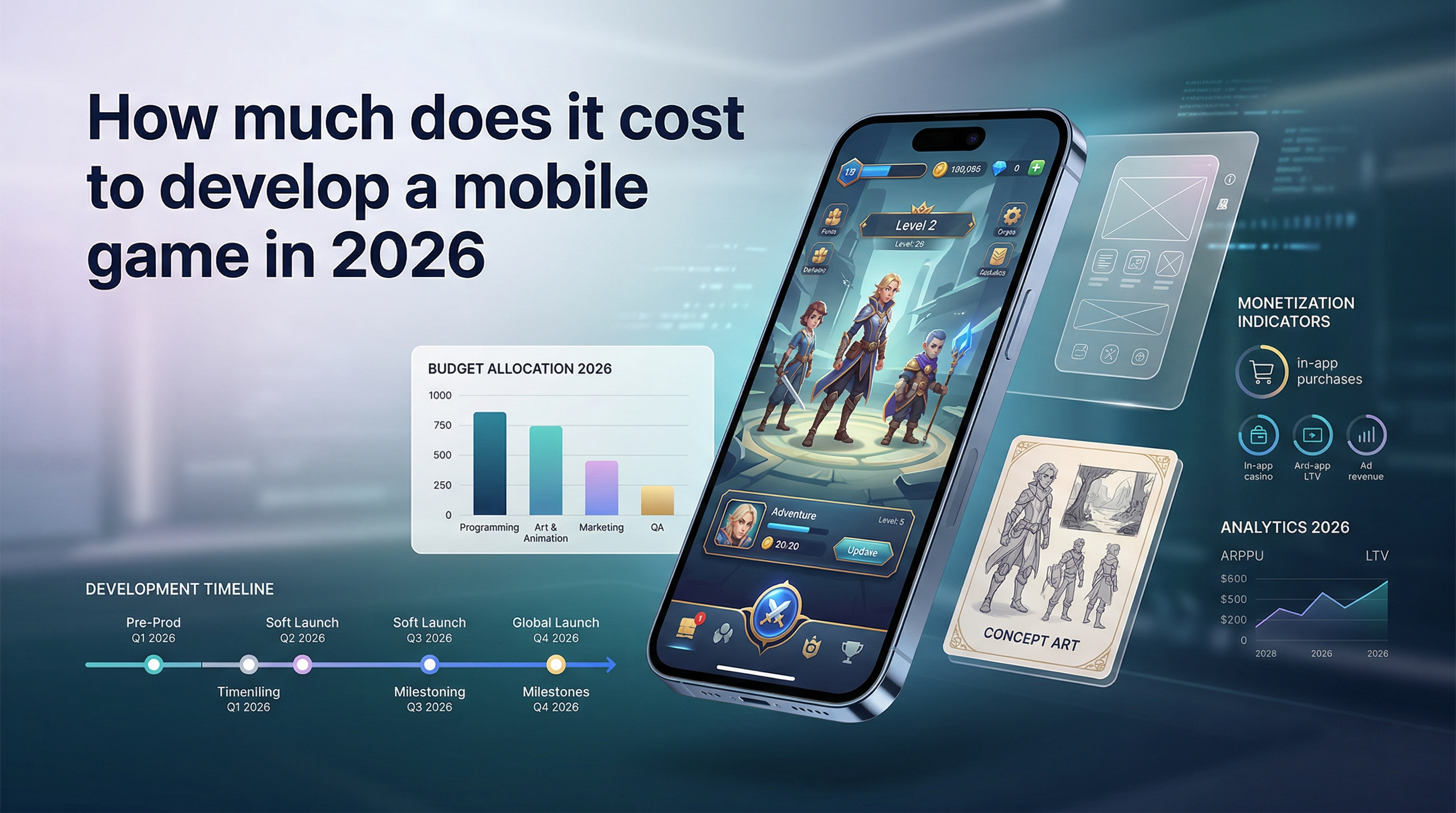
Here's how a typical mobile game budget breaks down across phases. We're using a mid-range casual game ($60K total) as our reference.
| Phase | % of Budget | Cost (at $60K) | What's Included |
|---|---|---|---|
| Game Design & Planning | 8–12% | $5K–$7K | GDD, wireframes, flowcharts, monetization design, competitive analysis |
| Art & Animation | 30–40% | $18K–$24K | UI/UX design, character art, environments, animations, VFX, icons |
| Programming & Engineering | 25–35% | $15K–$21K | Core mechanics, systems, backend, integrations, optimization |
| Sound & Music | 5–8% | $3K–$5K | SFX, background music, ambient sounds, adaptive audio |
| QA & Testing | 8–12% | $5K–$7K | Functional testing, device compatibility, performance, regression |
| Launch & Deployment | 5–8% | $3K–$5K | Store setup, ASO, soft launch, analytics integration |
Pro Tip
Never skip the Game Design Document (GDD) phase. A $5K investment in planning can save $20K+ in rework. At Raijin, every project starts with a detailed GDD — even for hyper-casual games.
Detailed Costs by Game Type
Hyper-Casual Games ($5K–$30K)
The simplest and fastest type of game to build. One core mechanic, minimal UI, short play sessions (under 60 seconds), and ad-based monetization.
- Design: $500–$2K (1-page GDD, basic wireframes)
- Art: $1K–$8K (minimalist/geometric, limited animations)
- Development: $2K–$12K (single mechanic, 30–100 levels)
- Audio: $500–$2K (stock or simple SFX)
- QA: $500–$3K (limited device testing)
- Timeline: 2–6 weeks
Best for:Studios testing market viability, ad-revenue models, CPI testing. At Raijin, we've shipped 200+ hyper-casual titles — many in under 3 weeks.
Casual & Puzzle Games ($30K–$100K)
Games with engaging core loops, progression systems, and polished UI. Think match-3, word games, runners, and tower defense.
- Design: $3K–$8K (full GDD, economy design, UX flows)
- Art: $10K–$35K (custom 2D art, character design, VFX)
- Development: $12K–$40K (multiple systems, IAPs, ads, progression)
- Audio: $2K–$8K (original music, themed SFX)
- QA: $3K–$9K (multi-device, monetization testing)
- Timeline: 2–4 months
Casino & Card Games ($50K–$300K)
Casino games have unique requirements: certified RNG systems, regulatory compliance, real-money or virtual currency economies, and multiplayer tables.
- Poker/Rummy/Card Games: $50K–$150K (multiplayer tables, lobby, tournament systems)
- Slot Games: $30K–$80K per game (math models, payline systems, bonus rounds)
- Full Casino Platform: $150K–$300K+ (turnkey solutions with multiple games, admin panel, payment integration)
Mid-Core & Strategy Games ($100K–$500K)
Games with deep progression, competitive features, guilds/clans, and retention mechanics. These need significantly more engineering and content.
- Design: $8K–$25K (full GDD, economy modeling, meta-game design)
- Art: $30K–$150K (rich 2D or 3D art, multiple characters, environments)
- Development: $40K–$200K (multiplayer, real-time systems, backend infrastructure)
- Audio: $5K–$20K (adaptive music, character voices, cinematic audio)
- QA: $10K–$40K (load testing, multiplayer testing, balance testing)
- Timeline: 4–10 months
AAA Mobile Games ($500K–$2M+)
Console-quality experiences on mobile. Open worlds, high-fidelity 3D graphics, real-time PvP, live content pipelines, and cinematic storytelling.
These projects typically require teams of 20–50+ people and 12–18 months of development. Budget $500K as a floor — most commercially successful AAA mobile titles have budgets in the $2M–$10M range when including marketing.
Hidden Costs Most Studios Don't Tell You About
The development quote is rarely the full picture. Here are the costs that catch first-time game developers off guard.
Server & Infrastructure Costs
Multiplayer games, leaderboards, and live-ops features need backend servers. Expect $200–$5,000/month depending on player count and data requirements. Cloud costs scale with success — a game with 100K DAU can cost $2K–$5K/month in AWS/GCP bills.
App Store Fees & Commissions
- Apple App Store: $99/year developer account + 15–30% commission on IAPs
- Google Play: $25 one-time + 15–30% commission on IAPs
- Ad revenue isn't taxed by stores, which is why hyper-casual games favor ads over IAPs
Third-Party SDKs & Licensing
Analytics (Firebase, GameAnalytics), ad mediation (ironSource, AppLovin MAX), crash reporting (Crashlytics), push notifications, and attribution (AppsFlyer, Adjust). Most are free under a threshold, but costs scale at $500–$5K/month for high-volume games.
Localization
Translating your game into 10 languages costs $3K–$15K depending on text volume. But it can increase revenue by 25–40% in international markets. ROI is almost always positive.
Marketing & User Acquisition
This is the elephant in the room. In 2026, the average CPI (cost per install) is:
- Hyper-casual: $0.15–$0.50
- Casual: $1.00–$3.00
- Mid-core: $3.00–$10.00
- Casino: $20.00–$80.00
A soft launch alone typically costs $5K–$20K in ad spend. Scale-up budgets for casual games start at $50K–$100K/month. Marketing often exceeds development cost.
In-House Team vs. Outsourcing: Cost Comparison
One of the biggest decisions you'll make is whether to hire an in-house team or partner with a game development studio. Here's how the costs compare for building a casual mobile game over 4 months.
| Cost Item | In-House (US/EU) | Outsource (India/SEA) | Savings |
|---|---|---|---|
| Game Designer (1) | $28K–$40K | Included | – |
| Programmers (2) | $56K–$80K | Included | – |
| Artists (2) | $48K–$64K | Included | – |
| QA Tester (1) | $16K–$24K | Included | – |
| Project Manager (1) | $20K–$32K | Included | – |
| Recruitment & Onboarding | $10K–$20K | $0 | – |
| Tools & Licenses | $3K–$8K | Included | – |
| Office & Overhead | $8K–$15K | $0 | – |
| Total (4 months) | $189K–$283K | $30K–$80K | 40–70% |
Why outsourcing works
It's not just about lower rates. An established studio like Raijin brings pre-built systems, reusable frameworks, and 500+ projects of experience. We don't start from zero — and neither should your budget.
How to Reduce Game Development Costs (Without Cutting Quality)
1. Start with an MVP
Build the core gameplay loop first. Test it with real players. Then invest in polish, content, and features based on validated data, not assumptions. An MVP costs 30–50% less than a full build and tells you whether the game is worth finishing.
2. Choose a Smart Art Style
Minimalist or stylized art can look stunning andcost 60% less than realistic 3D. Games like Monument Valley, Alto's Odyssey, and Crossy Road prove that art direction beats art budget every time.
3. Use Proven Engines & Frameworks
Building on Unity or Unreal Engine instead of a custom engine saves months of development. Leverage asset stores for non-critical elements and spend custom art budget where it matters — characters, UI, and key environments.
4. Phase Your Development
Don't build everything at once. Launch with core content and add features post-launch. This spreads cost over time and lets you invest based on real revenue.
5. Outsource to the Right Partner
Not the cheapest. Not the most expensive. The right partner has relevant portfolio experience, clear communication, and a track record of shipping. Ask to see games they've launched — not just concepts.
Regional Cost Differences in 2026
Where your development team is based dramatically affects cost. Here are average hourly rates for game developers by region.
| Region | Hourly Rate | Monthly (Full-time) | Quality Level |
|---|---|---|---|
| United States | $100–$200 | $16K–$32K | Highest |
| Western Europe (UK, Germany) | $80–$160 | $13K–$26K | Very High |
| Eastern Europe (Poland, Ukraine) | $40–$80 | $6.5K–$13K | High |
| India | $20–$50 | $3.2K–$8K | High (at top studios) |
| Southeast Asia (Vietnam, Philippines) | $20–$45 | $3.2K–$7.2K | Medium-High |
| South America (Brazil, Argentina) | $30–$60 | $4.8K–$9.6K | Medium-High |
India's sweet spot: At Raijin, we operate from Rajkot, India — offering rates that are 60–70% lower than US studios while maintaining international quality standards. Our portfolio of 500+ shipped games speaks for itself. See our work →
How to Plan Your Budget: A Practical Framework
Here's a simple framework for allocating your total game investment:
| Category | % of Total Investment | Notes |
|---|---|---|
| Game Development | 40–50% | Design, art, engineering, QA, launch |
| Marketing & UA | 30–40% | Soft launch, scaling, creatives, ASO |
| Live Ops (Year 1) | 10–15% | Content updates, events, bug fixes |
| Buffer / Contingency | 10–15% | Scope changes, unexpected issues |
For example, if your total budget is $100K:
- $40K–$50K on development
- $30K–$40K on marketing
- $10K–$15K on post-launch updates
- $10K–$15K kept as buffer
Common mistake
Spending 100% of your budget on development and having $0 left for marketing. The best game in the world fails if nobody knows it exists. Plan for marketing from day one.
Frequently Asked Questions
How much does it cost to make a game like Candy Crush?
A Candy Crush-style match-3 game with 100+ levels, IAPs, and polished art costs $40K–$80K for initial development. However, King spent significantly more on the original due to live ops, data infrastructure, and years of content — the total investment over time is in the hundreds of millions.
Can I build a mobile game for under $10,000?
Yes — if it's a hyper-casual game with simple art and one core mechanic. For anything with progression, IAPs, or multiplayer, $30K is a more realistic minimum for a quality product.
How much do game developers charge per hour?
Rates vary wildly: $20–$50/hour in India and Southeast Asia, $40–$80 in Eastern Europe, $100–$200 in the US. A studio rate is typically lower per hour than hiring individual freelancers because studios have optimized pipelines and reusable systems.
What's the most expensive part of game development?
Art and animation are consistently the largest line item (30–50% of budget). For multiplayer games, backend development can rival art costs. Scope creep — adding features mid-development — is the most expensive mistake.
How long does it take to develop a mobile game?
Hyper-casual: 2–6 weeks. Casual: 2–4 months. Mid-core: 4–10 months. AAA mobile: 12–18+ months. These timelines assume a dedicated team working full-time.
Should I hire freelancers or a game development studio?
For small projects (under $15K), freelancers can work. For anything larger, a studio provides project management, integrated pipelines, and accountabilitythat freelancers can't match. Studios also absorb risks like team member turnover.
What's not included in most game development quotes?
Server hosting, app store fees, marketing/UA spend, localization, post-launch maintenance, and analytics tools. Always ask your development partner what's included vs. additional.
Final Thoughts: Invest Smart, Ship Fast
Mobile game development in 2026 is more accessible than ever — but "accessible" doesn't mean "cheap." The studios that win are the ones who budget realistically, start lean, validate fast, and scale what works.
Here's what separates successful game projects from failed ones:
- Start with a clear GDD — even a 2-page document saves thousands in rework.
- Build an MVP first — test the core loop before investing in polish.
- Budget for marketing from day one — development is only half the battle.
- Choose your partner on shipped games — not pitch decks, not promises, not price alone.
- Plan for post-launch — modern games are living products, not one-time releases.
The right development partner doesn't just write code — they help you make smarter decisions about scope, technology, and budget so you launch a game that players love and that makes business sense.
How Raijin Can Help You Build Your Game
You've read the numbers. You understand the costs. Now the question is: who do you trust to build it?
At Raijin, we're not a faceless outsourcing factory. We're a team of gamers who became game developers — and we bring that player-first mentality to every project we touch.
500+
Games Shipped
Since 2019
In the Industry
100+
Happy Clients
40–60%
Cost Savings vs US/EU
What Makes Us Different
- We play what we build.Every game goes through our own "gamer gut-check" before delivery. If we wouldn't play it, we don't ship it.
- Full-stack game studio. Design, art, development, QA, and launch — all under one roof. No juggling 5 freelancers across 3 time zones.
- Battle-tested pipelines.500+ shipped games means we have reusable systems, optimized workflows, and zero learning curve. Your project benefits from every game we've built before it.
- Transparent pricing. No surprise invoices. We scope honestly, communicate proactively, and deliver on budget. Every time.
- India quality, India rates. International-standard output at 40–60% lower cost than US/EU studios. Not because we cut corners — because our operational costs are lower.
- We stick around after launch.Live ops, content updates, performance optimization — we don't disappear after delivery.
Our Expertise Spans Every Game Type
Whether you're building a $10K hyper-casual prototype or a $200K multiplayer casino platform, we've done it. Our services include:
- Unity Game Development — our bread and butter for mobile
- Unreal Engine Development — for high-fidelity 3D titles
- 2D & 3D Game Art — from concept to final asset
- Casino & Slots — poker, rummy, slot machines, turnkey platforms
- VR & AR Development — immersive experiences and training simulations
Get a Custom Cost Estimate
for Your Game Idea
Tell us what you want to build and we'll send you a detailed breakdown — cost, timeline, tech stack, and team composition.