

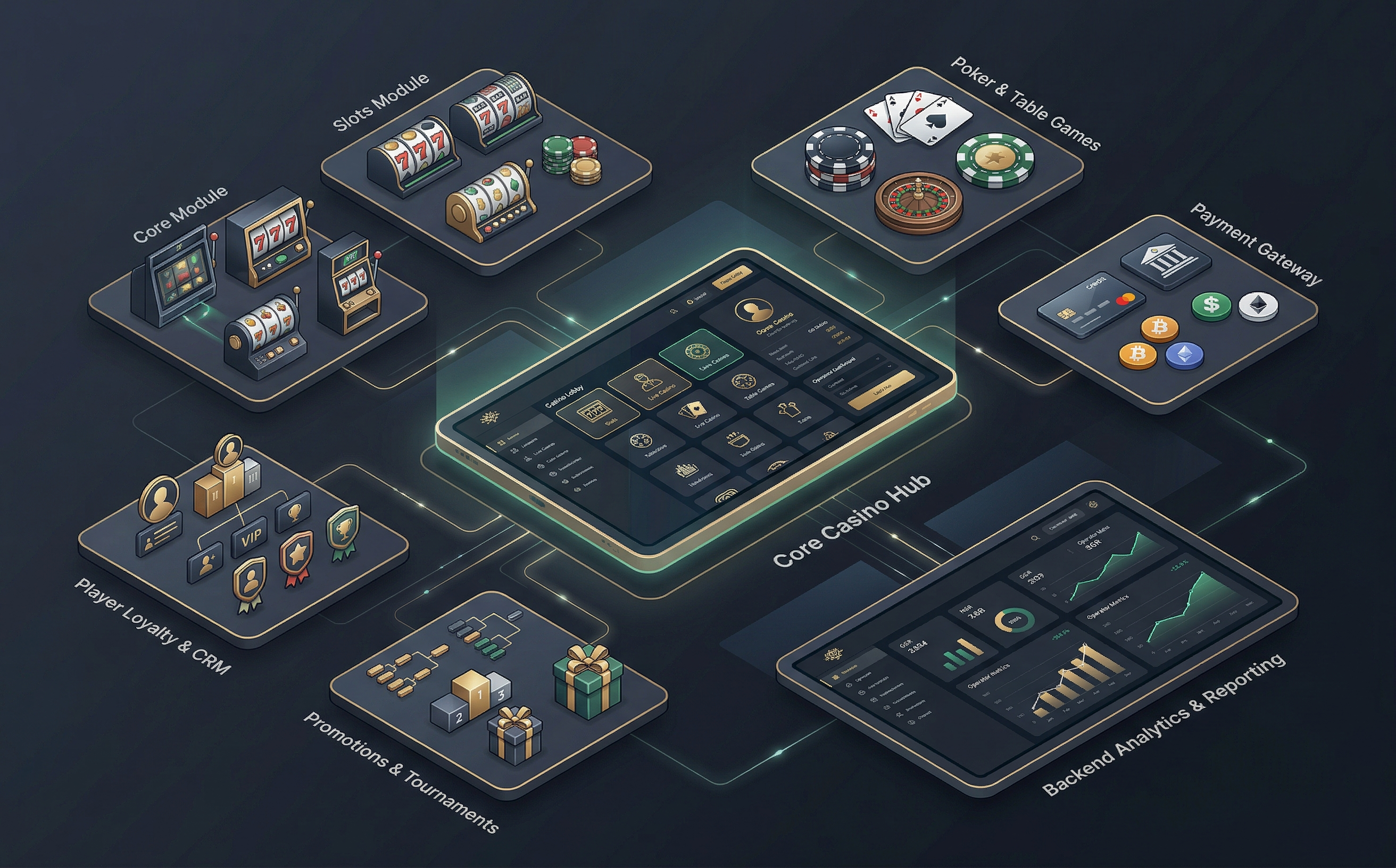
The global iGaming industry surpassed $320 billion in 2026, and the demand for turnkey casino platforms has never been higher. Operators want to launch fast, scale globally, and stay compliant without building everything from scratch. But behind every successful online casino lies a deeply technical architecture — one that must handle real-time gameplay, secure financial transactions, regulatory compliance across jurisdictions, and millions of concurrent players.
This guide breaks down the complete technical architectureof a production-grade turnkey casino platform. Whether you're an operator evaluating vendors, a CTO planning your stack, or a startup exploring the iGaming space, this is the engineering blueprint you need.
What Is a Turnkey Casino Platform?
A turnkey casino platform is a complete, ready-to-deploy online gambling solution that includes the game library, payment processing, player management, compliance tooling, and admin dashboard — all integrated into a single operational system. Unlike white-label solutions where operators get limited control over branding, a turnkey platform typically provides full source code ownership, backend access, and the ability to customize every component.
The "turnkey" distinction matters because operators can launch in weeks rather than months, with pre-built modules handling the heaviest engineering challenges: real-time wallet transactions, certified RNG systems, multi-jurisdiction compliance, and game provider integrations.
Turnkey — Full source code ownership, modular backend, operator controls everything. Launch in 4–8 weeks. Best for operators who want full control with fast time-to-market.
White-Label — Operator gets branding layer; vendor controls backend and infrastructure. Fastest launch (2–4 weeks) but limited flexibility and often revenue-sharing models.
Custom Build — Built from scratch. Maximum control but 6–18 months development, $500K+ investment, and requires a dedicated engineering team.
High-Level Architecture Overview
A modern turnkey casino platform follows a layered microservices architecture with clear separation of concerns. Every critical function — authentication, wallet management, game sessions, compliance, payments — runs as an independent service, communicating through APIs and event streams.
┌─────────────────────────────────────────────────────────────┐
│                    CLIENT LAYER                              │
│   Web App (React/Vue)  ·  Mobile (iOS/Android)  ·  PWA      │
└──────────────────────────┬──────────────────────────────────┘
                           │
                    ┌──────▼──────┐
                    │ API GATEWAY  │  Auth · Rate Limiting
                    │ (Kong/Nginx) │  Versioning · Routing
                    └──────┬──────┘
                           │
  ┌────────────────────────┼────────────────────────┐
  │           CORE MICROSERVICES LAYER               │
  │                                                  │
  │  ┌──────────┐ ┌──────────┐ ┌──────────────────┐ │
  │  │   AUTH    │ │  WALLET  │ │  GAME SESSIONS   │ │
  │  │ Service  │ │  Ledger  │ │  & Orchestration │ │
  │  └──────────┘ └──────────┘ └──────────────────┘ │
  │  ┌──────────┐ ┌──────────┐ ┌──────────────────┐ │
  │  │ PAYMENT  │ │   RNG    │ │   PROMOTIONS     │ │
  │  │ Service  │ │  Engine  │ │   & Bonuses      │ │
  │  └──────────┘ └──────────┘ └──────────────────┘ │
  │  ┌──────────┐ ┌──────────┐ ┌──────────────────┐ │
  │  │COMPLIANCE│ │ BACK     │ │   ANALYTICS      │ │
  │  │ KYC/AML  │ │ OFFICE   │ │   & Reporting    │ │
  │  └──────────┘ └──────────┘ └──────────────────┘ │
  └────────────────────────┼────────────────────────┘
                           │
  ┌────────────────────────┼────────────────────────┐
  │           DATA & MESSAGING LAYER                 │
  │  PostgreSQL · Redis · Kafka · ClickHouse         │
  └────────────────────────┼────────────────────────┘
                           │
  ┌────────────────────────┼────────────────────────┐
  │         EXTERNAL INTEGRATIONS LAYER              │
  │  Game Providers · Payment PSPs · KYC Vendors     │
  │  CRM · CDN · Monitoring · BI Tools               │
  └─────────────────────────────────────────────────┘
The API Gateway is the single entry point, handling authentication validation, request routing, rate limiting, and API versioning. Behind it, each microservice owns its domain logic and data. Services communicate through synchronous REST/gRPC calls for real-time operations and asynchronous event streaming (Kafka or RabbitMQ) for analytics, compliance logging, and bonus calculations.
Core Microservices Breakdown
Each microservice in a casino platform has unique requirements for performance, consistency, and fault tolerance.
Authentication & Player Identity Service
Manages player registration, login, MFA, device fingerprinting, session tokens, and player preferences. In a casino context, it also enforces responsible gaming controls like self-exclusion flags and session time limits.
- Stateless auth endpoints — JWT or opaque tokens with OAuth 2.0. Sessions stored in Redis for low-latency validation.
- Device trust & fingerprinting — Track device IDs, IP geolocation, and browser fingerprints to detect account takeover.
- Rate limiting — Aggressively rate-limit OTP and login endpoints to prevent brute-force attacks.
- Player profiles — Gaming history, preferences, and bonus eligibility flags, all accessible via internal APIs.
Wallet & Ledger Service
The financial heart of the casino platform. Handles real-money balances, bonus balances, bet deductions, win credits, and every transaction in between. Must be ACID-compliant with idempotent operations to prevent double credits.
Every wallet operation (debit, credit, bet placement, win) must be idempotent. Casino game callbacks from providers can repeat. If your system processes the same callback twice, you either double-pay a player or double-deduct — both are catastrophic. Use unique transaction IDs and check-before-write patterns.
Game Session & Orchestration Service
Manages the lifecycle of each gaming session: launching games, routing players to the correct provider, handling round events (bet placed → result → payout), and closing sessions cleanly. Also responsible for dynamic game routing based on provider, geography, and load.
Promotions & Bonus Engine
Casino bonuses are surprisingly complex to engineer. Welcome bonuses, deposit matches, free spins, cashback offers, VIP tier rewards, and wagering requirements all have different trigger conditions, expiry rules, and contribution weights per game type. The bonus engine evaluates rules in real-time as bets are placed, tracking wagering progress and converting bonus funds to withdrawable real money when conditions are met.
Random Number Generation (RNG) Engine
The RNG engine is the cornerstone of game fairness. Regulators like the Malta Gaming Authority (MGA), UK Gambling Commission (UKGC), and Curaçao eGaming require certified, independently audited RNG systems before granting an operating license.
A cryptographically secure pseudorandom number generator (CSPRNG) produces game outcomes that are statistically random and unpredictable. The RNG service must be completely isolated from wallet and game logic — regulators audit the separation to ensure outcomes cannot be influenced by financial states or player data.
For provably fair systems (common in crypto casinos), the architecture combines a server seed and a client seed, hashed together before the round begins. Players can verify any outcome post-game by checking the hash.
Key architectural decisions for the RNG service:
- Isolation — Run RNG as a standalone, hardened microservice with no direct database access to wallet or player data.
- Deterministic replay — Store seed values and round parameters so any game outcome can be reproduced during audits or disputes.
- Tamper-evident logging — Every RNG invocation logged with timestamps and seed values in append-only (WORM) storage.
- Third-party certification — Labs like GLI, eCOGRA, iTech Labs, and BMM Testlabs perform statistical testing on billions of generated numbers.
Payment Gateway & Wallet System
Payment processing is where casino platforms succeed or fail. Players expect instant deposits, fast withdrawals, and support for their preferred payment method — credit cards, e-wallets (Skrill, Neteller, PayPal), bank transfers, UPI, or cryptocurrency.
Core Components
- PSP Aggregation Layer — Multiple payment providers behind a unified API. Intelligent routing — if one PSP goes down, transactions automatically route to a backup.
- Multi-Currency Engine — Fiat and cryptocurrency conversions, real-time exchange rates, and jurisdiction-specific currency restrictions.
- Risk Scoring Engine — Every transaction evaluated against device fingerprint, account age, velocity, amount thresholds, and chargeback history.
- Withdrawal Pipeline — KYC verification, bonus wagering validation, fraud screening, AML checks, and PSP execution. Automate as much as possible with manual review queues for flagged transactions.
- Crypto Payment Module — Chain-aware confirmation policies, hot/cold wallet management, multi-sig authorization, and real-time on-chain monitoring.
Build your payment layer with PCI-DSS compliance from day one. Never store raw card data on your servers — use tokenization through your PSP. Without PCI-DSS compliance, no reputable payment provider will work with you.
KYC, AML & Regulatory Compliance Layer
Compliance isn't a checkbox — it's a continuous, enforceable system woven into every transaction, login, and withdrawal. Regulators in 2026 demand evidence that compliance checks are live and automated.
KYC (Know Your Customer) — Document verification, liveness checks, age verification, address confirmation. Triggered at registration, first withdrawal, and periodically based on risk tier.
AML (Anti-Money Laundering) — Transaction monitoring, velocity rules, suspicious activity detection, threshold alerts, and case management with regulatory reporting (STR/SAR filings).
Responsible Gaming — Deposit limits, loss limits, session time limits, cooling-off periods, self-exclusion mechanisms. Mandatory in nearly all regulated markets.
Geo-Fencing & Jurisdiction Rules — IP-based and GPS-based location verification, restricting access to games and payment methods by player location.
Compliance controls must be enforced from the backend. Log every compliance decision (which rule fired, when, and why) because regulators and payment partners regularly require evidence trails.
Third-Party KYC/AML Integrations
Most platforms integrate with specialized compliance vendors: Jumio or Onfido for document and liveness verification, Chainalysis for cryptocurrency transaction screening, and purpose-built iGaming compliance platforms like Aristotle or GBG for identity verification across jurisdictions.
Game Aggregation & Provider Integration
A casino platform lives or dies by its game content. Players expect thousands of titles across slots, table games, live dealer, crash games, and more. A game aggregation layer normalizes the APIs of dozens of providers into a single, unified integration point.
How Game Integration Works
- Game launch — Player clicks a game tile. The platform creates a session token, passes it to the provider's API with wallet reference and jurisdiction data.
- Game round — The provider's server runs game logic. On each bet, it calls back to your wallet API to deduct funds. On each win, it calls back to credit.
- Session close — Player exits, session terminates, all pending transactions finalized.
- RTP reporting — Providers supply Return to Player data per game. Your platform aggregates this for regulatory reporting.
Using a game aggregator (10,000+ games through a single API) dramatically reduces integration time. Direct integrations with individual providers give more control and better commercial terms but require significantly more engineering. Most successful platforms use a hybrid approach — aggregator for breadth, direct for strategic partnerships.
Frontend & Player Experience Layer
The player-facing frontend must deliver a seamless experience across desktop, mobile web, and native apps. Mobile accounts for over 70% of online gambling traffic in 2026, making mobile-first design non-negotiable.
Most modern casino frontends are built as SPAs using React or Vue.js, communicating with the backend through REST and WebSocket APIs. Key components include the game lobby (search, filtering, personalized recommendations), cashier (deposit/withdrawal flows), bonus tracker, live chat, and responsible gaming controls. The lobby should use a CDN-backed asset pipeline — game thumbnails and promotional banners served from edge servers.
Back Office & Admin Dashboard
The control center for day-to-day operations: player management, financial reporting, promotional campaigns, compliance workflows, and game configuration. A well-built back office can be the difference between needing 5 staff members or 50.
Essential modules include: player search with full transaction history, real-time GGR/NGR dashboards, promotional campaign builders with rule engines, compliance case management, game management (enable/disable, bet limits by jurisdiction), risk alerts, and role-based access control with full audit trails.
Security Architecture
Casino platforms are high-value targets. They process real money, store sensitive personal data, and run 24/7.
Data encryption — TLS 1.3 for all data in transit. AES-256 for sensitive data at rest.
DDoS protection — Cloud-based mitigation (Cloudflare, AWS Shield). Casino platforms are frequently targeted, especially around major promotions.
Fraud detection — Real-time behavioral analytics for multi-accounting, bonus abuse, collusion (poker), and account takeover.
Penetration testing — Regular third-party pen testing. Many jurisdictions require annual security audits from certified labs.
Compliance standards — ISO 27001, PCI-DSS, GDPR.
Scalability & Infrastructure
Casino traffic is highly variable. A normal Tuesday might see 2,000 concurrent players. A Champions League final with a promo could see 50,000+.
Infrastructure Principles
- Container orchestration — Kubernetes (EKS, GKE, or self-managed). Auto-scale based on CPU, memory, and custom metrics like active game sessions.
- Multi-region deployment — At least two cloud regions with active-active or active-passive failover. Global load balancing routes players to the nearest healthy region.
- Database strategy — PostgreSQL with read replicas for transactional data. Redis for sessions and leaderboards. ClickHouse or BigQuery for analytics at scale.
- Event streaming — Kafka or Pulsar for asynchronous processing. Wallet events, compliance triggers, analytics data, and game telemetry all flow through the event bus.
- CDN & edge caching — Game assets and static resources from a CDN. Keep dynamic API responses lean and fast.
- Observability — Prometheus + Grafana for metrics, ELK stack for logging, Jaeger or Zipkin for distributed tracing.
Recommended Tech Stack
Based on what leading platforms in 2026 are running:
Backend Services
Node.js / Go / Java, gRPC + REST, PostgreSQL, Redis, Apache Kafka, Kubernetes, Docker
Frontend
React / Vue.js, TypeScript, Next.js / Nuxt.js, WebSockets, PWA
Infrastructure & DevOps
AWS / GCP / Azure, Terraform, GitHub Actions / GitLab CI, Cloudflare CDN, Prometheus + Grafana, ELK Stack
Compliance & Payments
Jumio / Onfido (KYC), Chainalysis (Crypto AML), Stripe / Nuvei / PayOp (PSP), PCI-DSS Tokenization
Game Providers & RNG
Pragmatic Play, Evolution, NetEnt, Play'n GO, GLI / eCOGRA Certified RNG
Development Timeline & Cost Factors
Phase 1 — Discovery & Architecture (2–4 weeks): Requirements gathering, technical architecture design, licensing strategy, technology selection.
Phase 2 — Core Platform Development (12–20 weeks): Authentication, wallet/ledger, payment integrations, game aggregation layer, admin back office, compliance layer.
Phase 3 — Frontend & UX (6–10 weeks, parallel): Responsive player-facing web app, game lobby, cashier flows, account management.
Phase 4 — Testing & Certification (4–8 weeks): Load testing, security audits, RNG certification, penetration testing, UAT.
Phase 5 — Launch & Live Ops (2–4 weeks): Staged rollout, monitoring setup, content loading, operator training.
Total: 6–9 months for a fully custom platform. Accelerated turnkey builds using pre-built modules can reduce this to 4–8 weeks.
Cost Factors
A basic platform with 500–1,000 integrated games, single-jurisdiction compliance, and standard payments starts from $150,000–$300,000. A full-featured, multi-jurisdiction platform with custom games, native apps, crypto support, sportsbook integration, and AI personalization can range from $500,000 to $2M+.
Ongoing operational costs include licensing fees ($20K–$500K+/year), game provider revenue shares (10–20% of GGR), payment processing fees, hosting, compliance vendor subscriptions, and the team to manage live operations.
Frequently Asked Questions
What is a turnkey casino platform?
A turnkey casino platform is a complete, ready-to-deploy online gambling solution that includes the game library, payment processing, player management, compliance tooling, and admin dashboard — all integrated into a single system. Unlike white-label solutions, a turnkey platform typically provides full source code ownership and backend access.
How much does it cost to build a turnkey casino platform?
A basic platform starts from $150,000–$300,000. Full-featured, multi-jurisdiction platforms with custom games, native apps, crypto support, and AI personalization range from $500,000 to $2M+.
How long does it take to build?
A fully custom turnkey casino platform takes 6–9 months. White-label or accelerated builds using pre-built modules can reduce this to 4–8 weeks.
What tech stack is recommended in 2026?
Node.js, Go, or Java for backend; PostgreSQL and Redis for databases; Apache Kafka for event streaming; Kubernetes for orchestration; React or Vue.js for frontend; AWS, GCP, or Azure for cloud. Compliance: Jumio or Onfido for KYC, Chainalysis for crypto AML.
What is RNG certification and why is it important?
RNG certification verifies that game outcomes are truly random and unmanipulated. Regulators like MGA, UKGC, and Curaçao eGaming require certified, independently audited RNG systems before granting operating licenses. Testing labs like GLI, eCOGRA, and iTech Labs perform statistical testing on billions of generated numbers.
What compliance requirements are needed?
Platforms must implement KYC verification, AML monitoring, responsible gaming controls (deposit/loss limits, self-exclusion), and geo-fencing. Also required: PCI-DSS for payment security, GDPR for EU data protection, and ISO 27001 for information security.
Why Build Your Casino Platform With Raijin
At Raijin Studio, we've built casino and slot game solutions from the ground up — poker, rummy, horse racing, slot machines, and complete turnkey casino platforms. Our team understands both the entertainment side (compelling game experiences that retain players) and the engineering side (microservices architecture, RNG certification, multi-PSP integrations, and regulatory compliance).
We work across Unity, Unreal Engine, and custom HTML5/WebGL for game development, while our backend engineers architect scalable, audit-ready platforms on cloud-native infrastructure. Whether you need a single slot game or a complete turnkey casino ecosystem with thousands of integrated titles, we deliver end-to-end.


Ready to Build Your
Casino Platform?
Get a free technical architecture review, development quote, and compliance roadmap for your turnkey casino platform.