
In July 2025, a small German studio called Lessmore UG released a deceptively simple mobile puzzle game called Arrows Puzzle Escape. It had no licensed IP, no celebrity endorsement, no viral marketing budget, and no flashy 3D graphics. Just a clean grid, a handful of arrows, and one rule: tap them in the right order to clear the board.
By March 2026 — eight months after launch — the game had crossed 18 million downloads, accumulated 144,000 reviews averaging 4.7 stars, and was generating 170,000 new installs every single day. It now sits in the top free puzzle charts across dozens of markets on Google Play and the App Store.
If you're an entrepreneur, publisher, or studio looking to enter the mobile puzzle market, Arrows Puzzle Escape is one of the cleanest case studies in mobile game design you'll find. This guide breaks down how the game actually works, what makes it succeed, what it costs to develop a game like it, and how Raijin Studio can build your version.
18M+ total downloads
170K daily new installs
4.7★ average rating across 144,000 reviews
8 months from launch to 18 million downloads
What Is Arrows Puzzle Escape?
Arrows Puzzle Escape is a minimalist logic puzzle game developed and published by Lessmore UG (haftungsbeschränkt), a small mobile gaming studio based in Eschelbronn, Germany. The game launched on Google Play in July 2025 and is also available on the Apple App Store.
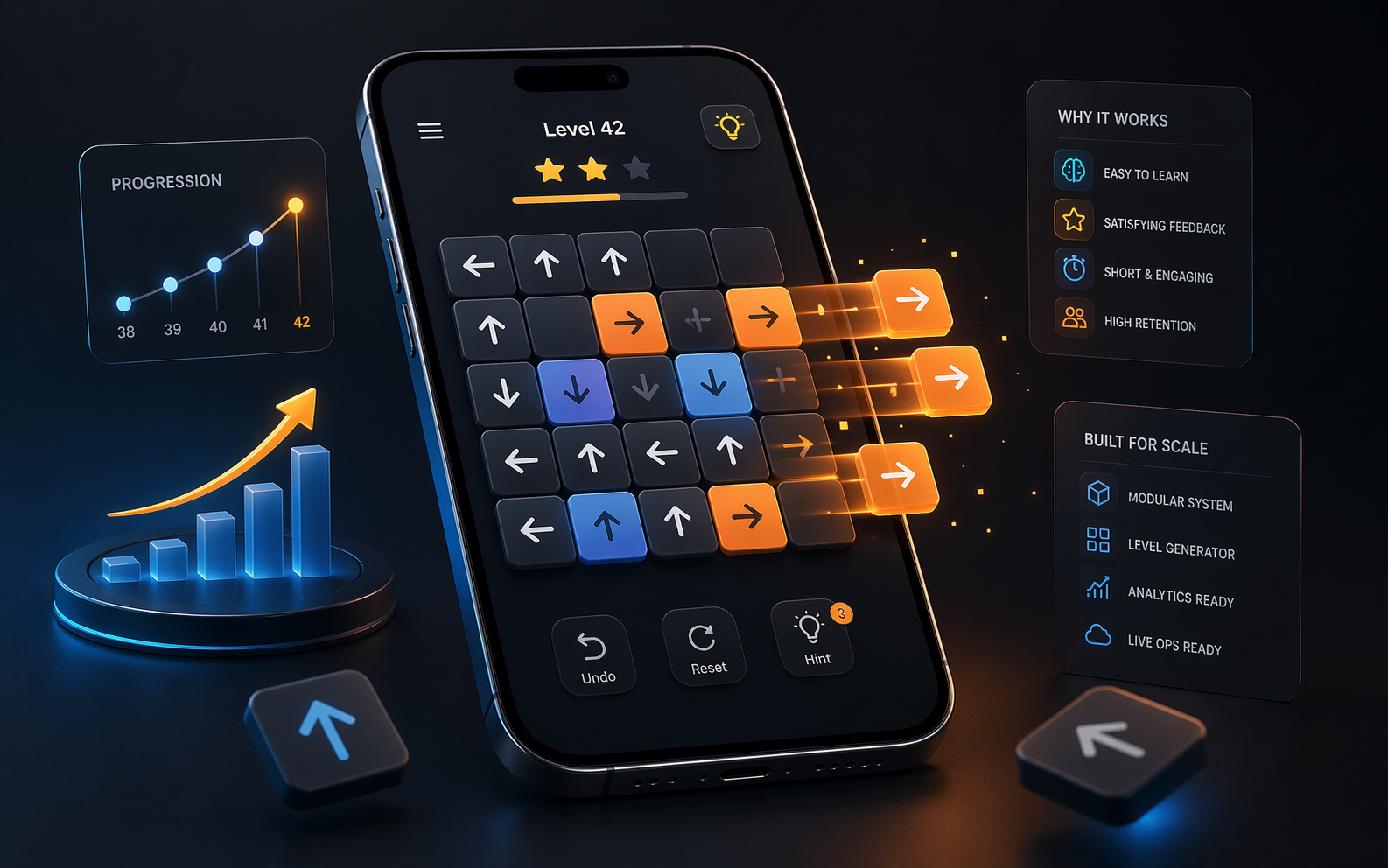
The premise is so simple it almost sounds boring on paper: a grid fills with arrows pointing in different directions, and the player taps them one at a time to make them fly off the board. Each tapped arrow shoots in the direction it points until it exits — or hits another arrow, which costs the player a heart. Three hearts and the level resets.
That's the entire game. One mechanic. Infinite variety. And it's working on a scale most studios can only dream of.
Why Arrows Puzzle Escape Works (The Real Reasons)
Plenty of puzzle games launch every month. Most disappear without a trace. Arrows Puzzle Escape didn't get to 18 million downloads by accident. There are five compounding factors that explain why this game broke through where countless others failed:
The One-Rule Mechanic
The entire game can be explained in a single sentence. This eliminates tutorial drop-off — the biggest killer of D1 retention in mobile gaming. Players understand the game in 10 seconds and start solving puzzles in the first minute. No friction, no learning curve, no confusion.
The Underpenetrated Logic Puzzle Category
Match-3 (Candy Crush, Royal Match) is saturated. Hyper-casual is saturated. But the directional logic puzzle space — games where you extract, route, or sequence items through a grid — has very few dominant titles. Arrows Puzzle Escape entered a category with genuine player demand and weak competition from polished entrants. That's textbook product-market fit.
Puzzle Genre Retention Outperforms the Industry
The 30-day retention rate for puzzle games sits around 18%, compared to the 13% mobile gaming average. Players who start a logic puzzle habit are significantly more likely to still be playing a month later, which directly translates into higher lifetime ad revenue per install (LTV).
Reasonable Ad Frequency
Reading user reviews of Arrows Puzzle Escape, the most-cited praise is the ad pacing. Most free mobile puzzle games show ads every level — Arrows Puzzle Escape shows them every 2–3 levels. This single decision dramatically improves both retention and store ratings, which compounds into more organic visibility.
App Store Algorithm Alignment
Both Google Play and the App Store reward games with high session counts, strong D7/D30 retention, and long average session times. Arrows Puzzle Escape excels at all three because of its bite-sized level structure. This triggered a self-reinforcing feedback loop: the algorithm pushed the game to more users, which generated more installs and reviews, which further boosted ranking.
Core Gameplay Mechanics — Detailed Breakdown
If you're going to build a game inspired by Arrows Puzzle Escape, you need to understand the mechanic at a level deeper than "tap arrows." Here's the precise breakdown:
The Board
A 2D grid, typically ranging from 4×4 to 8×8 for normal levels, scaling up to 10×10+ for harder difficulty tiers. Each cell either contains an arrow or is empty.
The Arrow
Each arrow has one of four directions: up, down, left, or right. Some advanced levels introduce diagonal arrows or special variants, but the base game uses only cardinal directions.
The Tap Action
When the player taps an arrow, it begins moving in the direction it points, advancing one cell at a time. One of three things happens:
- Successful exit — The arrow reaches the board's edge and flies off. Player progresses.
- Collision — The arrow hits another arrow in its path before exiting. Player loses one heart (typically 3 hearts per level).
- Path blocked from the start — If the arrow has no clear exit path, the tap fails immediately and a heart is deducted.
The Win Condition
The level is solved when all arrows have been successfully extracted from the board. Levels always have at least one valid solution. The most elegantly designed levels have only onevalid solution — that's what separates puzzles from exercises.
Three right-pointing arrows in a row. Tap the middle one first and it collides with the rightmost. Tap the rightmost first and the path clears for the others. Always work from the exit backwards.
Optional Advanced Mechanics
Arrows Puzzle Escape adds depth without adding complexity by introducing variations on the core rule:
- Obstacles & walls — Impassable cells that block arrow movement, forcing the player to plan around them.
- Colored arrows — Must be extracted in color groups or matching order.
- Multi-tap arrows — Stacked arrows that need 2–3 taps to fully extract.
- Direction changers — Cells that rotate arrows passing through them.
- Teleporters — Paired cells that warp arrows from one to the other.
Feature Set: What to Build for Parity
To compete in the same category, your game needs feature parity with Arrows Puzzle Escape. Here's the complete feature checklist based on what the leading title actually ships:
Core Game Features
- Tap-based arrow extraction — The core mechanic, polished with smooth animations and haptic feedback.
- 1,000+ handcrafted levels — At launch. More added through LiveOps updates.
- Multiple difficulty tiers — Normal, Hard, Super Hard, Nightmare. Players self-select their challenge.
- Daily challenge — A single new level every day. Massive driver of daily active users.
- Hint system — Reveals the next correct move. Gated behind rewarded video ads or earned currency.
- Undo / rewind — Lets players take back their last move. Essential for keeping flow state.
- Hearts / lives system — 3 hearts per level. Failures reset progress on that level only.
- Progress map — Visual world map showing player progression through level packs.
- Achievement system — 30–50 long-term goals covering milestones, skill, exploration.
- Streak tracking — Daily login streaks with escalating rewards.
Technical Features
- Offline mode — Non-negotiable for puzzle games. Players use these during commutes and flights.
- Cloud save — Google Play Games Services and Apple Game Center integration for cross-device progress.
- Localization — At minimum 10 languages: English, Spanish, French, German, Portuguese, Russian, Chinese (Simplified), Japanese, Korean, Arabic.
- Haptic feedback — Subtle vibrations on extractions and collisions. Adds significant perceived polish.
- Accessibility — Colorblind modes, adjustable text size, optional reduced-motion mode.
Monetization Features
- Interstitial ads — Between levels, with reasonable frequency (every 2–3 levels).
- Rewarded video ads — For hints, extra hearts, or unlocks.
- Remove Ads IAP — One-time purchase ($3.99–$6.99 sweet spot).
- Optional bundles — Hint packs, theme unlocks, premium level packs.
Technical Architecture & Tech Stack
The technical implementation of a game like Arrows Puzzle Escape is leaner than most people assume. Here's the production-grade stack we recommend at Raijin:
Engine & Core Tech
Unity 2022 LTS or Unity 6, C# as the primary language, Unity 2D Toolkit for rendering, ScriptableObjects for level data, DOTween for animations, and Addressables for content delivery.
Backend & Live Services
Firebase Realtime DB, Firebase Cloud Functions, Firebase Remote Config, Google Play Games Services, and Apple Game Center for cloud save, daily challenges, and remote configuration.
Analytics & Monetization
Firebase Analytics, AppsFlyer for attribution, Unity LevelPlay or AdMob for ad mediation, Unity IAP for purchases, and Sentry for crash reporting.
Architecture Overview
The game breaks down into seven core systems, communicating through a central event bus:
┌─────────────────────────────────────────────────────────────┐
│                       UI LAYER                               │
│      Menus  ·  HUD  ·  Lobby  ·  Settings  ·  Cashier        │
└──────────────────────────┬──────────────────────────────────┘
                           │
   ┌───────────────────────┼───────────────────────┐
   ▼                       ▼                       ▼
┌─────────────┐    ┌─────────────────┐    ┌────────────────┐
│ Grid System │    │ Arrow Controller│    │ State Machine  │
│ Cells/Pos   │    │ Movement / Coll │    │ Idle→Play→Win  │
└──────┬──────┘    └────────┬────────┘    └────────┬───────┘
       │                    │                      │
       ▼                    ▼                      ▼
┌─────────────┐    ┌─────────────────┐    ┌────────────────┐
│Level Loader │    │  Progression    │    │  Monetization  │
│ Deserialize │    │ Hearts/Streaks  │    │  Ads + IAP     │
└──────┬──────┘    └────────┬────────┘    └────────┬───────┘
       │                    │                      │
       └────────────────────┼──────────────────────┘
                            ▼
┌─────────────────────────────────────────────────────────────┐
│ Cloud Layer · Firebase Analytics · Cloud Save · Remote Cfg  │
└─────────────────────────────────────────────────────────────┘
Level Data Format
Keep level data as lightweight as possible for fast loading and easy editing. A typical level fits in 100–300 bytes:
{
  "levelId": 247,
  "gridSize": [5, 5],
  "arrows": [
    {"pos": [0, 1], "dir": "right"},
    {"pos": [1, 1], "dir": "down"},
    {"pos": [2, 0], "dir": "up"},
    {"pos": [3, 2], "dir": "left"}
  ],
  "obstacles": [[2, 2]],
  "difficulty": "medium",
  "minMoves": 4,
  "hearts": 3
}
At ~250 bytes per level, you can ship 10,000 levels in under 3MB — trivial for modern mobile.
Level Design Strategy: Handcrafted vs Procedural
This is the most consequential decision in building an arrow puzzle game. Get it wrong and your game either costs too much to produce or feels generic. The answer for a title aiming at the top charts is almost always a hybrid approach.
Levels 1–500: Handcrafted
The first 500 levels should be designed by humans. This is where you establish the player's relationship with the game — the difficulty curve, the "aha" moments, the elegant single-solution puzzles. Handcrafted levels feel intentional because they are.
Production rate: A skilled level designer produces 15–25 quality levels per day. 500 levels = roughly 25–35 working days of design effort.
Levels 500+: Procedural with Quality Filtering
Beyond the first 500 levels, procedural generation becomes essential for scale. Arrows Puzzle Escape's "thousands of handcrafted levels" claim is genuinely impressive, but ongoing content drops are almost certainly assisted by procedural tooling and curated post-hoc.
Naive procedural generation fails — most random configurations are either trivial or unsolvable. The correct approach is reverse generation:
// Reverse-generated solvable level (Unity C#)
public Level GenerateLevel(int difficulty) {
    Grid grid = new Grid(size: difficulty + 3);

    // Step 1: Start from solved state (empty grid)
    // Step 2: Add arrows one by one in reverse order
    // Step 3: Each added arrow must be "last extractable"

    for (int i = 0; i < difficulty * 4; i++) {
        Position p = FindValidExitPosition(grid);
        Direction d = ChooseDirection(p, grid);
        grid.AddArrow(p, d);
    }

    // Step 4: Validate uniqueness (only one solution path)
    if (!HasUniqueSolution(grid)) return GenerateLevel(difficulty);

    // Step 5: Score by "interestingness" (branching, min-moves)
    return new Level(grid, score: EvaluateQuality(grid));
}Generate 100 procedural levels, keep the top 10 by interestingness score (branching factor, possible solution orders, minimum-move count). This gives you procedural content with handcrafted-feeling quality — and is how you scale from 500 to 10,000+ levels without losing polish.
Monetization Model & Revenue Math
Arrows Puzzle Escape uses a hybrid monetization model: ads as the primary revenue driver, IAP as a secondary opt-out path. Here's how the revenue actually breaks down:
Shown between levels every 2–3 completions. Use mediation networks (Unity LevelPlay, AdMob, ironSource) to maximize eCPM. Tier-1 markets (US/UK/Canada/Australia) yield $15–$40 eCPM. Emerging markets sit at $3–$8.
Optional. Players trade 15–30 seconds of video viewing for hints, extra hearts, or undo moves. Highest-eCPM ad format and players actually appreciate it because they control the trade.
One-time purchase to eliminate all interstitial ads. Sweet spot is $3.99 to $6.99. Top titles that price this at $9.99 see lower conversion and worse reviews. Lower price = higher conversion + cleaner reviews.
Revenue Math (Realistic Projections)
For a well-executed clone with 1M total downloads in year one, conservative revenue projections look like this:
- Average daily active users (DAU): ~80,000 (8% of total downloads, typical for puzzle games)
- Ad impressions per DAU per day: ~12 (mix of interstitials and rewarded)
- Blended global eCPM: $8 (mix of tier-1 and emerging markets)
- Daily ad revenue: 80K × 12 × $0.008 = $7,680
- Annual ad revenue: ~$2.8M
- IAP revenue (1.5% conversion at $4.99): 1M × 0.015 × $4.99 = $74,850
- Total Year 1 revenue estimate: ~$2.87M
These numbers scale linearly — at 5M downloads, you're looking at $14M+ in year one. That's why studios are racing to build in this category right now.
How Much It Costs to Develop a Game Like This
Here's what it actually costs to build a game like Arrows Puzzle Escape, based on current 2026 rates from established studios. These figures assume outsourced development from established Indian studios — building in the US or UK adds 2–3x to these numbers.
Budget: $8,000 – $12,000
Includes: Core gameplay loop, 100–200 handcrafted levels, single difficulty tier, basic UI & menus, ads integration (AdMob), iOS + Android deployment.
Budget: $15,000 – $20,000
Includes: Full polish & UX refinement, 1,000+ levels (handcrafted + procedural), 4 difficulty tiers, hint/undo/hearts systems, daily challenge module, cloud save, localization (10 languages), full analytics + A/B testing.
Budget: $30,000 – $40,000
Includes: Everything in Tier 02 plus seasonal events & themed packs, leaderboards, achievements, premium IAP tiers + bundles, ML-based difficulty tuning, admin back office, ongoing LiveOps retainer.
Start with Tier 01 to validate concept and get real player data. If retention metrics are healthy after 30 days, scale to Tier 02 with the same studio (no re-onboarding cost). Most successful clones in this space follow exactly this path.
Development Timeline & Process
Here's what a well-structured development engagement looks like for a game like Arrows Puzzle Escape, broken down by phase:
- Phase 1 — Discovery & Game Design Document (1 week) — Detailed GDD, mechanic specs, level design philosophy, monetization strategy, target metrics defined.
- Phase 2 — Prototype (1–2 weeks) — Playable prototype with core mechanic, 5–10 test levels, basic UI. Validates the gameplay feel before full production.
- Phase 3 — Core Production (4–8 weeks) — Full mechanic implementation, level generation tools, UI polish, 500+ levels designed, all monetization integrated.
- Phase 4 — LiveOps Features (2–3 weeks) — Daily challenge system, cloud save, leaderboards, achievement system, push notifications.
- Phase 5 — QA & Soft Launch (1–2 weeks) — Internal QA, soft launch in 2–3 test markets (Philippines, India, Brazil typical), metrics gathering.
- Phase 6 — Optimization & Polish (1–2 weeks) — Tune difficulty curve, ad placements, IAP pricing based on soft launch data.
- Phase 7 — Global Launch & Marketing (Ongoing) — Worldwide rollout, ASO, paid UA campaigns, influencer outreach.
- Phase 8 — LiveOps (Ongoing monthly retainer) — Weekly content drops, seasonal events, A/B testing, performance optimization.
Is It Legal to Develop a Clone? (Yes — Here's How)
The most common question we get from publishers exploring this category: "Is it legal to make a game like Arrows Puzzle Escape?"The short answer is yes — with important nuances. Let's be precise about what is and isn't protected:
Game mechanics and rules. Under US, UK, and EU copyright law, game rules and mechanics cannot be copyrighted. The "tap arrows in correct order to extract them" mechanic is fair game. So is the grid structure, the heart system, the difficulty progression, and the daily challenge concept.
Visual design, brand name, source code, and specific level layouts. You cannot use the name "Arrows Puzzle Escape," reproduce its specific UI, copy its source code, or duplicate its exact level designs. Your version must have original art, original UI, original code, and original level designs.
This is exactly why studios like Voodoo, Lion Studios, and SayGames build entire portfolios of "inspired by" titles — and why Match-3 has hundreds of legitimate variants. The mechanic is shared; the execution is original.
We always recommend building genuinely differentiated versions — distinctive visual identity, unique level designs, fresh mechanical twists (e.g., new arrow types, theming, or progression systems). This is both legally cleaner and commercially smarter, because pure clones face brutal ASO competition against the original.
Common Mistakes That Kill Clone Games
Most clones of successful mobile games fail. Here are the specific reasons we see, again and again:
Ads every level instead of every 2–3. Tanks reviews, kills retention, destroys long-term revenue despite higher short-term ad impressions. The math always favors restraint.
Looking like every other puzzle game in the category. Players see hundreds of these — yours needs a distinctive aesthetic to stand out in screenshots and store listings.
Many games ramp difficulty hard early then flatline. Players who finish 50 levels expect ongoing challenge. Introduce new mechanics progressively.
Going straight to global launch without testing in soft launch markets. Costs you the chance to tune monetization, difficulty, and onboarding before the expensive UA spend.
Treating launch as the finish line. Top puzzle games maintain weekly content drops, seasonal events, and active A/B testing. Without this, retention dies after month 2.
$5,000 builds exist. They never produce 18M-download games. The gap between an MVP that ships and an MVP that retains is the studio's production maturity. Quality is the value.
Frequently Asked Questions
How much does it cost to develop a game like Arrows Puzzle Escape?
Developing a game like Arrows Puzzle Escape costs $8,000–$12,000 for a basic MVP with 100–200 levels, $15,000–$20,000 for a production-grade release with 1,000+ levels, full monetization, and analytics, and $30,000–$40,000 for a premium platform with daily challenges, seasonal events, and ongoing LiveOps. Costs depend on level design approach, feature scope, and the studio's region.
How long does it take to build a game like Arrows Puzzle Escape?
An MVP takes 4–6 weeks. A production-ready release takes 10–14 weeks. A premium platform with LiveOps capability takes 16–24 weeks. Timeline depends on level count, feature scope, art polish, and how much is handcrafted vs procedurally generated.
What technology stack is used to build a game like Arrows Puzzle Escape?
The recommended stack is Unity (2022 LTS or Unity 6) with C#, ScriptableObjects for level data, DOTween for animations, Firebase for analytics, and Unity LevelPlay or AdMob for ad mediation. Backend services like Firebase Cloud Functions handle daily challenges and cloud save. The full game ships under 50MB and supports both iOS and Android.
Is Arrows Puzzle Escape successful, and is it worth cloning?
Yes — Arrows Puzzle Escape by Lessmore UG had 18 million downloads, 144,000 reviews averaging 4.7 stars, and 170,000 daily installs as of March 2026. It demonstrates strong product-market fit in the underpenetrated logic puzzle category. The genre is in growth phase, not saturation, making 2026 a strong window for new entrants with differentiated execution.
How does Arrows Puzzle Escape make money?
Arrows Puzzle Escape uses a hybrid monetization model: interstitial ads between levels, rewarded video ads for hints and extra lives, and an optional in-app purchase to remove ads. The game's reasonable ad frequency is praised by users in reviews — typically one ad every 2–3 levels rather than per level.
Can the gameplay be cloned legally?
Game mechanics and rules are not copyrightable under US, UK, and EU law. You can legally develop a game using similar tap-arrow extraction mechanics, grids, and level structures. What you cannot copy is the visual design, brand name, source code, specific level layouts, or trademarked elements. Working with an experienced studio ensures your game is original in execution while inspired by the proven mechanic.
Why Raijin Studio Should Build Your Game
At Raijin Studio, we build mobile puzzle games for global publishers and entrepreneurs who want chart-topping production quality without chart-topping budgets. Our team has shipped across casual, hyper-casual, casino, and mid-core genres, with deep expertise in the exact stack required for a game like Arrows Puzzle Escape — Unity 2D, ScriptableObject-based level systems, Firebase-powered LiveOps, and Unity LevelPlay monetization.
What makes us different from the dozens of other studios pitching for this work:
- End-to-end ownership — Game design, art, development, QA, store launch, and post-launch LiveOps all in one team. No handoffs.
- 50–70% cost savings vs US/UK studios — Same Unity expertise and production maturity, fundamentally different cost structure.
- Working hours overlap with US/EU — Daily standups in your timezone. Fast iteration cycles.
- Proper IP protection — Mutual NDAs upfront, work-for-hire contracts, ISO-aligned security practices.
- LiveOps capability built-in — We don't disappear at launch. Monthly retainer engagements available for ongoing content drops and optimization.
Ready to Build Your
Arrow Puzzle Game?
Get a free 60-minute consultation with our puzzle game team. We'll review your concept, suggest differentiation strategies, and provide a custom quote — all under NDA.