

Key Takeaways
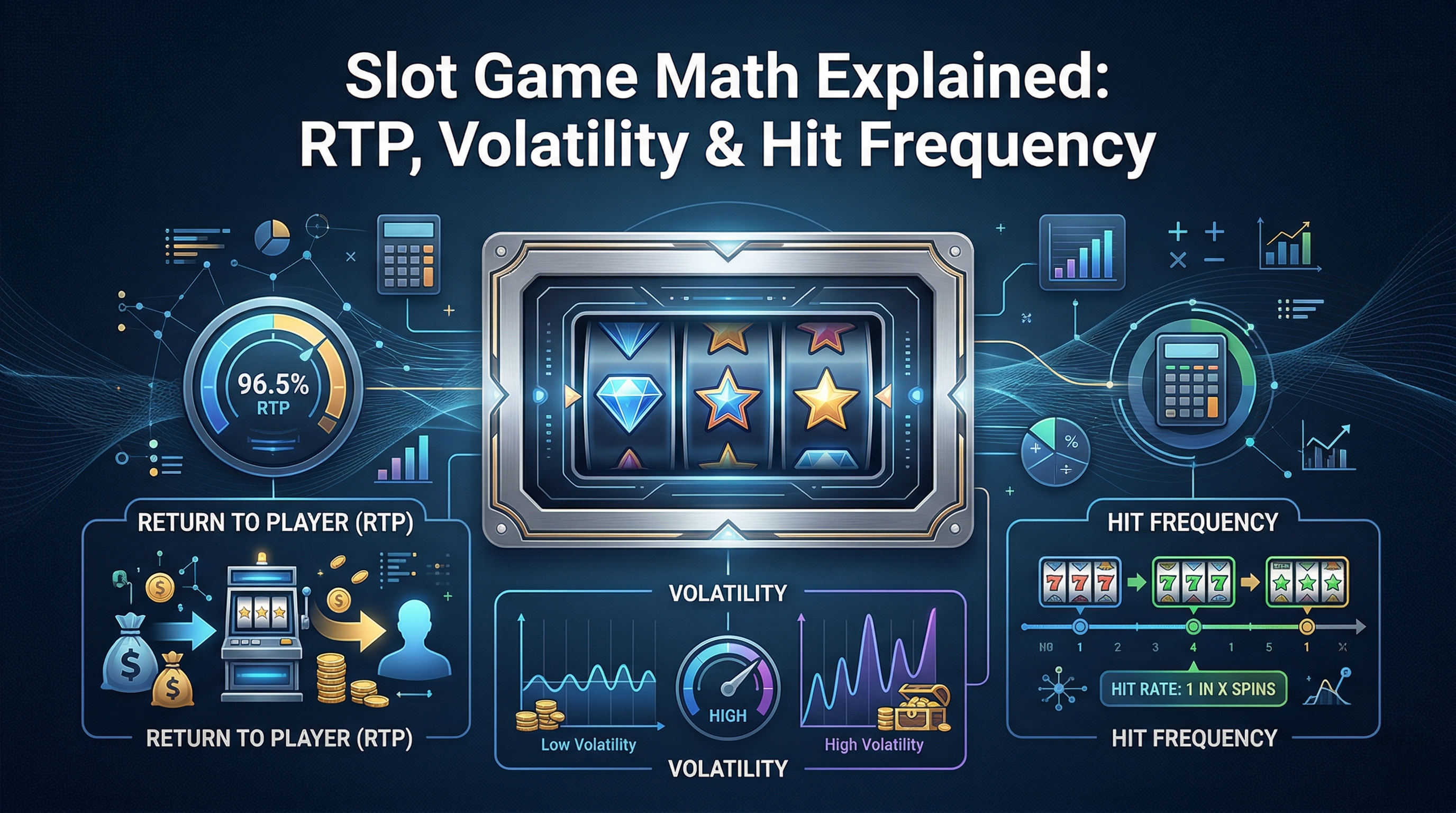
- RTP (Return to Player) is the percentage of all wagered money a slot pays back over time. A 96% RTP means the house keeps 4%.
- Volatility determines the risk profile — low volatility = frequent small wins, high volatility = rare big wins.
- Hit frequency is how often a spin results in any win. Typical range: 20–35% for modern video slots.
- These three metrics are interdependent — changing one affects the others. Getting the balance right is what separates a hit slot from a forgettable one.
Every slot game — from a 3-reel classic to a modern Megaways title — runs on math. Not random math. Carefully designed, tested, and certified math that determines how much a game pays, how often it pays, and how it feels to play.
If you're an operator launching a casino platform, a founder building your first slot game, or a developer tasked with designing a math model — this guide will give you a clear, practical understanding of the three pillars of slot math: RTP, volatility, and hit frequency.
At Raijin, we've built 50+ slot gameswith custom math models, and every one has passed certification on the first or second submission. This article is based on what we've learned shipping real games to real operators.
What Is RTP (Return to Player)?
Definition
RTP (Return to Player) is a theoretical percentage that represents how much of all wagered money a slot machine will pay back to players over its lifetime. It is calculated across millions of spins, not individual sessions.
Simple Formula
RTP = (Total Amount Returned to Players ÷ Total Amount Wagered) × 100
If players collectively wager $1,000,000 on a slot with 96% RTP, the game will return approximately $960,000 and keep $40,000 (the house edge).
Typical RTP Ranges
| RTP Range | Classification | Where You'll See It | House Edge |
|---|---|---|---|
| 99–97% | Very High | Online slots (competitive markets) | 1–3% |
| 96–97% | High (Industry Standard) | Most modern online video slots | 3–4% |
| 94–96% | Medium | Some online slots, mobile slots | 4–6% |
| 90–94% | Low | Land-based casino slots | 6–10% |
| 85–90% | Very Low | Pub/bar fruit machines, some VLTs | 10–15% |
Why the range matters: Online slot players in regulated markets expect 95%+ RTP. Going below 94% in an online environment risks negative player reviews and lower engagement metrics. Land-based machines can afford lower RTPs because players accept higher house edges in physical venues.
Common RTP Misconceptions
- "96% RTP means I get $96 back for every $100 I bet." — No. RTP is a long-term statistical average calculated over millions of spins. In any single session, your actual return could be 0% or 500%+. RTP tells you nothing about individual outcomes.
- "Higher RTP = better game." — Not necessarily. A 97% RTP low-volatility slot might feel boring because all wins are tiny. A 95% RTP high-volatility slot might be far more exciting because of its large win potential. RTP is one dimension of a three-dimensional equation.
- "The casino can change RTP at will." — In regulated markets, RTP is locked into the math model and verified by testing labs (GLI, eCOGRA, BMM, iTech Labs). The operator selects a certified RTP configuration; they cannot alter it arbitrarily.
RTP Configurations for Operators
Most professionally built slot games offer multiple RTP configurations — typically 3 to 5 settings that operators can choose from. For example:
| Config | RTP | Use Case |
|---|---|---|
| Config 1 | 96.5% | Default — online casino, competitive market |
| Config 2 | 95.0% | Mobile-first platforms, emerging markets |
| Config 3 | 94.0% | Social casino, sweepstakes platforms |
| Config 4 | 92.0% | Land-based terminals, amusement machines |
| Config 5 | 88.0% | Pub/bar machines (UK AWP-style) |
At Raijin, we build every slot game with at least 3 RTP tiers so operators can deploy to different markets from a single build.
What Is Volatility (Variance)?
Definition
Volatility (also called variance) describes the risk profile of a slot game — specifically, the distribution pattern of payouts. It answers the question: "How does this game deliver its RTP?"
- Low volatility: Pays out frequently in small amounts. Steady, predictable sessions.
- Medium volatility: Balanced mix of small frequent wins and occasional larger payouts.
- High volatility: Pays out rarely, but when it does, wins are significantly larger.
Two slots can have identical 96% RTP but completely different player experiences based on volatility. That's why volatility is arguably the most important design decision in slot game math.
Volatility Comparison
| Factor | Low Volatility | Medium Volatility | High Volatility |
|---|---|---|---|
| Win Frequency | High (30–40%) | Medium (22–30%) | Low (15–25%) |
| Average Win Size | 0.5–3× bet | 2–10× bet | 5–50×+ bet |
| Max Win Potential | 500–1,000× bet | 1,000–5,000× bet | 5,000–50,000×+ bet |
| Bankroll Drain Speed | Slow | Moderate | Fast |
| Session Length | Long | Medium | Short (unless big win) |
| Target Player | Casual, new players | Most players | Thrill-seekers, streamers |
| Example Games | Starburst, Blood Suckers | Gonzo's Quest, Dead or Alive 2 | Book of Dead, Jammin' Jars |
How Volatility Is Measured
Mathematically, volatility is quantified using the standard deviation of the payout distribution. In practice, most studios and testing labs use a volatility index scale:
| Volatility Index (VI) | Classification | Standard Deviation Range |
|---|---|---|
| 1–5 | Very Low | < 3 |
| 6–10 | Low | 3–5 |
| 11–15 | Medium-Low | 5–8 |
| 16–20 | Medium | 8–12 |
| 21–30 | Medium-High | 12–18 |
| 31–50 | High | 18–30 |
| 50+ | Very High / Extreme | 30+ |
A slot with VI of 12 will feel smooth and predictable. A slot with VI of 45 will have long dry spells punctuated by massive wins. Neither is better — it depends on your target audience.
Volatility and Player Experience
Volatility is the single biggest factor in how a slot feels. Here's how it maps to player psychology:
- Low volatilitygenerates a "steady drip" of positive reinforcement. Players feel like they're always winning something. Ideal for casual players and long sessions. The downside: wins feel unremarkable.
- High volatilitycreates tension, anticipation, and explosive moments. Players chase the "big hit." Ideal for streamers and experienced players. The downside: long losing streaks can cause frustration and churn.
- Medium volatility is the sweet spot for most commercial slots. It keeps engagement high without excessive bankroll drain. Most top-performing slots on major platforms fall in the medium-high range (VI 16–30).
What Is Hit Frequency?
Definition
Hit frequency is the percentage of spins that result in anypayout — including wins smaller than the original bet. It's the simplest of the three metrics but has a massive impact on player satisfaction.
Formula
Hit Frequency = (Number of Winning Spins ÷ Total Spins) × 100
A slot with 30% hit frequency means roughly 1 in every 3.3 spins will produce some kind of win.
Typical Hit Frequency Ranges
| Hit Frequency | What It Feels Like | Typical Slot Type |
|---|---|---|
| 40%+ | Constant wins (many below bet size) | Low-volatility slots, cluster-pay games |
| 30–40% | Frequent wins, engaging sessions | Casual video slots, 5-reel standard |
| 20–30% | Balanced — standard for most slots | Medium-volatility video slots |
| 15–20% | Noticeable gaps between wins | High-volatility slots |
| < 15% | Long dry spells, big potential payouts | Extreme volatility, jackpot-focused slots |
Hit Frequency vs. RTP — They're Not the Same
A common confusion: a slot with 35% hit frequency doesn't mean it has 35% RTP. Hit frequency counts any win, including wins that return less than the bet amount. Consider this example:
Example: Two Slots, Same RTP, Different Hit Frequency
Slot A — 96% RTP, 35% hit frequency
- 35 out of 100 spins win something
- Many wins are 0.2×–0.5× the bet (net losses disguised as wins)
- Occasional 5×–20× wins
- Feels: busy, constant action
Slot B — 96% RTP, 18% hit frequency
- 18 out of 100 spins win something
- Most wins are 3×–10× the bet
- Rare 100×–500× mega wins
- Feels: tense, dramatic, streaky
Both return 96% over time. But the player experience is completely different.
Losses Disguised as Wins (LDWs)
When a spin pays out less than the wager, it's technically a loss — but the game plays win sounds, shows animations, and makes the player feel like they won. These are called Losses Disguised as Wins (LDWs), and they're a key tool for managing hit frequency.
A 20-line slot at $1/line ($20 total bet) that returns $3 on a spin is a net $17 loss — but it registers as a "win" in hit frequency calculations. LDWs can inflate hit frequency by 10–15 percentage points, making the game feel more generous than it actually is.
Regulators in some jurisdictions (notably the UK Gambling Commission) have started scrutinizing LDW mechanics. When designing your math model, consider whether your target markets have restrictions on LDW presentation.
How RTP, Volatility & Hit Frequency Work Together
These three metrics are interdependent. You can't adjust one without affecting the others. Here's how they relate:
| Scenario | RTP | Volatility | Hit Frequency | Player Experience |
|---|---|---|---|---|
| Casual Crowd-Pleaser | 96% | Low | 35% | Frequent small wins, long sessions, steady engagement |
| Balanced Best-Seller | 96% | Medium | 25% | Mix of small and big wins, broad appeal |
| Streamer Favorite | 96% | High | 18% | Dramatic wins, long dry spells, high max win |
| Jackpot Hunter | 94% | Very High | 12% | Most spins lose, but jackpot potential is massive |
| Penny Slot Classic | 92% | Low | 38% | Very frequent tiny wins, high entertainment per dollar |
The Golden Rule
For a fixed RTP, increasing volatility means decreasing hit frequency (and vice versa). You can't have high volatility, high hit frequency, AND high RTP — the math won't balance. Choose two, and the third is determined.
How to Build a Slot Game Math Model
A math model is the blueprint that defines every possible outcome in a slot game. Here's the process we follow at Raijin when building slot math from scratch.
Step 1: Define Your Target Metrics
Before writing a single formula, answer these questions:
- What RTP does the operator/market require? (e.g., 96.5% for online EU, 92% for land-based)
- What volatility fits the target player? (casual = low-medium, core = medium-high)
- What hit frequency feels right? (30%+ for casual, 20–25% for balanced, <20% for high-vol)
- What's the max win cap? (1,000× for casual, 5,000–10,000× for medium, 50,000×+ for high-vol)
Step 2: Design the Paytable
The paytable defines what each symbol combination pays. Key considerations:
- Symbol count: Typically 8–12 regular symbols + 1–3 special symbols (Wild, Scatter, Bonus)
- Pay tiers: Low-pay symbols (1–5× per line), mid-pay (5–20×), high-pay (20–100×+)
- Symbol distribution on reels: More low-pay symbols on each reel, fewer high-pay symbols
- Wild substitution rules: Which symbols can wilds replace? Do wilds have multipliers?
Step 3: Build the Reel Strips
Reel strips are the actual sequences of symbols on each reel. This is where the math lives. A 5-reel slot with 30 stops per reel has 30⁵ = 24.3 million possible combinations. The placement of each symbol on each reel determines the probability of every winning combination.
Reel strip design is iterative — you adjust symbol positions, run millions of simulated spins, check if the output matches your target RTP/volatility/hit frequency, and repeat until it converges.
Step 4: Design Bonus Mechanics
Bonus features (free spins, pick-and-click, wheel bonuses) typically contribute 20–40% of total RTP. The base game handles the rest. This split is crucial:
| RTP Split | Base Game | Bonus | Effect on Gameplay |
|---|---|---|---|
| Conservative | 75–80% | 20–25% | Base game feels rewarding; bonus is a nice bump |
| Balanced | 60–70% | 30–40% | Base game is leaner; bonus is where big wins happen |
| Bonus-Heavy | 50–60% | 40–50% | Base game is dry; game lives/dies on bonus triggers |
High-volatility slots tend to use bonus-heavy splits — the base game is a "pay to enter" grind and the bonus round is where the action is. Low-volatility slots spread returns more evenly across base game and bonus.
Step 5: Simulate & Validate
Once the math model is built, we run 10 billion+ simulated spins to verify:
- Actual RTP matches target (within ±0.1%)
- Volatility index falls within the desired range
- Hit frequency matches expectations
- Max win is achievable but at the correct probability
- Bonus trigger frequency is appropriate (typically every 80–150 spins)
- No degenerate patterns (e.g., a specific bet size exploiting the math)
RTP Certification: What You Need to Know
Before a slot game can go live in a regulated market, its math model must be certified by an accredited testing lab. The lab independently verifies that the game's actual RTP matches its claimed RTP and that the RNG (Random Number Generator) is truly random.
Major Testing Labs
| Lab | Headquarters | Key Markets |
|---|---|---|
| GLI (Gaming Laboratories International) | USA | North America, Asia, Latin America |
| BMM Testlabs | USA | Global — 15+ jurisdictions |
| eCOGRA | UK | UK, Malta, Gibraltar, Denmark |
| iTech Labs | Australia | Australia, Asia, Europe |
| QUINEL | UK/Malta | UK, Malta, Sweden |
| NMi | Netherlands | Europe, South Africa |
What the Certification Process Covers
- Math model review: Verifying RTP calculations, paytable accuracy, and probability distributions
- RNG testing: Statistical tests (Diehard, NIST, Chi-squared) on the random number generator
- Game rules verification: Ensuring displayed rules match actual game behavior
- Simulation testing: Running 10M+ spins to verify theoretical RTP matches practical RTP
- Responsible gaming features: Session limits, reality checks, loss limits
Pro Tip from Our Experience
The #1 reason for certification failure is paytable/reel strip mismatches — the displayed paytable says one thing but the actual reel strips produce different probabilities. We catch this in our internal QA before submission. A failed certification costs 4–8 weeks of delays plus resubmission fees ($5K–$15K per jurisdiction).
Math-Driven Design Decisions for Your Slot Game
Understanding the math lets you make better productdecisions. Here's how to choose your math profile based on your business goals.
Building for Casual Players
- RTP: 95–96%
- Volatility: Low to Medium (VI 8–18)
- Hit frequency: 28–38%
- Max win: 500–2,000× bet
- Bonus frequency: Every 60–100 spins
- Why: Casual players want entertainment, not adrenaline. Frequent small wins keep them playing longer and spending more per session.
Building for Core/Experienced Players
- RTP: 96–97%
- Volatility: Medium-High (VI 20–35)
- Hit frequency: 20–28%
- Max win: 5,000–10,000× bet
- Bonus frequency: Every 100–150 spins
- Why: Experienced players understand variance and are willing to endure dry spells for meaningful win potential. Higher RTP is expected in competitive online markets.
Building for Streamers / Viral Potential
- RTP: 96%+
- Volatility: Very High (VI 40+)
- Hit frequency: 12–20%
- Max win: 20,000–50,000×+ bet
- Bonus frequency: Every 150–250 spins
- Why: Streamers need "clip-worthy" moments. Extreme volatility creates the dramatic wins that generate organic marketing through Twitch/YouTube clips. The game sells itself when a streamer hits 40,000× on camera.
Common Math Model Mistakes to Avoid
- Ignoring the base game/bonus split. Putting too much RTP into the bonus makes the base game feel punishing. Players quit before they ever trigger the feature.
- Max win too low for the volatility. If your game is high-volatility but caps at 1,000×, players feel cheated. High variance needs high reward to justify the dry spells.
- Not offering multiple RTP configs. Operators in different markets need different RTPs. Build this flexibility in from day one — retrofitting is expensive.
- Underestimating LDW impact on perception. Too many LDWs (wins below bet) can make the game feel deceptive. Some regulators are cracking down on this.
- Skipping simulation at scale.Running 1 million spins isn't enough. You need 1 billion+ to catch edge cases — like a specific bonus/wild combination that pays 100,000× due to a reel strip error.
- Building the math after the art. Math should drive design, not the other way around. The number of symbols, reel configuration, and payline structure should be decided based on math model requirements before a single asset is drawn.
Frequently Asked Questions
What is a good RTP for a slot game?
For online slots in competitive markets (EU, UK, North America), 95.5–96.5% is the standard. Below 95% may struggle in player reviews and comparison sites. Above 97% is generous but reduces operator margin.
Can players tell the difference between 95% and 96% RTP?
Not in individual sessions — the variance is too high. But over thousands of sessions across your player base, 1% RTP difference represents significant revenue. Players can't feel 1% RTP, but they can feel the volatility and hit frequency that come with it.
What RTP do regulators require?
It varies by jurisdiction. The UK requires a minimum 70% for gaming machines. Malta has no hard minimum but requires disclosure. Many jurisdictions require minimum 85–90%. Always check the specific requirements for your target markets.
How long does it take to develop a slot game math model?
A straightforward 5-reel video slot math model takes 2–4 weeks. Complex mechanics (Megaways, cascading reels, progressive jackpots) can take 4–8 weeks. Simulation and validation add another 1–2 weeks.
What's the difference between volatility and variance?
In slot game math, they mean the same thing. "Volatility" is the term used by game designers and operators. "Variance" is the statistical/mathematical term. Both describe the distribution of payouts around the mean (RTP).
Can I change the RTP after the game is certified?
You can switch between pre-certified RTP configurations. You cannot create new RTP values without recertification. This is why building multiple RTP tiers upfront is essential.
How much does slot game math model certification cost?
Testing lab fees range from $5,000 to $25,000 per jurisdiction depending on the lab, game complexity, and number of RTP configurations. Multi-jurisdiction certification can cost $30K–$80K total for a single game.
Final Thoughts: Math Is the Game
Art, sound, and animation make a slot game look good. Math makes it play good.The most beautifully designed slot in the world will fail if the math model doesn't deliver the right experience — the right balance of tension, reward, and surprise.
The three pillars — RTP, volatility, and hit frequency — are not just numbers on a spec sheet. They are the invisible architecture of player experience. Get them right, and players come back. Get them wrong, and no amount of polish will save the game.
Whether you're building your first slot or your fiftieth, the math model should be the first thing you design and the last thing you certify.
How Raijin Can Help You Build Your Slot Game
We don't just write code — we design the math. At Raijin, slot game math model design is a core competency, not an afterthought. Every model we build goes through our internal simulation pipeline (10B+ spins) before it ever reaches a testing lab.
Our Slot Game Capabilities
- Custom math model design — from target metrics to certified reel strips, built for your specific market and player audience
- Multi-RTP configurations — every game ships with 3–5 certified RTP tiers for maximum operator flexibility
- Full game development — math, art, animation, sound, frontend, backend — end-to-end slot development
- Certification support — we prepare the submission package and handle communication with GLI, BMM, eCOGRA, and iTech Labs
- Turnkey casino platforms — if you need not just games but the entire platform, we build that too
- Slot game art — custom symbol design, UI, animations, and VFX from our in-house art team


Ready to Build Your
Next Slot Game?
Get a custom math model design, full game development quote, and certification roadmap — completely free.