
Key Takeaways
- Hybrid-casual is the dominant genre in 2026 — combining hyper-casual accessibility with mid-core depth and monetization.
- AI-driven personalization is reshaping everything from game difficulty to ad placement to live ops events.
- Cross-platform play is no longer optional — players expect to move between mobile, PC, and console seamlessly.
- The mobile game market is projected to hit $130+ billion in 2026, with India and Southeast Asia driving the fastest growth.
Mobile gaming isn't just the biggest segment of the games industry — it's the fastest-evolving one. What worked in 2024 is already outdated. The studios that thrive in 2026 are the ones reading the market right nowand building for where it's heading.
At Raijin, we've shipped 500+ mobile games since 2019. We see trends early because we're building in them. This isn't a trend report based on analyst predictions — it's based on what our clients are asking us to build, what's performing on the charts, and what's changing in player behavior.
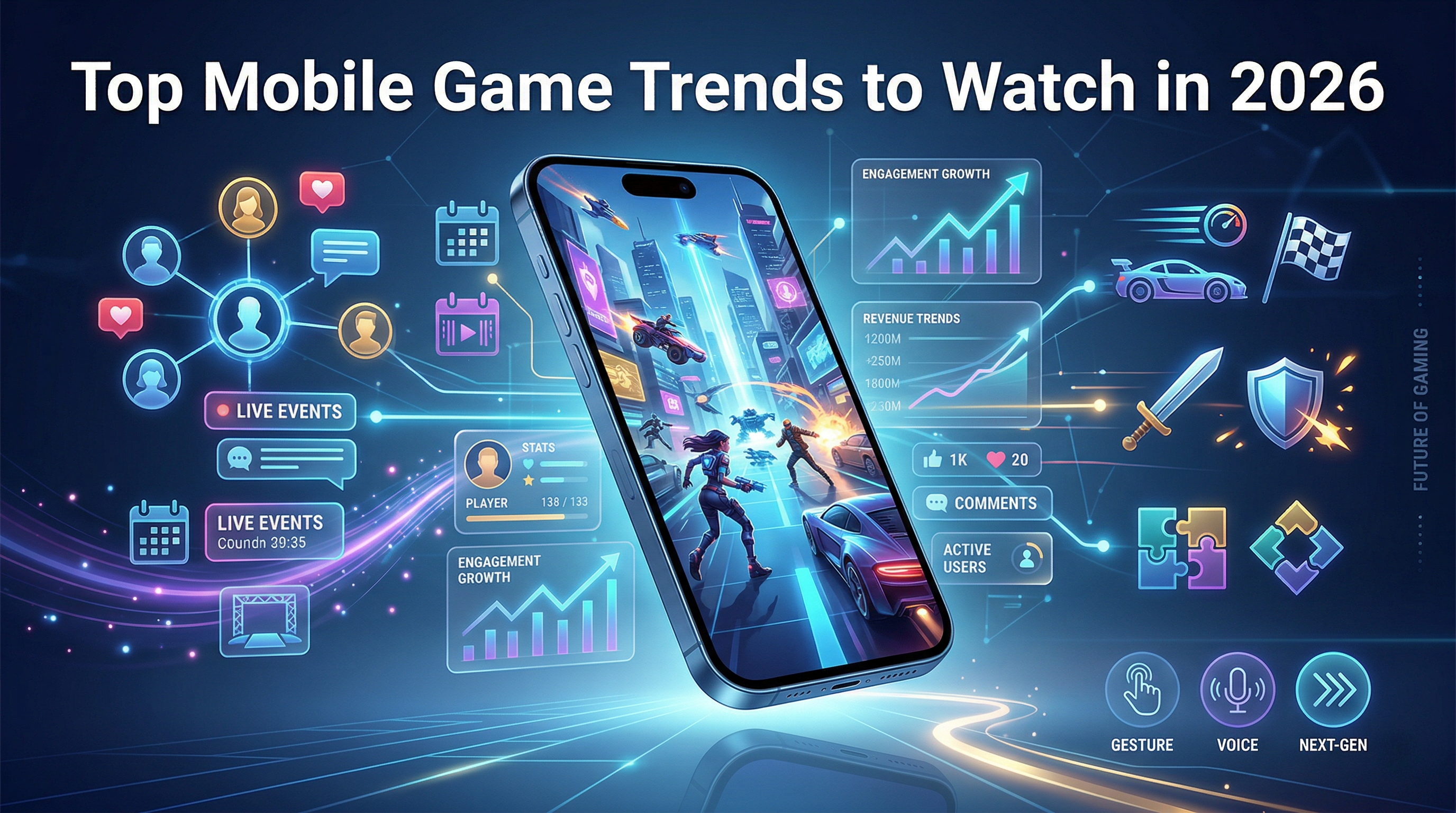
Here are the 12 mobile game trends that matter most in 2026.
1. Hybrid-Casual Games Dominate the Market
The hyper-casual gold rush is over. CPIs have risen, ad revenue per user has flattened, and the market is saturated with simple tap-to-play games. The response? Hybrid-casual — games that combine the instant accessibility of hyper-casual with the progression, meta-layers, and monetization of mid-core.
What makes a game hybrid-casual:
- Simple core loop that anyone can learn in 10 seconds
- Meta-game progression — upgrades, unlocks, character evolution, base building
- Dual monetization — both ads (rewarded video) AND in-app purchases
- Higher LTV than hyper-casual ($1–$5 vs. $0.10–$0.50), justifying higher CPIs
Games like Mob Control, Survivor.io, and Archero pioneered this space. In 2026, hybrid-casual is the default — not the exception.
What This Means for You
If you're planning a casual game, build meta-game layers from day one. A simple core loop with no progression will struggle to compete. Budget for 20–30% more development time to add progression systems — the ROI is worth it.
2. AI-Driven Game Personalization
AI isn't just a buzzword in gaming anymore — it's production infrastructure. In 2026, the most successful mobile games use AI to personalize the experience for every player, in real time.
Where AI Is Being Applied
- Dynamic difficulty adjustment (DDA):The game gets easier or harder based on individual player skill, keeping them in the "flow state" longer. Result: higher session times and retention.
- Personalized offers:AI analyzes player behavior to serve the right IAP offer at the right time. A player who's stuck on a level gets a power-up offer. A collector gets a rare cosmetic bundle.
- Smart ad placement: Instead of showing ads at fixed intervals, AI determines the optimal moment to show an ad (when the player is most likely to watch and least likely to churn).
- Procedural content generation: AI-generated levels, quests, and challenges that adapt to player preferences. This extends content lifespan without manual level design.
- Churn prediction: ML models identify players who are about to stop playing, triggering retention mechanics (bonus rewards, personalized push notifications, easier levels).
Studios that aren't leveraging AI in their live ops pipeline are leaving money on the table. The gap between AI-optimized and non-optimized games is widening every quarter.
3. Cross-Platform Play Is Now Expected
Players in 2026 don't think in terms of "mobile games" vs. "PC games." They think in terms of games — and they expect to play them everywhere.
The technical barriers have dropped dramatically:
- Unity and Unreal Engine both support single-codebase cross-platform deployment
- Cloud save services (PlayFab, Firebase, custom backends) sync progress across devices
- Cross-platform matchmaking is no longer technically complex — middleware solutions handle it
The business case is clear:cross-platform games see 25–40% higher lifetime value because players can engage during commutes (mobile), at home (PC/console), and socially (any device). Fortnite, Genshin Impact, and PUBG proved this model — now it's filtering down to smaller studios.
4. Short-Form Content Integration
TikTok changed how people consume content — and it's changing how games are designed. The trend: games that create shareable moments.
- Built-in clip recording that exports directly to TikTok/Reels/Shorts
- Replay systems that auto-capture highlights (big wins, clutch moments, funny fails)
- UGC (User-Generated Content) tools that let players create custom levels, skins, or challenges and share them
- Designed-for-streaming mechanics — games that look exciting to watch, not just to play
The cost of user acquisition keeps rising. Games that generate organic content through short-form video get free marketing at scale. Your game's content strategy should be designed into the game, not bolted on after launch.
5. Live Ops Becomes the Product
In 2026, the initial launch is just the opening act. The real product is the ongoing live operations — seasonal events, battle passes, limited-time modes, collaborative challenges, and narrative updates.
Key live ops trends:
- Shorter event cycles: Weekly micro-events instead of monthly mega-events. Keeps the content cadence high without massive production overhead.
- Community-driven events: Players vote on next content, contribute to global milestones, or participate in community challenges with shared rewards.
- Cross-game events: Collaborations between games (IP crossovers, shared events, cross-promotion) are increasingly common and effective.
- Serverless live ops: Tools like Firebase Remote Config and LaunchDarkly let studios update game parameters without app store updates.
Budget Reality Check
Plan for 20–30% of your initial development budget per year for live ops. A game without live ops in 2026 has a shelf life of 30–60 days. A game with strong live ops can generate revenue for years.
6. India & Southeast Asia Drive Global Growth
While North America and Europe remain the highest-revenue markets, the fastest growth is in India, Southeast Asia, and Latin America. In 2026:
- India has 500M+ mobile gamers — the largest player base in the world. Revenue is catching up fast as payment infrastructure (UPI, digital wallets) matures.
- Southeast Asia (Indonesia, Vietnam, Philippines, Thailand) has a rapidly growing middle class with increasing smartphone penetration and gaming spend.
- MENA (Middle East & North Africa) is an emerging hotspot, with Saudi Arabia and UAE investing heavily in gaming infrastructure.
What this means for developers: design for these markets from the start. Low-end device optimization, regional payment support, localization, and culturally relevant content are no longer nice-to-haves — they're requirements for capturing the majority of global growth.
7. Subscription Models Gain Ground
Apple Arcade, Google Play Pass, and Netflix Games normalized the idea that mobile games can be subscription-based. In 2026, we're seeing:
- In-game subscriptions (VIP passes, season passes) as a growing share of IAP revenue — often contributing 15–30% of total revenue
- Hybrid models: Games that are free-to-play with ads/IAPs but offer a $4.99/month "premium" tier that removes ads, adds perks, and provides daily rewards
- Bundle subscriptions: Studios with multiple games offering cross-game subscription bundles
Subscriptions create predictable recurring revenue — which makes business planning, fundraising, and scaling far more manageable than volatile IAP-dependent models.
8. Web3 Goes Practical (Finally)
The 2021–2023 blockchain gaming hype crashed hard. But the useful parts survived. In 2026, Web3 in mobile gaming looks nothing like the speculative NFT games of the past:
- Token-gated rewards — players earn loyalty tokens through gameplay that can be redeemed for in-game items, discounts, or real-world perks. No crypto wallet required.
- Player-owned assets — limited-edition cosmetics and items that players can trade on official marketplaces. The studio takes a cut on every transaction.
- Invisible blockchain — the tech runs in the background. Players never see a wallet address or gas fee. It just works like a loyalty program.
The lesson: blockchain as infrastructure, not as marketing. Players don't care about the technology — they care about what it enables.
9. Social-First Multiplayer Design
The most successful mobile games in 2026 are social platforms disguised as games. The shift:
- Co-op over competition: Collaborative modes (co-op quests, team challenges, guild activities) drive more engagement and spending than PvP alone
- In-game social features: Voice chat, emotes, gifting, spectating, shared housing/spaces
- Asynchronous social: "Raid your friend's base" and "beat your friend's score" mechanics that keep players connected even when playing alone
- Community building: In-game guilds, clans, and clubs with their own progression systems, creating social obligation that drives retention
Why it matters: Social connections are the #1 predictor of long-term retention. Players who join a guild/clan have 3–5× higher 30-day retention than solo players.
10. AR and Location-Based Gaming Evolves
Pokémon GO proved the model. In 2026, AR and location-based games are evolving beyond novelty:
- Apple Vision Pro and Meta Quest 3 are normalizing spatial computing — AR experiences are getting richer
- Brand partnerships — retailers, restaurants, and destinations partnering with games for location-based promotions and scavenger hunts
- Fitness + gaming convergence — step-counting rewards, AR running games, and location-based challenges tied to health metrics
- Persistent AR worlds — shared AR environments where multiple players interact with the same virtual objects in real-world locations
The technology is ready. The challenge is designing experiences that justify pulling out your phone and pointing it at the world — repeatedly, not just once for the novelty.
11. Privacy-First Design & Contextual Monetization
Apple's ATT (App Tracking Transparency), Google's Privacy Sandbox, and tightening global regulations have fundamentally changed mobile game monetization and user acquisition.
What's working in 2026:
- First-party data strategies: Games collecting their own behavioral data (with consent) rather than relying on third-party tracking
- Contextual ad targeting: Showing ads based on what's happening in the game (just finished a level, in the shop, watching a replay) rather than user demographics
- Predictive LTV models: Using early-session behavior to predict player lifetime value and adjust monetization accordingly — without personal data
- On-device ML: Running personalization models on the player's device instead of sending data to servers, satisfying privacy requirements
Studios that adapted early to the privacy-first world are now outperformingthose still clinging to IDFA-era tactics. The data disadvantage is real — but it's also an equalizer for smaller studios who never had massive data moats to begin with.
12. Games as Platforms (Not Just Products)
The biggest mobile games in 2026 aren't just games — they're platforms. Roblox, Fortnite, and Minecraft led the way. Now the model is filtering into smaller-scale games:
- User-generated content (UGC): Players creating levels, skins, game modes, and stories within your game — extending content lifespan infinitely
- Creator economies: Top creators earning revenue from their creations, incentivizing quality UGC
- Modding tools: Even mobile games are offering simplified modding/creation tools
- Social spaces: Games functioning as virtual hangouts where the "game" is secondary to the social experience
You don't need to build the next Roblox. But thinking about your game as a platform that players contribute to — rather than a fixed product they consume — will extend its lifespan and reduce your content production burden.
The Numbers Behind the Trends
For context, here's where the mobile game market stands in 2026:
| Metric | 2024 | 2026 (Projected) | Growth |
|---|---|---|---|
| Global Mobile Game Revenue | $98B | $130B+ | +33% |
| Mobile Gamers Worldwide | 2.8B | 3.2B+ | +14% |
| Average CPI (Casual) | $1.50 | $2.20 | +47% |
| IAP Share of Revenue | 65% | 58% | -7pp |
| Ad Revenue Share | 30% | 32% | +2pp |
| Subscription Revenue Share | 5% | 10% | +5pp |
The key takeaway: revenue is growing but acquisition costs are rising faster. Studios that can drive organic growth (through shareable content, UGC, community, and cross-platform play) will have a massive advantage over those relying purely on paid UA.
Frequently Asked Questions
What type of mobile game should I build in 2026?
Hybrid-casual offers the best risk-reward ratio for most studios. Simple core loop, meta-game progression, dual monetization (ads + IAP). Lower development cost than mid-core, higher LTV than hyper-casual.
Is hyper-casual dead?
Not dead, but significantly harder to profit from. Rising CPIs and falling eCPMs mean the margins are razor-thin. Pure hyper-casual works if you can produce games extremely fast (under 2 weeks) and test aggressively. For most studios, hybrid-casual is the better bet.
How important is AI for mobile game development?
Increasingly critical for live ops and monetization optimization. For game development itself, AI tools are accelerating art production, QA testing, and content generation. Studios not using AI in their pipeline are operating at a competitive disadvantage.
Should I build for multiple platforms from the start?
If your game targets mid-core or above, yes. Use Unity or Unreal for single-codebase cross-platform deployment. For casual/hyper-casual, mobile-first is still fine — cross-platform adds complexity that may not justify the ROI at lower price points.
What are the fastest-growing mobile game markets?
India, Southeast Asia (Indonesia, Vietnam, Philippines), MENA (Saudi Arabia, UAE), and Latin America (Brazil, Mexico). These markets have rapidly growing smartphone penetration, improving payment infrastructure, and young demographics with high gaming engagement.
How much should I budget for live ops?
20–30% of your initial development cost per year. This covers content updates, seasonal events, bug fixes, balance patches, and community management. Without live ops, most mobile games see engagement drop off within 30–60 days of launch.
Final Thoughts: Build for Where the Market Is Going
The mobile game market in 2026 rewards studios that are adaptive, data-driven, and player-obsessed. The trends are clear:
- Depth over simplicity — hybrid-casual beats pure hyper-casual
- Personalization over one-size-fits-all — AI makes every player's experience unique
- Platforms over products — games that players contribute to outlast games they consume
- Social over solo — connected players stay longer and spend more
- Global over local — the fastest growth is in emerging markets
You don't need to chase every trend. Pick the 2–3 that align with your game, your audience, and your budget — and execute them well.
How Raijin Can Help You Build for 2026
We've been building mobile games since 2019 — and we evolve with the market. Whether you're launching a hybrid-casual hit, a cross-platform multiplayer game, or an AI-personalized live-service title, we have the team and the track record.
- 500+ games shipped — we know what works and what doesn't
- Full-stack studio — Unity, Unreal, 2D & 3D art, backend, live ops
- Casino & slots expertise — certified math models, turnkey platforms
- VR/AR development — immersive experiences for the next wave
- 40–60% cost advantage — international quality from our Rajkot, India studio

Ready to Build Your
Next Mobile Game?
Tell us your game idea and get a detailed cost estimate, timeline, and technical roadmap — completely free.