
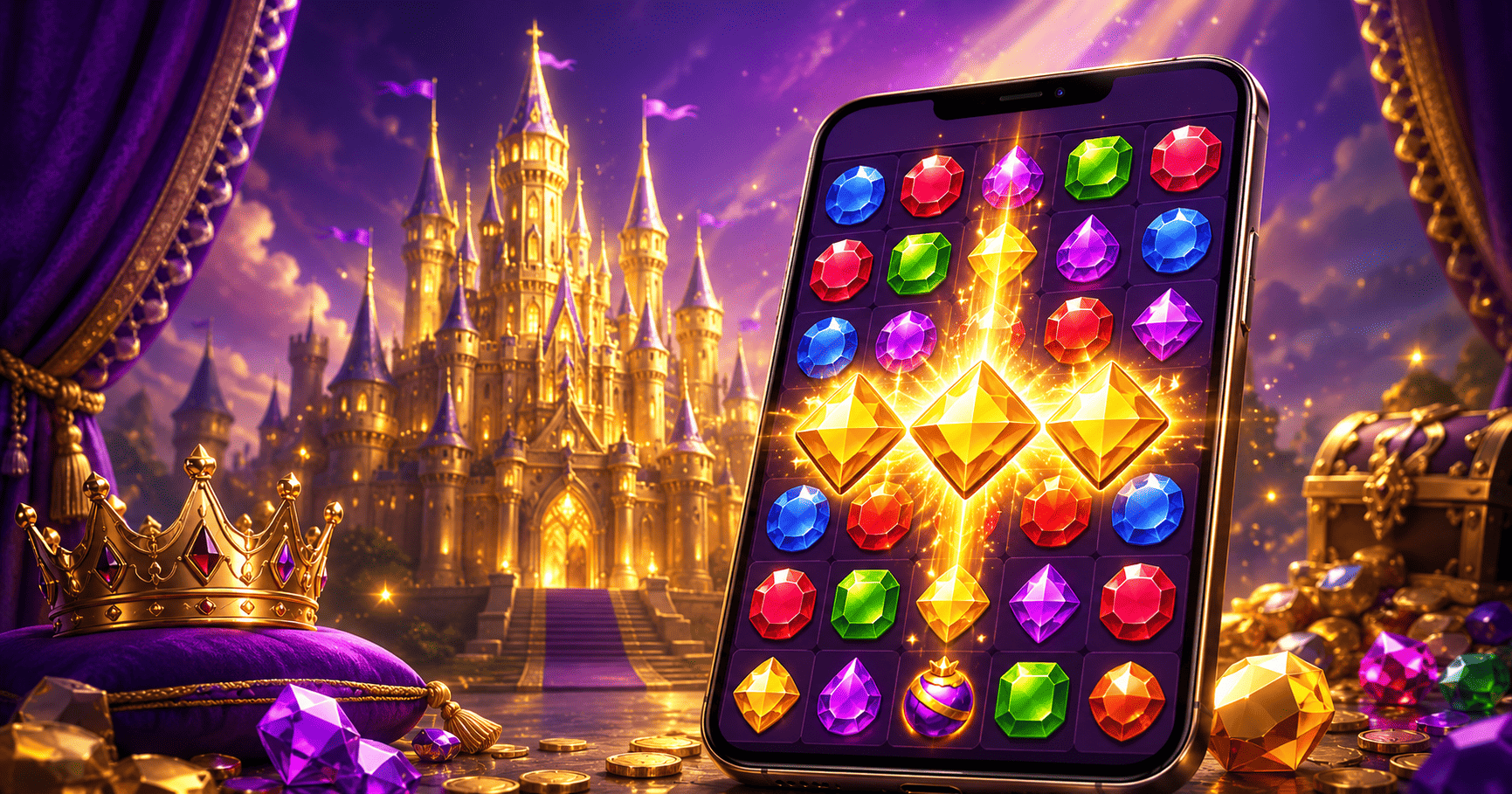
In 2021, a young Istanbul studio founded by former Peak Games executives released a match-3 game with a king, a castle, and a promise that sounded almost naive in the ad-saturated mobile market: no ads, ever. Five years later, Royal Match by Dream Games has crossed $3 billion in lifetime revenue, been installed over 300 million times, and — most remarkably — out-earns Candy Crush Saga with roughly half the monthly active users.
Match-3 remains the most lucrative casual genre in mobile gaming, and it's also the most unforgiving. User acquisition costs are at all-time highs, players uninstall "good enough" games on day two, and the gap between a $50K clone that dies in soft launch and a title that retains for years comes down to systems most studios never build: mathematically tuned difficulty curves, automated level testing, and a meta-layer that gives every match long-term purpose.
This guide breaks down how match-3 games actually work at a production level, what Royal Match specifically does differently, what it costs to build a competitive title in 2026, and how Raijin Studio approaches match-3 development for publishers. If you're evaluating this genre, this is the technical and commercial map.
$3B+ lifetime revenue
300M+ total installs
55M monthly active users
4,500+ levels — and $0 ad revenue (zero ads)
What Is Royal Match — and Why It's the Benchmark
Royal Match is a free-to-play tile-matching puzzle game developed and published by Dream Games, founded in Istanbul in 2019 by a group of former Peak Games executives (the team behind Toon Blast and Toy Blast, acquired by Zynga for $1.8B). Players complete match-3 levels to earn stars, which fund the restoration of King Robert's castle room by room.
The company raised the largest Series A in Turkish startup history ($50M) while Royal Match was still in soft launch, followed by a $155M Series B and $255M Series C — reaching a $2.8 billion valuation. Since 2023, Royal Match has consistently ranked among the top ten mobile games globally by monthly revenue, and it overtook Candy Crush Saga in 2024. The sequel, Royal Kingdom, launched in November 2024 and secured a top-10 grossing spot by January 2026.
Royal Match generates more monthly revenue than Candy Crush Saga while having roughly half its monthly active users. That's not a UA story — that's a monetization design story. The rest of this guide explains how they do it.
Why Royal Match Works (The Real Reasons)
Frictionless Pure-Puzzle Onboarding
Royal Match opens with gameplay in seconds — no forced story, no long tutorial. Analysts have praised its speed, fluidity, and generous early power-ups compared to Playrix and King titles. Every element of the first session is engineered to get the player to their first satisfying cascade as fast as possible. In a market where acquired installs cost more than ever, zero-friction onboarding directly protects UA spend.
A Meta-Layer That Gives Matches Purpose
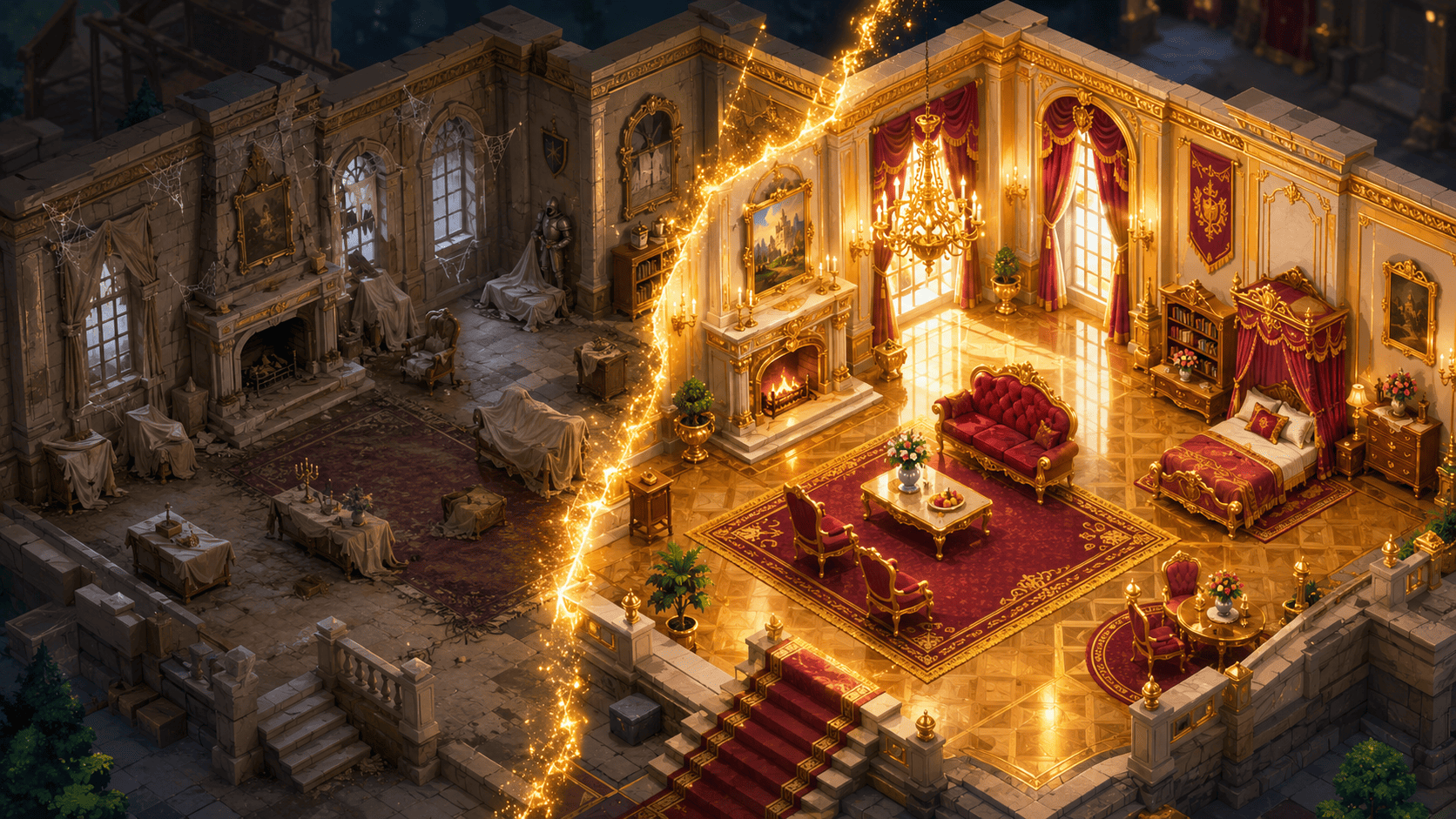
Matching tiles is fun for a week. Restoring a castle is a project that lasts years. The decoration meta transforms each level win into progress toward something visible and personal — the single most important retention structure in modern casual gaming. Players don't come back for level 2,847; they come back to finish the library room.
Mathematically Tuned Difficulty
Every level in a top match-3 game is a calibrated economic instrument. Difficulty curves are engineered with telemetry: win rates, average attempts, booster usage, and quit points per level. When a level's churn exceeds its revenue contribution, it gets rebalanced. This is invisible to players and decisive for the business.
The Zero-Ads Premium Experience
No interstitials. No banner clutter. No rewarded-video begging. This positions Royal Match as a premium experience that respects the player's session — which paradoxically makes players far more willing to pay. The absence of ads is itself a monetization strategy: every frustration in the game has exactly one relief valve, and it's the IAP store.
Relentless Polish & Production Discipline
Dream Games brought in Edwin Catmull — Pixar's co-founder — as a strategic advisor. That tells you the bar: every animation, haptic, sound cue, and celebration is tuned to feel expensive. In a genre where every competitor has the same core mechanic, feel is the moat.
Core Match-3 Mechanics — Engineering Breakdown
The match-3 core looks simple and is deceptively deep to engineer well. Here's the anatomy of the system you're actually building:
The Board & Match Loop
- Swap — Player swaps two adjacent tiles. If the swap produces no match, it reverses (with a satisfying "denied" animation).
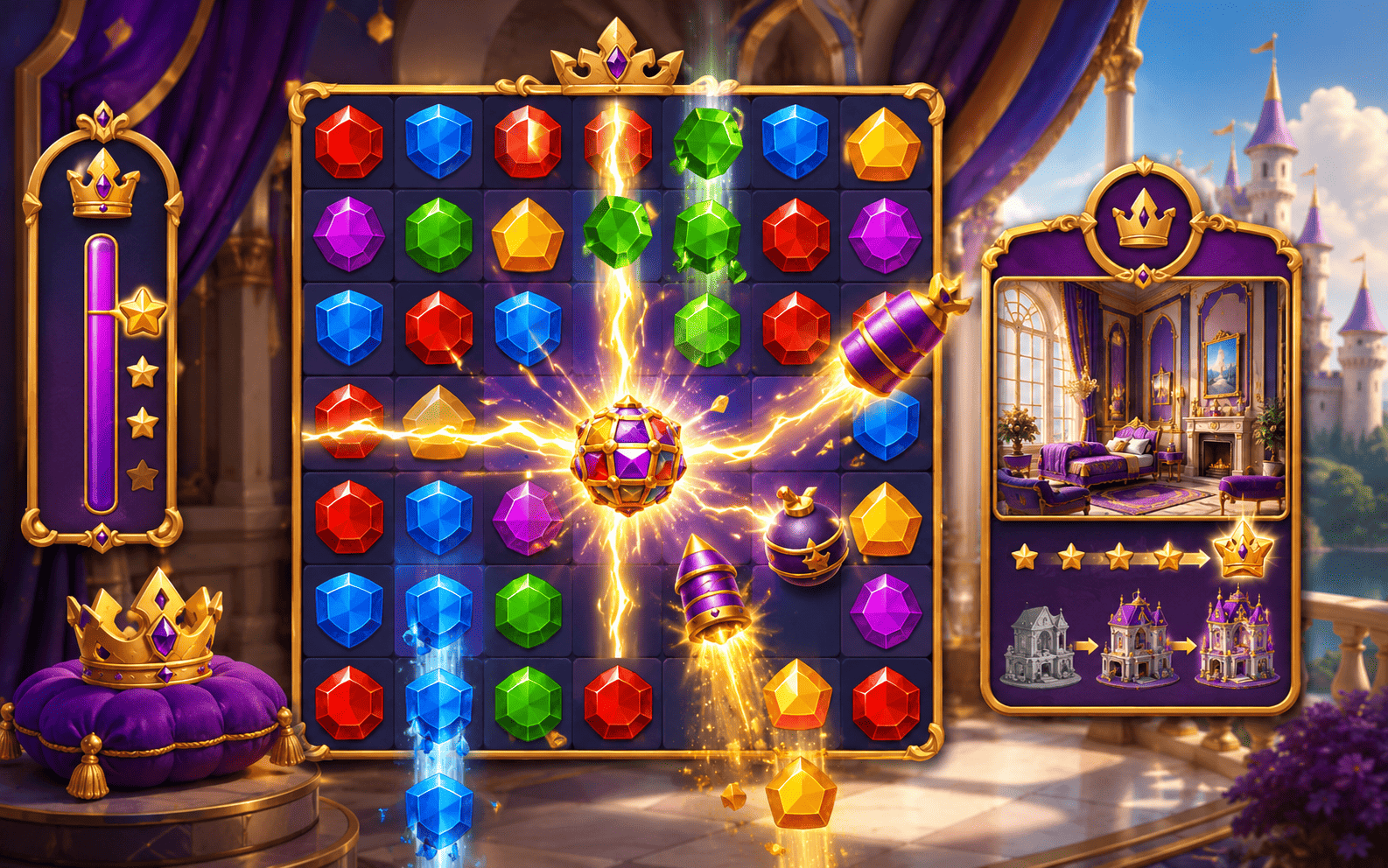
- Match detection — The engine scans for 3+ same-type tiles in a row or column. Shapes matter: 4-in-a-row, L-shapes, T-shapes, and 5-in-a-row each spawn different power-ups.
- Clear & collapse — Matched tiles are removed, tiles above fall down (gravity), and new tiles spawn from the top of each column.
- Cascade resolution — Falling tiles can create new matches automatically. The engine resolves chains until the board is stable. Cascades are the dopamine engine of the genre.
- Objective check — Each level has goals (collect N items, clear obstacles, reach targets) and a move limit. Moves-remaining is the core tension mechanic — and the core monetization lever.
   1 · SWAP            2 · MATCH ×3          3 · CASCADE
 ┌───┬───┬───┐      ┌───┬───┬───┐       ┌╌╌╌┬╌╌╌┬╌╌╌┐
 │ ● │ ● │ ○ │      │ ✓ │ ✓ │ ✓ │       │ ○ │ ○ │ ● │  ← refill
 ├───┼───┼───┤      ├───┼───┼───┤       ├───┼───┼───┤
 │ ◆ │ ● │ ◆ │ ───▶ │ ◆ │ ○ │ ◆ │  ───▶ │ ◆ │ ○ │ ◆ │
 └───┴───┴───┘      └───┴───┴───┘       └───┴───┴───┘
  swap gold up       three clear         gravity + refill

  Chains resolve automatically — cascades are the genre's dopamine engine.
Power-Ups & Combos
Power-ups are where match-3 depth lives. The standard vocabulary (with genre-typical spawn rules):
- Rocket / Line blast — Spawned by 4-in-a-row. Clears a full row or column.
- Bomb / Area blast — Spawned by L or T shapes. Clears a radius.
- Color clear / Rainbow — Spawned by 5-in-a-row. Removes all tiles of one color.
- Combo interactions — Swapping two power-ups together produces amplified effects (rocket + bomb = triple-line blast, etc.). Combo design is a major differentiator; Royal Match's tap-to-activate power-ups are notably more potent than genre norms.
Obstacles & Level Objectives
Obstacles are the level designer's palette: boxes that need adjacent matches, ice that locks tiles, spreading hazards that punish slow play, items that must be dropped to the bottom. A production match-3 game needs 15–25 obstacle types at launch, introduced one at a time every 10–20 levels to keep the learning curve alive for months.
The Meta-Layer: Why Decoration Loops Print Money
Here's the uncomfortable truth about the genre: the match-3 core is a commodity. Every competitor has swaps, cascades, and rockets. What separates a $3B game from a dead clone is the meta-layer — the persistent progression system that wraps around the puzzle core.
Royal Match uses a decoration/renovation meta: winning levels earns stars, stars unlock decoration tasks (restore the fireplace, choose the carpet, repair the garden), and completed rooms unlock new areas with light narrative beats. The loop looks like this:
              THE RETENTION FLYWHEEL

   ┌──────────────┐         ┌──────────────┐
   │  Play Levels │ ──────▶ │  Earn Stars ★│
   │  match-3 core│         │ progress cur.│
   └──────────────┘         └──────┬───────┘
          ▲                        │
          │   "I'll just finish    ▼
          │      this room…"  ┌──────────────┐
   ┌──────┴───────┐           │Decorate Rooms│
   │ New Area +   │ ◀──────── │visible progr.│
   │ Story hook   │           └──────────────┘
   └──────────────┘

   — every retained player, daily, for years
Why this structure works so well, in business terms:
- It converts sessions into a project. A player who has restored 14 rooms has sunk visible identity into the game. Uninstalling now means abandoning the castle — sunk-cost retention that no pure puzzle can create.
- It smooths difficulty frustration. When a hard level blocks progress, the player isn't just stuck on a puzzle — they're one star away from the new chandelier. That motivation gap is exactly where booster purchases happen.
- It creates content cadence. New areas ship as LiveOps content drops, giving lapsed players a reason to return that "500 new levels" never could.
Treating the meta as decoration for the store page rather than a designed system. A bolted-on meta with no economy tuning reads instantly as hollow — analysts reviewing failed clones cite "the meta-layer feels bolted on" as a recurring cause of death. Budget the meta as a first-class system: it's 25–35% of total development effort in a serious title.
Level Design Math: Difficulty Curves & Churn Points
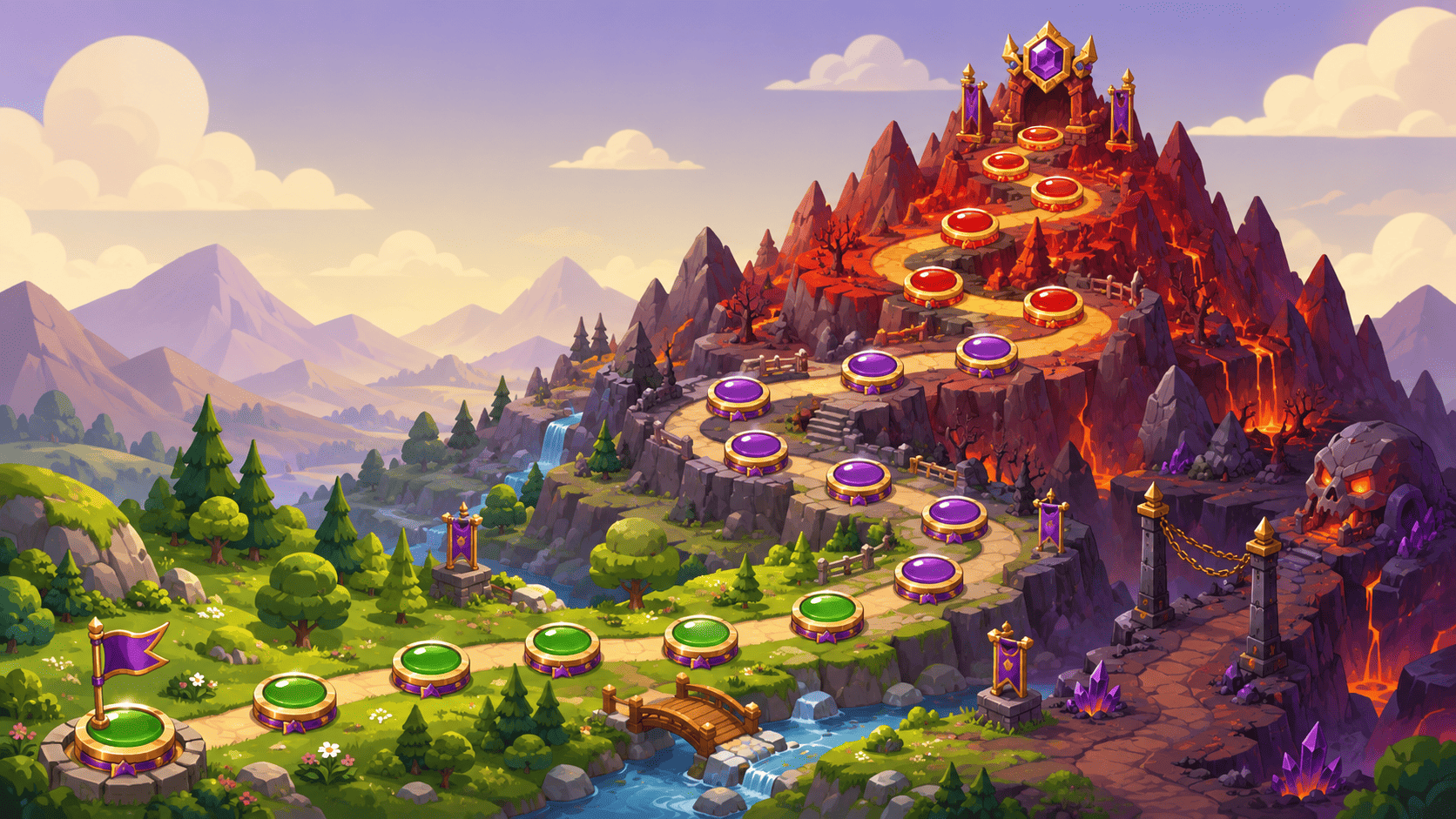
Level design is where match-3 stops being a creative exercise and becomes applied mathematics. Royal Match ships 4,500+ levels; a competitive launch needs 1,000–2,000 with a pipeline producing 50–100 more per week. At that scale, manual playtesting collapses — which is why the defining production capability of 2026-era match-3 studios is automated level testing.
Bot-Based Level Validation
Leading studios run headless bot simulations across thousands of levels, identifying difficulty spikes, dead ends, and frustration points before any human tester touches the build. The board engine must therefore be built deterministic and headless-runnable from day one — a bot plays each level 1,000+ times with different strategies, producing a statistical fingerprint:
// Level difficulty fingerprint from bot simulation
{
  "levelId": 847,
  "simRuns": 2000,
  "botWinRate": 0.31,          // target band: 0.25–0.40 for "hard"
  "avgMovesLeft": 1.8,         // tension: lower = closer calls
  "nearMissRate": 0.44,        // % of losses within 2 moves of winning
  "deadBoardRate": 0.02,       // unwinnable states — must be ~0
  "expectedBoosterLift": 0.36  // win-rate gain with one booster
}
The near-miss rate is the quiet star of that data block. Levels that players lose barely— one move short, one objective remaining — are the genre's monetization engine: that's the moment the "+5 moves" offer appears. Ethically tuned games keep this tension fair; the level is genuinely winnable without paying, but the close call makes the purchase feel like agency rather than a toll.
The Difficulty Rhythm
Great match-3 games don't ramp difficulty linearly — they pulse it. The genre-standard rhythm alternates easy "breather" levels (85–95% win rate) with hard spikes (25–40%), roughly one hard level per 5–8. Breathers build confidence and consume the boosters earned from events; spikes create the tension that drives both engagement and revenue. Flat difficulty is the fastest route to churn in either direction — too easy bores, too hard exhausts.
Feature Set: What to Build for Genre Parity
Match-3 players arrive with expectations set by billion-dollar products. Here's the parity checklist a serious 2026 entrant needs:
Core & Meta
- Match-3 engine — Full power-up vocabulary, combos, 15–25 obstacle types, cascade physics with tuned timing.
- Decoration/renovation meta — Star economy, task system, area progression, light narrative.
- 1,000–2,000 launch levels — Bot-validated, with a weekly content pipeline behind them.
- Lives/energy system — Session pacing plus the classic "ask friends / wait / pay" triangle.
Engagement & LiveOps
- Time-limited events — Collection events, race events, streak bonuses (win-streaks granting pre-boosted boards are a proven retention driver).
- Teams/social layer — Team chat, life-sharing, team tournaments. Social obligation is a top-3 retention force in the genre.
- Season pass — Free + premium reward tracks refreshed monthly.
- Leaderboards & tournaments — Weekly competitive loops with cosmetic and booster rewards.
Infrastructure
- Remote-configurable everything — Difficulty, economy prices, event schedules, offer targeting — all server-driven, no client updates needed.
- Full analytics stack — Per-level funnels, booster economics, cohort LTV, churn prediction.
- A/B testing framework — Difficulty variants, offer pricing, onboarding flows.
- Cloud save, cross-device sync, and offline play — table stakes.
Tech Stack & Board Engine Architecture
Royal Match runs on Unity, and so should your match-3 — the engine's 2D pipeline, tweening ecosystem, and device coverage make it the unambiguous genre standard. The architecture principle that matters most: separate the board simulation from its presentation.
The recommended stack: Unity 2022 LTS or Unity 6, C# for a deterministic board core, DOTween for cascade animation, ScriptableObjects + JSON for level data, Firebase Remote Config, Firebase Analytics + AppsFlyer, Unity IAP, Cloud Functions for events and economy, and a Python level-generation and bot-simulation pipeline.
The board core is a pure C# state machine — no Unity dependencies — that takes a board state and a move, and returns the resolved result. This single decision unlocks three critical capabilities: headless bot simulation for level validation (thousands of runs per level on a build server), deterministic replays for debugging player-reported issues, and server-side verification if you later add competitive modes. The Unity layer is a renderer that animates whatever the core dictates.
// Presentation-agnostic board core — the heart of the architecture
public class BoardEngine {
    public MoveResult ApplyMove(BoardState state, Move move) {
        if (!ProducesMatch(state, move)) return MoveResult.Rejected();

        var events = new List<BoardEvent>();
        ResolveMatches(state, events);      // clear + spawn power-ups
        ApplyGravity(state, events);        // collapse columns
        RefillBoard(state, events);         // seeded RNG — deterministic
        while (HasMatches(state))            // cascade until stable
            ResolveCascade(state, events);

        return new MoveResult(state, events); // Unity layer animates events
    }
}
Monetization: The IAP-First Model
Match-3 monetization inverts the logic of the arrow-puzzle genre we covered in our Arrows Puzzle Escape guide. There, ads carry 80%+ of revenue. In top-tier match-3, IAP dominates — and the best in class runs no ads at all.
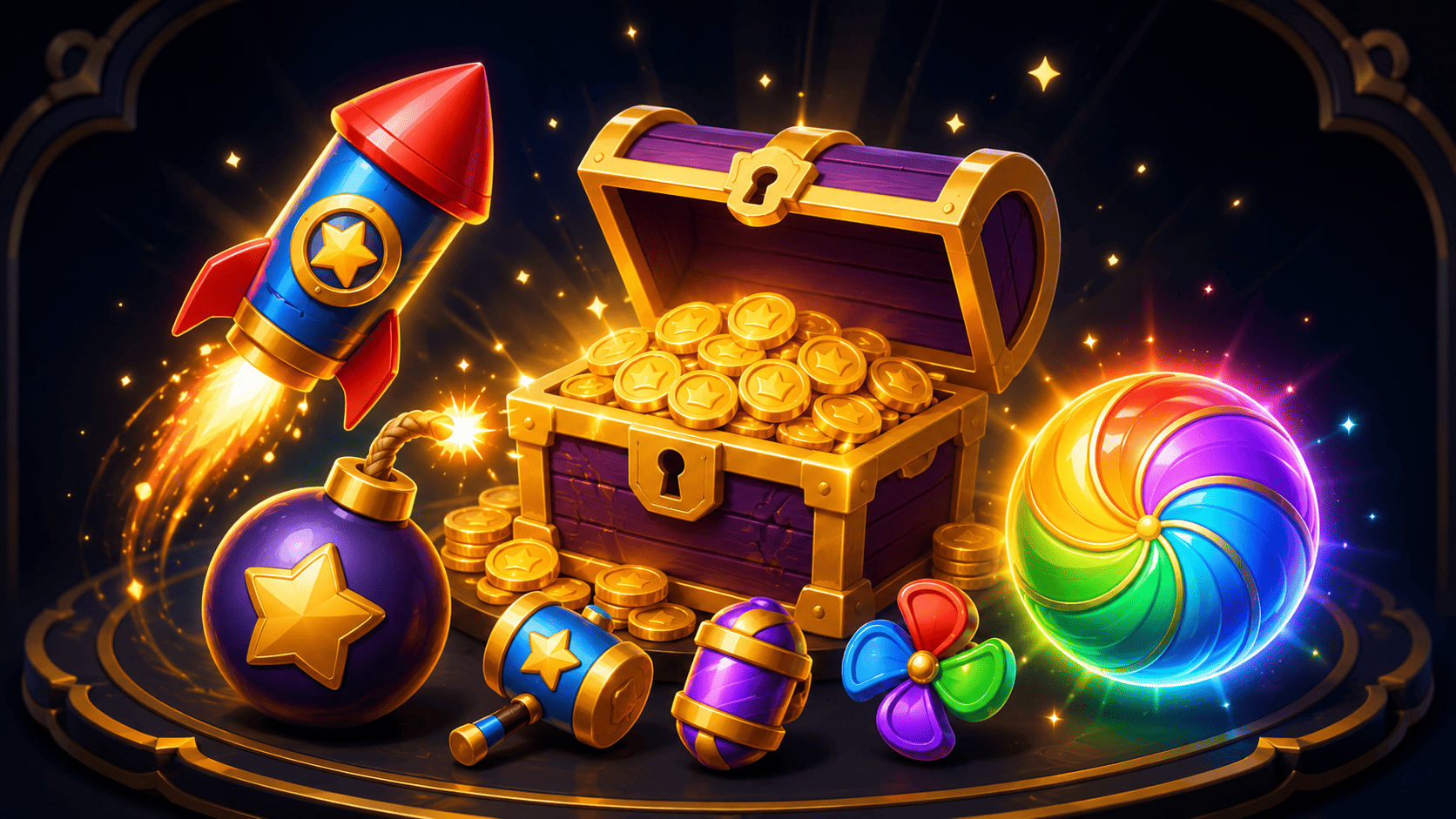
The core of match-3 IAP. Pre-level boosters (start with a rocket) and in-level rescues (+5 moves when you're one objective short). The near-miss moment is where the genre's billions are made. Typical price points: $0.99–$4.99 for move packs, with coins as the intermediate currency.
Segmented starter packs, "piggy bank" mechanics that accumulate value players unlock by paying, and remote-configured offers triggered by behavior (three consecutive fails → discounted booster bundle). Offer targeting is where the analytics stack pays for itself.
A monthly premium track ($4.99–$9.99) converting your most engaged non-spenders. Event participation feeds pass progress, tying LiveOps and monetization into one loop.
Should a New Title Copy the Zero-Ads Strategy?
Honest answer: probably not at launch. Royal Match can afford ad-free purity because a $2.8B company funds its UA. A new title without that war chest typically launches hybrid — IAP-first with optional rewarded video only (extra life, bonus booster), never forced interstitials. Rewarded video preserves the premium feel because the player always chooses the trade. As organic revenue scales, ads can be dialed down — several successful titles have removed ads entirely after establishing IAP momentum.
Match-3 Development Cost in 2026
Match-3 costs more than most casual genres because the meta-layer, content pipeline, and LiveOps tooling are inseparable from the product. Here's the realistic 2026 picture with an established outsourced studio (US/UK in-house adds 2–3x — see our outsourcing cost comparison):

Budget: $30,000 – $60,000
Includes: Full match-3 engine + power-ups, 8–10 obstacle types, 200–300 bot-validated levels, lives system + basic economy, simple meta (single area), soft-launch analytics.
Budget: $80,000 – $180,000
Includes: Complete decoration meta-layer, 1,500+ levels + weekly pipeline, 15–25 obstacle types, events/streaks/season pass, full IAP + offer targeting, remote config + A/B testing, 10-language localization.
Budget: $250,000 – $400,000+
Includes: Everything in Tier 02 plus teams/social layer, automated level-testing farm, ML-assisted difficulty tuning, narrative meta with characters, dedicated LiveOps team.
In this genre, development is the smaller line item. Competitive match-3 titles live or die on UA spend and LiveOps cadence. If your total budget is $100K, a leaner genre (like the arrow-puzzle category) offers better odds; if you can commit $250K+ including marketing, match-3's LTV ceiling is unmatched in casual.
Is Building a Game Like Royal Match Legal?
Matching three tiles, boosters, cascades, move limits, lives, decoration metas, star economies — game mechanics and rules are not copyrightable under US, UK, and EU law. The entire genre is built on shared mechanics: Royal Match itself iterates on Toon Blast and Homescapes conventions, as genre analysts have documented since its launch.
The name "Royal Match," King Robert as a character, Dream Games' art style and assets, its source code, specific level layouts, and its trade dress. Your title needs original characters, an original theme (your castle can't be their castle), original art, and original code.
Practically: the winning strategy isn't cloning anyway. Royal Match owns the castle-renovation lane and outspends everyone on UA. New entrants win with a differentiated theme and a mechanical twist — a fresh setting, a novel obstacle vocabulary, or a hybrid meta (the merge-meta wave led by titles like Gossip Harbor shows how much room the market leaves for variants).
Why Most Match-3 Clones Fail
A decoration layer with no economy design, no narrative beats, and no pacing reads as hollow within one session. Players in 2026 have zero tolerance — a D7 curve that never straightens is usually a meta problem, not a puzzle problem.
Testing levels by hand at scale is no longer viable. Without bot validation, difficulty spikes ship blind, churn points go undiagnosed, and the content pipeline can't sustain LiveOps velocity.
Launching with 300 levels and no pipeline means your best players run out of game in three weeks. A live match-3 that runs out of content churns — content production is a permanent operation, not a launch task.
Forced interstitials and aggressive paywalls make a puzzle game feel like "a slot machine wearing a puzzle costume" — a phrase reviewers genuinely use. It destroys the premium feel that IAP conversion depends on.
Industry analysts are blunt about this: generalist studios with great artists and coders often lack the granular math, behavioral psychology, and churn-point balancing that puzzle games require. Genre-specific production experience isn't a nice-to-have in match-3 — it's the difference between the tiers above succeeding or burning.
How Raijin Builds Match-3 Games
At Raijin Studio, match-3 and casual puzzle development sits at the center of our mobile practice. Our production approach is built around the exact systems this guide describes: a deterministic Unity board engine designed headless-first for bot-driven level validation, procedural level generation pipelines with quality-gate filtering (the same methodology behind our arrow-puzzle work), meta-layer economy design treated as a first-class system from the GDD stage, and remote-configured LiveOps tooling so your game evolves without client updates.
- Genre-specific level design capability — difficulty rhythm engineering, churn-point diagnosis, and content pipelines that sustain weekly drops.
- Full-cycle delivery — game design, art, Unity engineering, QA, store launch, and post-launch LiveOps under one roof.
- 50–70% cost advantage vs US/UK studios — the tier budgets above, with production maturity to match.
- IP protection built in — mutual NDAs upfront, full work-for-hire IP assignment, secure development practices.


Building a
Match-3 Game?
Get a free 60-minute consultation with our puzzle team. We'll review your concept, pressure-test the meta-layer design, and give you a custom quote — under NDA.
Frequently Asked Questions
How much does it cost to develop a match-3 game like Royal Match?
A match-3 MVP with 200–300 levels costs $30,000–$60,000. A production-grade release with a meta-layer, 1,500+ levels, and full LiveOps tooling costs $80,000–$180,000. A premium platform aiming at Royal Match-level polish with automated level testing, deep meta systems, and ongoing content pipelines runs $250,000–$400,000+. Costs assume outsourced development with established studios; US/UK in-house teams add 2–3x.
How long does it take to build a match-3 game?
An MVP takes 8–12 weeks. A production release with meta-layer and LiveOps systems takes 16–24 weeks. Reaching content maturity (2,000+ tested levels, seasonal events, live economy) is an ongoing effort of 6–12 months post-launch. Match-3 games are live products, not one-time builds.
Why is Royal Match so successful?
Five compounding factors: frictionless pure-puzzle onboarding, a decoration meta-layer that gives matches long-term purpose, mathematically tuned difficulty curves, an ad-free premium experience monetized entirely through in-app purchases, and relentless polish. It has earned over $3 billion in lifetime revenue with 300 million installs, and out-earns Candy Crush Saga with roughly half the monthly active users.
What engine is best for match-3 game development?
Unity is the industry standard — Royal Match itself runs on Unity. Its 2D toolchain, tweening ecosystem, and mobile optimization make it ideal for cascade-heavy puzzle games. The critical engineering work is the board simulation engine: a deterministic, headless-runnable match-3 core that supports automated level testing with bots.
Should a match-3 game use ads or in-app purchases?
Top-grossing match-3 games monetize primarily through in-app purchases — Royal Match famously runs zero ads. However, for new titles without massive UA budgets, a hybrid model (IAP-first plus optional rewarded video) typically maximizes early revenue. The key rule: never interrupt the core loop with forced interstitials in a match-3 aimed at long-term retention.
Is it legal to make a game like Royal Match?
Yes. Game mechanics and rules — matching three tiles, boosters, cascades, level objectives, decoration meta-layers — are not copyrightable under US, UK, and EU law. What you cannot copy is Royal Match's name, art, characters, source code, or specific level layouts. Your game must be original in execution while building on proven genre mechanics — which is exactly how the match-3 category has always evolved.