
The most downloaded mobile game in the world right now isn't a battle royale, an RPG, or a billion-dollar franchise. It's an 8×8 grid, three block pieces, and one rule — built by Hungry Studio, a Chinese developer founded in 2021 that almost nobody in the industry had heard of three years ago.
Block Blast! was the most downloaded mobile game on Earth in 2024, 2025, and every month of Q1 2026, according to AppMagic and Sensor Tower. It has crossed 870 million lifetime downloads, reaches 70 million daily active users, and generates an estimated $584,000 per day. And here's the part that breaks most publishers' mental models: its lifetime in-app purchase revenue is roughly $66,000 — total. Not per day. Ever. The entire business runs on advertising.
If Royal Match (which we broke down in our match-3 development guide) is the perfect IAP machine, Block Blast is its exact opposite: the perfect in-app advertising machine. Two games, two opposite monetization poles, both printing money at the top of the same genre. This guide breaks down how Block Blast works mechanically, why it retains at freakish scale, what its ad-first economics actually look like — and how to build a competitive block puzzle of your own in 2026.
870M+ lifetime downloads
70M daily active users · 300M monthly active users
$17.5M estimated monthly revenue
~$66K lifetime IAP — total, ever (the rest is 100% ads)
What Is Block Blast — and Why It's Not Tetris
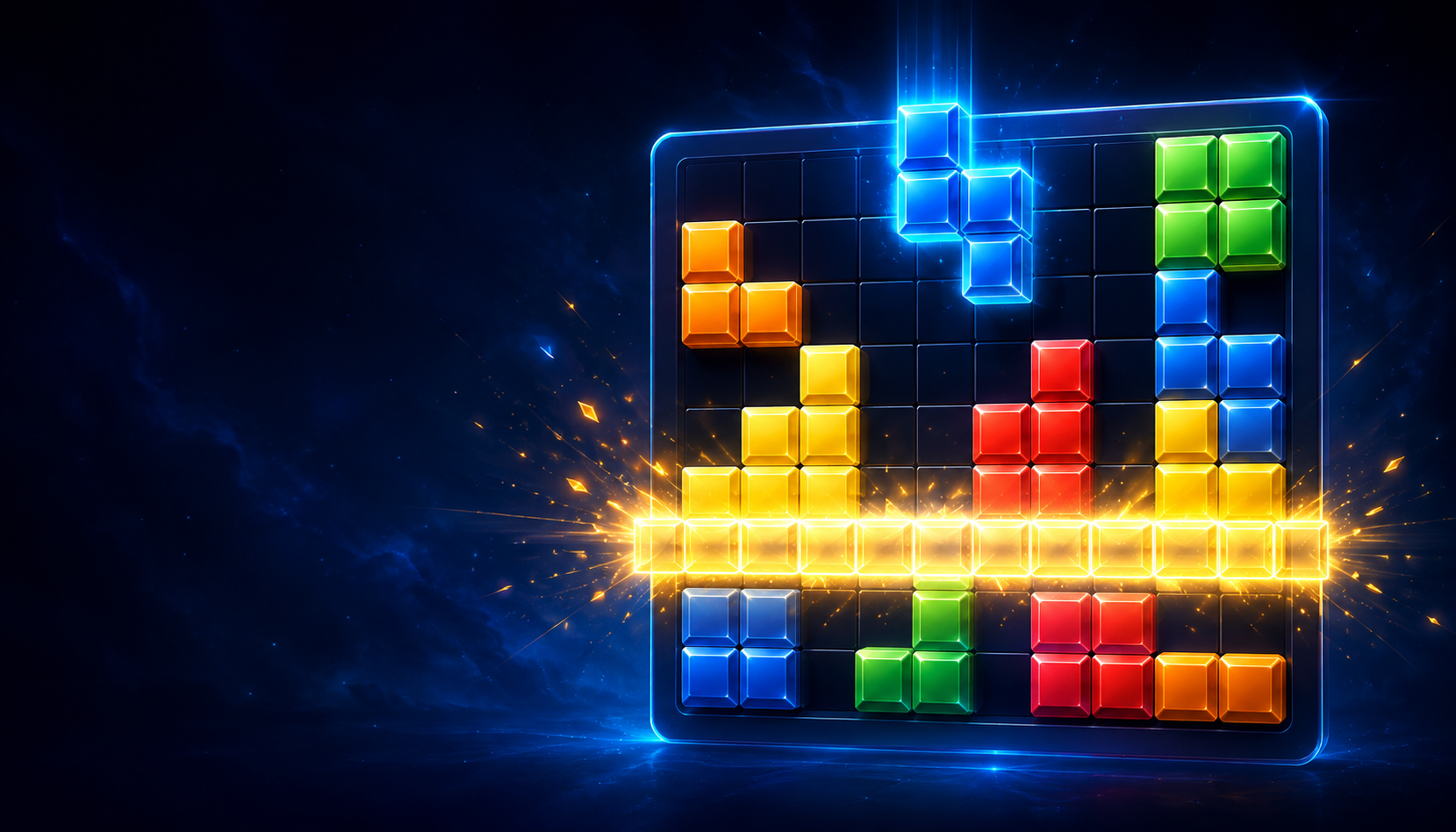
Block Blast! is a free block puzzle game released by Hungry Studio in 2022. Players drag one of three offered block pieces onto an 8×8 grid; filling any complete row or column clears it. When none of the three offered pieces fits anywhere on the board, the game ends. Your only opponent is your own high score.
The comparison everyone reaches for is Tetris — Hungry Studio has even leaned into that confusion in its ads. But mechanically, Block Blast inverts almost every Tetris rule, and understanding the inversion is understanding why it works on mobile:
- No gravity. Pieces don't fall. The player places them anywhere with a drag — turning a reflex game into a planning game.
- No timer. Zero time pressure. Sessions are calm, which is exactly what the 2026 stress-relief gaming audience wants.
- Rows AND columns clear. Tetris clears horizontal lines only; Block Blast clears both axes simultaneously, enabling spectacular multi-line combo moments.
- Choice of three pieces. Instead of reacting to one falling piece, the player sequences three known pieces — a mini logistics puzzle every turn.
- Fail state is spatial, not temporal. You lose when you run out of room, not time. Every game-over feels self-inflicted — "I placed that badly" — which drives immediate restarts.
Why Block Blast Works (The Real Reasons)
One drag gesture. Rules understood in five seconds by an eight-year-old or an eighty-year-old, in any language, with zero tutorial. That's why it scales across 200+ countries and why India, Indonesia, Brazil, and Vietnam — the world's download engines — adopted it as readily as the US and Japan. Accessibility is distribution.
Hungry Studio reportedly ran around 25,000 A/B tests in 2025 alone, nearly all focused on retention. Piece timing, feedback copy, ad pacing, color tuning, difficulty pulses — everything is experimentally optimized. Block Blast isn't a lucky hit; it's the most heavily instrumented casual game ever shipped. This is the operational lesson most clones ignore entirely.
The game predicts player behavior and adjusts difficulty to stay just hard enough — challenging without tipping into frustration. Piece generation isn't purely random; it's a tuned system responding to board state and player skill. This invisible system is Block Blast's real moat, and we break down how to engineer it in the next section.
"Unbelievable!" "Perfect!" — escalating praise copy, screen-shake, haptic buzzes, and combo celebrations fire on every good move. Studies consistently link these micro-reward prompts to longer play sessions. Block Blast strips out everything else (no meta, no social, no leaderboards) and concentrates its entire polish budget on the feel of a single placement.
Where Royal Match built a castle meta and match-3 rivals stack events on events, Block Blast bet the opposite way: no meta at all. No lives, no progression walls, no social obligations — instant restart forever. For the enormous audience that plays to decompress, the absence of systems is the retention feature. It also makes the game radically cheaper to build and operate — which is exactly why the pure-ads model can be profitable.
Core Mechanics — Engineering Breakdown
The Turn Loop
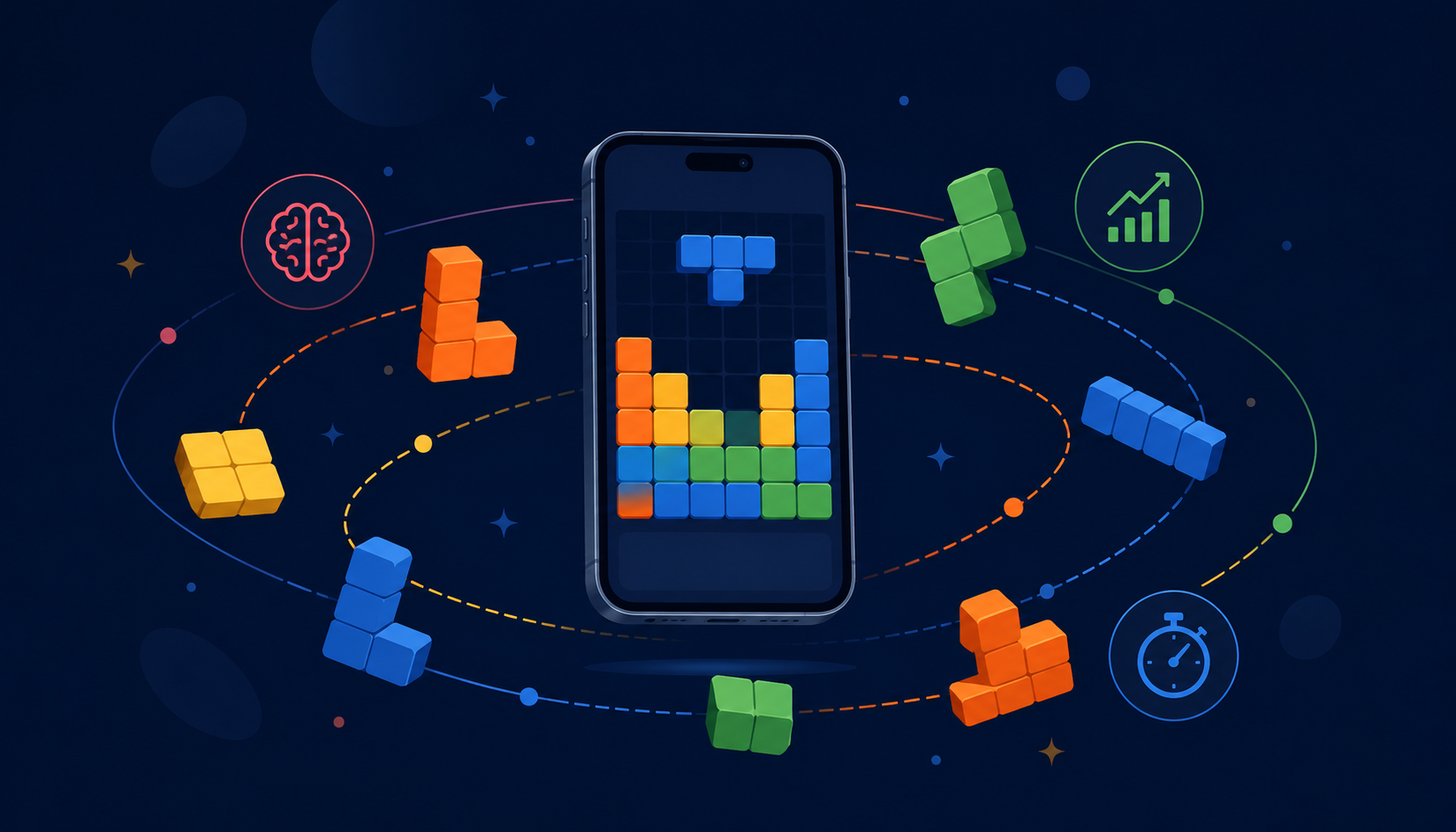
- Deal — Three pieces appear in the tray, drawn from a library of ~30 shapes (1×1 up to 3×3 squares, lines, Ls, Ts, corners).
- Drag & preview — As the player drags, the board live-highlights the landing cells and glows any row/column the placement would complete. This preview is the single most important piece of UX in the genre — it converts guesswork into planning.
- Place — The piece locks in. Placement is valid anywhere the shape fits over empty cells.
- Clear check — Every full row and full column clears simultaneously. Multi-line clears trigger escalating combo celebrations and score multipliers; consecutive-turn clears build streaks.
- Refill — When all three tray pieces are used, three new ones are dealt.
- Game over check — If no remaining tray piece fits anywhere on the board, the run ends. Score, best-score comparison, restart.
  1 · DRAG THE PIECE       2 · ROW CLEARS         3 · COMBO FEEDBACK
  ┌───┬───┬───┬───┐       ┌───┬───┬───┬───┐      ┌───┬───┬───┬───┐
  │   │   │   │   │       │   │   │   │   │      │   │   │   │   │
  ├───┼───┼───┼───┤       ├───┼───┼───┼───┤      ├───┼───┼───┼───┤
  │ ▓ │ ▓ │ ░ │ ░ │ ────▶ │ ✦ CLEARED ✦   │ ───▶ │  "Unbelievable!" │
  ├───┼───┼───┼───┤       ├───┼───┼───┼───┤      │  COMBO ×3  +240   │
  │   │   │   │   │       │   │   │   │   │      │  haptic + shake   │
  └───┴───┴───┴───┘       └───┴───┴───┴───┘      └───┴───┴───┴───┘
   place, filling row      full line vanishes     praise + score pop

  Preview → clear → celebration. Three beats, endlessly repeatable, one-thumb.
The Scoring & Combo System
Scoring rewards efficiency and streaks: base points per cell placed, multipliers for multi-line clears (a simultaneous row + column clear is the genre's signature dopamine spike), and streak bonuses for clearing on consecutive placements. Because the high score is the only progression, score math isthe game economy — tune it so a casual session ends around a "so close to my best" number. Near-misses drive restarts here exactly the way they drive booster purchases in match-3.
The Adaptive Difficulty Engine (The Secret Sauce)
Here's what separates Block Blast from the hundred forgettable block puzzles that preceded it: piece generation is not random. The game reads the board and the player, then deals pieces calibrated to keep the session in the flow channel — hard enough to feel earned, never so hard it feels rigged.
A production-grade adaptive dealer works roughly like this:
// Adaptive piece dealer — the invisible system behind the retention
public Piece[] DealTray(BoardState board, PlayerProfile player) {
    float pressure = BoardPressure(board);   // 0 = open, 1 = nearly full
    float skill    = player.rollingSkill;    // EMA of recent performance

    // Weight the piece library: cramped board + average skill
    // → raise odds of small/rescuing shapes; open board + high
    // skill → deal awkward shapes to create tension
    var weights = BaseWeights()
        .BiasSmallPieces(pressure * (1f - skill) * rescueFactor)
        .BiasAwkwardPieces((1f - pressure) * skill * tensionFactor);

    // Guardrail: never deal a tray with zero legal placements
    // unless the board is genuinely unsalvageable
    Piece[] tray = WeightedDraw(weights, count: 3);
    if (!AnyPlacementExists(board, tray) && Salvageable(board))
        return DealTray(board, player);   // re-roll

    return tray;
}
Every constant in that system — the rescue factor, the tension factor, the skill decay rate — is an A/B testing surface. This is what "25,000 experiments a year" actually means in practice: thousands of tiny adjustments to one invisible dealer, each measured against D1/D7 retention and session length. Build this system remote-configurable from day one, or you'll be shipping app updates to tune a number.
Players sense manipulation. The dealer's job is to shape the distribution of challenge, never to guarantee failure — a game that visibly deals unwinnable trays gets review-bombed. Keep a hard guardrail (as above) and test perception, not just retention: "this game is rigged" complaints in reviews are a leading indicator of churn.
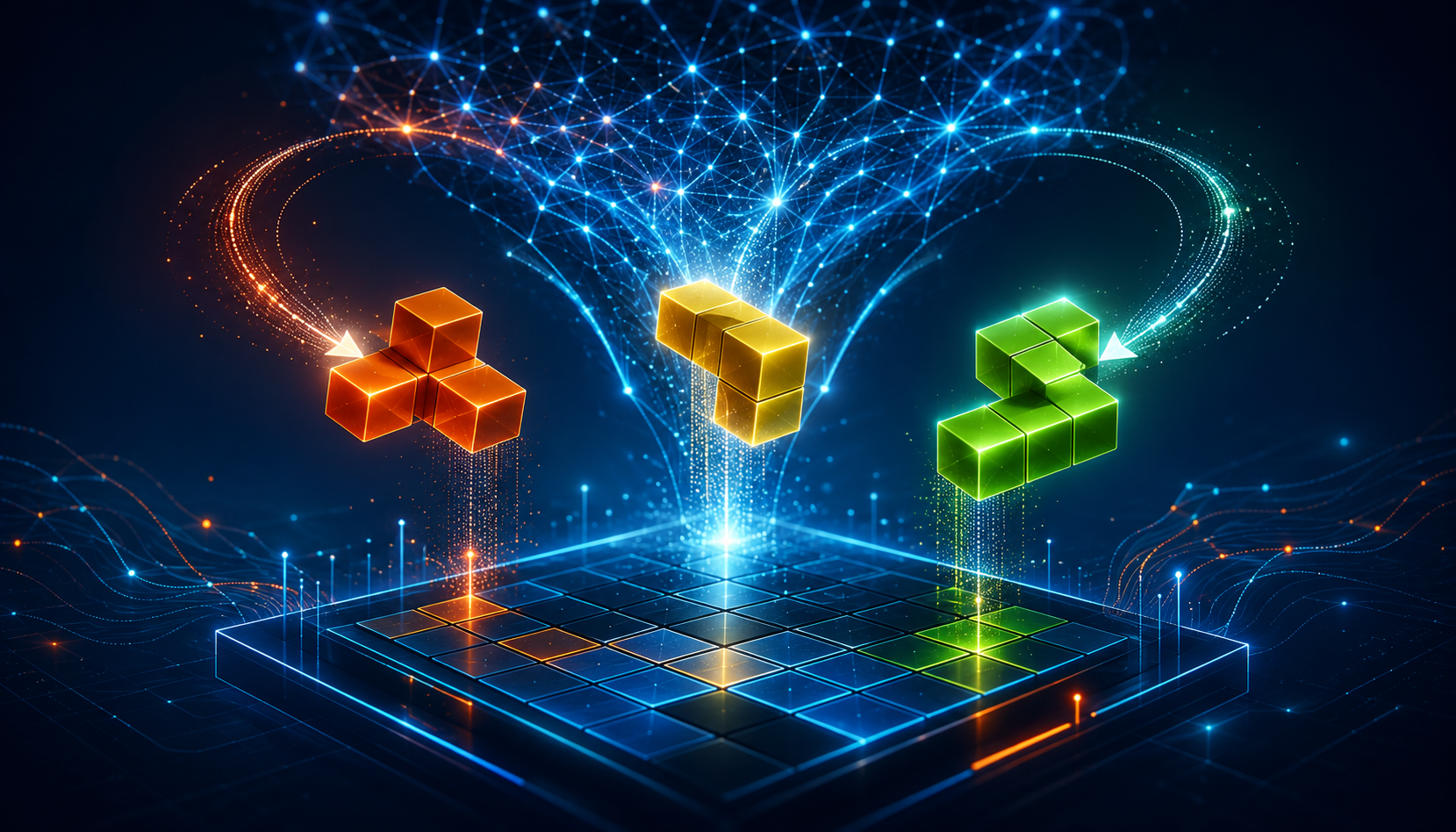
Feature Set: What to Build for Parity
Core (non-negotiable)
- 8×8 grid engine with drag placement, live landing preview, and row+column clear highlighting.
- ~30-shape piece library with the weighted adaptive dealer above.
- Score, combo, and streak system with escalating celebration feedback (praise copy, haptics, particles).
- Best-score persistence and instant restart — the entire progression loop.
- Full offline play. Block Blast's offline mode is part of its commute-and-flight ubiquity.
Modes & LiveOps
- Adventure/journey mode — objective-based levels layered on the same engine, adding light progression for players who want goals.
- Seasonal events — Block Blast runs themed events (a 21-day Space Rocket puzzle marathon, a Japan Sakura Festival with team competition) that refresh visuals and give lapsed players a re-entry hook without touching the core.
- Daily challenges & streaks — one special board per day; the cheapest DAU lever in the genre.
Infrastructure
- Ad mediation with waterfall/bidding optimization — this is your revenue engine; treat it as a core system, not an SDK checkbox.
- Remote config on every tunable — dealer constants, ad pacing, celebration thresholds.
- Analytics + experimentation pipeline — per-session funnels, ad-interaction tracking, and an A/B framework you'll actually use weekly.
Tech Stack & Architecture
The recommended stack: Unity 2022 LTS or Unity 6, C# for a deterministic grid core, DOTween for clear/combo animation, Firebase Analytics + Remote Config, AppsFlyer for attribution, Unity LevelPlay / AdMob / AppLovin MAX for ad mediation, and native haptics on both platforms — all in a sub-60MB, fully offline-capable build.
Architecturally this is the leanest genre we build — seven systems: grid engine, piece dealer, input/drag controller, score+combo manager, feedback/celebration layer, monetization layer, and analytics. The grid core should be pure C# with no Unity dependencies (the same principle as our match-3 board engine): deterministic and headless-runnable, so you can bot-simulate millions of games to tune the dealer's constants before a single human playtests them. A weekend of simulation replaces months of guesswork.
Board state fits in a single 64-bit integer (one bit per cell), which makes placement checks, line detection, and game-over scans bitwise operations — effectively free even on low-end Android devices in emerging markets, where a huge share of this genre's downloads live.
Monetization: The Pure-IAA Money Machine
This is the section where Block Blast rewrites publisher intuition. The game earns an estimated $584K/day (~$17.5M/month, ~$210M/year run-rate) with a lifetime IAP total of about $66K. On Black Friday 2025 alone — the biggest day in mobile advertising — it served roughly 55 million DAU and generated an estimated $1.8 million in ad revenue in a single day. The playbook:
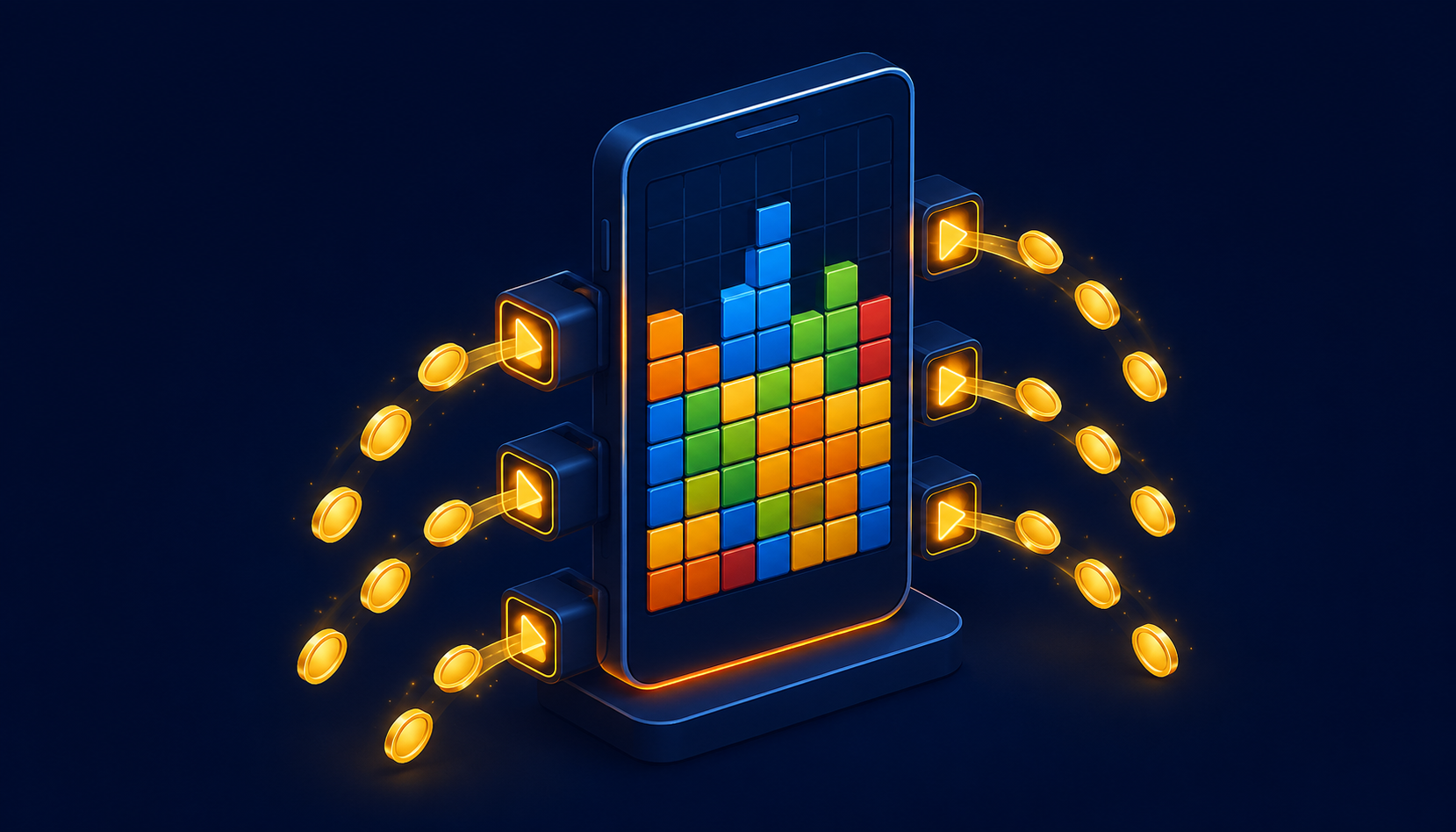
Occasional interstitials between games plus a single rewarded ad placement. That's the entire surface. The discipline is the strategy: fewer, better-paced placements protect the retention that generates billions of impressions over a player's lifetime. Hungry Studio also reportedly maintains one of the largest advertiser block-lists in mobile — protecting session quality even at the cost of eCPM.
The math only works at volume: tens of millions of DAU × several sessions daily × a handful of impressions per session. IAA games run 15–30% operating margins — thin next to IAP games — but with near-zero content costs (no levels to author, no meta to operate), the absolute profit at scale is enormous. This is a distribution-first business model: UA efficiency and retention are the whole game.
Short sessions and frequent, self-inflicted game-overs create natural, low-resentment ad breaks — the player was stopping anyway. Contrast that with interrupting a match-3 level mid-solve. The genre's structure is what makes the monetization tolerable; you can't bolt this ad load onto a long-session game.
Pure IAA is right if you're targeting broad, high-volume markets and can operate disciplined UA. If your reach will be smaller, run hybrid: keep Block Blast's ad pacing but add light IAP (remove-ads at $3.99–$5.99, a booster or undo). Hybrid monetization is the 2026 default precisely because it hedges both curves — see the revenue-model comparison in our mobile game cost guide.
Development Cost in 2026
Block puzzles are the most capital-efficient serious genre in mobile — no hand-authored levels, no meta economy, systemic content. Realistic budgets with an established outsourced studio (US/UK in-house adds 2–3x; full comparison in our outsourcing guide):
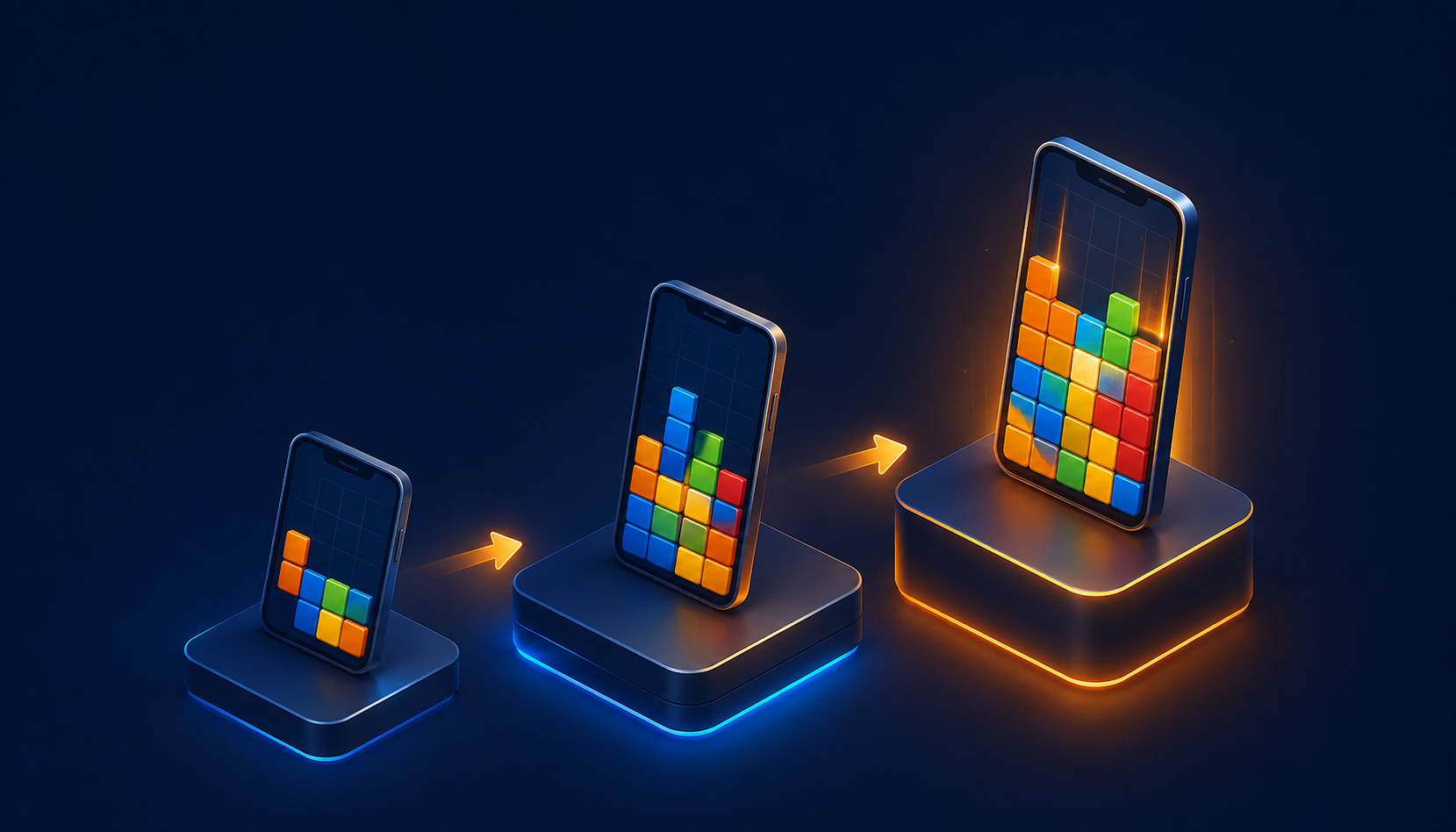
Budget: $12,000 – $25,000
Includes: Full 8×8 engine + drag preview, 30-shape piece library, score/combo/streak system, basic weighted dealer, ad SDK + basic analytics, iOS + Android with offline play.
Budget: $30,000 – $70,000
Includes: Adaptive difficulty dealer (remote-tuned), bot-simulation tuning pipeline, full celebration/juice layer, adventure mode + daily challenge, full ad mediation + hybrid IAP, A/B testing framework, 10-language localization.
Budget: $80,000 – $120,000+
Includes: Everything in Tier 02 plus ML-driven difficulty & churn prediction, seasonal event system + themes, team events & tournaments, advanced ad waterfall optimization, ongoing LiveOps retainer.
Note the inversion versus match-3: a competitive match-3 needs $80K+ just to enter, while a genuinely competitive block puzzle ships at half that. The catch is on the other side of launch — in a pure-IAA genre, your marketing budget should typically exceed your development budget, because distribution is the business model.
Is It Legal? (Yes — With One Big Caveat)
Grid placement, line clearing, piece trays, combo scoring, adaptive dealing — game mechanics and rules are not copyrightable under US, UK, and EU law. The block puzzle category contains hundreds of legitimate titles built on these shared mechanics, Block Blast itself among them.
You cannot use the Block Blast name, its specific art, color identity, source code, or trade dress. And one warning bigger than all of those: The Tetris Company litigates aggressively — and has won on trade-dress grounds — against games that copy Tetris's distinctive visual identity or invoke its name in marketing. Never call your game "like Tetris," never mimic the seven-tetromino visual language, never use the word in your ASO. Block Blast's own Tetris-flavored ad creatives are a risk they chose to carry; don't inherit it.
The commercially smart move is differentiation anyway: a distinct theme (wood, neon, gems, seasonal), a mechanical twist (hexagonal grids, special block types, dual boards), or a hybrid mode. The category rewards fresh skins on proven bones — that's how it has always grown.
Why Most Block Puzzle Clones Fail
Pure RNG dealing produces unfair-feeling losing streaks and boring easy runs. The adaptive dealer isn't optional polish — it's the difference between 2-day and 60-day retention. Most clones skip it because it's invisible; that's precisely why they die.
Copying Block Blast's revenue without copying its restraint. An interstitial after every game-over in a genre with 90-second sessions is an uninstall generator. Even the leader takes review criticism for interstitial length — the pacing ceiling is real.
Shipping mechanically identical gameplay with flat feedback. In a genre where the mechanic is a commodity, the celebration layer — praise copy, haptics, particles, sound — is the product. Clones that "work fine" but feel dead retain nobody.
Launching without an A/B framework and treating v1.0 as done. The category leader runs tens of thousands of tests a year. You don't need 25,000 — but you need the pipeline, and a weekly cadence of shipping measured changes.
Spending the whole budget on the build in a genre where the game is cheap and the audience is expensive. If there's no UA plan and no creative-testing budget, a block puzzle — however good — launches into silence.
How Raijin Builds Block Puzzle Games
Block and grid puzzles sit at the heart of Raijin Studio's casual practice — it's the same engineering DNA behind our arrow puzzle and match-3 work: deterministic, headless-first grid engines built for bot simulation, weighted generation systems tuned against millions of simulated games, remote-configured difficulty and ad pacing, and celebration layers built with the juice discipline this genre demands.
- Genre-proven pipeline — grid engines, adaptive dealers, and simulation tuning we've built before, not learned on your budget.
- Monetization engineering — full mediation setup, pacing experiments, and hybrid IAA/IAP structures designed around retention math.
- Full-cycle delivery — design, art, Unity engineering, QA, store launch, and LiveOps under one roof, at 50–70% below US/UK cost.
- IP protection standard — mutual NDA upfront, full work-for-hire assignment, and trademark-safe differentiation guidance baked into design.


Building a
Block Puzzle Game?
Get a free 60-minute consultation with our puzzle team. We'll pressure-test your differentiation, map the ad-revenue model to your UA plan, and give you a custom quote — under NDA.
Frequently Asked Questions
How much does it cost to develop a game like Block Blast?
A block puzzle MVP costs $12,000–$25,000 and takes 4–6 weeks. A production-grade release with adaptive difficulty, full ad mediation, and analytics costs $30,000–$70,000 over 8–12 weeks. A premium build with ML-driven difficulty tuning, LiveOps events, and a large-scale A/B testing framework runs $80,000–$120,000+. Block puzzles are among the most cost-efficient genres to enter because the content is systemic rather than hand-authored.
How does Block Blast make money with no in-app purchases?
Almost entirely through in-app advertising — interstitials between games and a single rewarded ad placement. Lifetime IAP revenue is only around $66,000, yet the game generates an estimated $584,000 per day (~$17.5 million per month) by serving billions of impressions to roughly 70 million daily active users. It's the textbook IAA playbook executed at unprecedented scale.
Why is Block Blast so popular?
It was the world's most downloaded mobile game in 2024, 2025, and Q1 2026. The drivers: a one-thumb drag–match–clear mechanic anyone grasps instantly, an adaptive difficulty system that keeps play challenging but never frustrating, deliberate minimalism (no meta, no timers, no social pressure), dopamine-rich feedback on every move, and relentless optimization — reportedly around 25,000 A/B tests in 2025 alone.
What's the difference between Block Blast and Tetris?
No gravity, no falling pieces, no timer. Players freely drag one of three offered pieces anywhere on a static 8×8 grid, and both full rows AND full columns clear simultaneously. The game ends only when no offered piece fits — making it a spatial planning puzzle rather than a reflex game.
What tech stack is used to build a game like Block Blast?
Unity (2022 LTS or Unity 6) with C#. Core components: a deterministic 8×8 grid engine (board state fits in a single 64-bit integer), a weighted adaptive piece dealer, DOTween for clear animations, Firebase for analytics and remote config, and an ad mediation stack (Unity LevelPlay, AdMob, or AppLovin MAX) as the revenue engine. The whole game ships under 60MB and runs fully offline.
Is it legal to make a game like Block Blast?
Yes — grid-placement and line-clear mechanics are not copyrightable, and the category holds hundreds of legitimate variants. You cannot copy the Block Blast name, art, code, or trade dress. One extra caution: The Tetris Company aggressively protects Tetris trademarks and trade dress, so avoid Tetris branding, its distinctive visual identity, and any Tetris references in your marketing or ASO.