
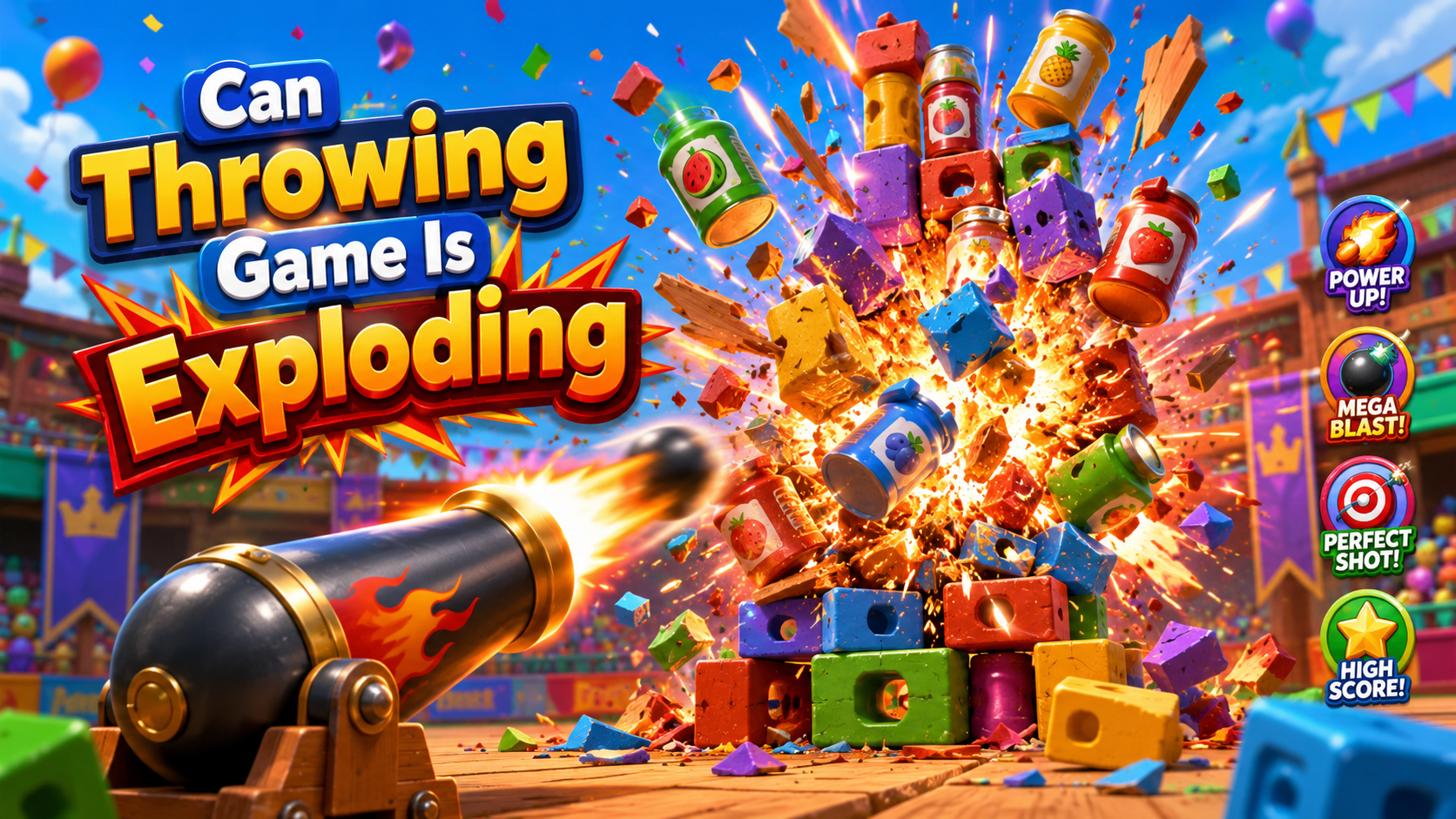
There's a certain kind of mobile game you've probably seen explode across your feed lately: a cannon points at a tower of bricks, glass, or stacked jars. You tap. The projectile flies, connects, and the whole structure erupts — pieces flying, debris tumbling, dust and sparks everywhere, a deeply satisfying crunch. Then you do it again. And again.
These are smash games — physics-based destruction titles — and they're one of the fastest-rising genres of 2026. The breakout example, Smash Fest! by Turkish studio Flow Games, launched in December 2025 and within months racked up a 4.7-star rating from nearly 200,000 reviews, with a full hybrid monetization model and weekly updates keeping it climbing. And it's far from alone — a whole wave of cannon-smash and destruction titles is riding the same surge.
So what's actually going on here? Why are these simple-looking games so wildly popular, why is every casual studio suddenly building one, and — if you're a publisher or founder — how would you make your own? Let's break it all down.
4.7★ Smash Fest rating · ~200K reviews in months
4–7x hybrid ARPDAU vs pure hypercasual
$1.99 → $99.99 IAP ladder · weekly update cadence
What Exactly Is a Smash Game?
A smash game is a physics-based mobile game built around one irresistible action: destroy something, and make the destruction feel amazing. The player fires a projectile — a cannonball, a ball, a swipe-launched object — at a structure made of destructible pieces, and physics does the rest: things topple, shatter, scatter, and chain-react.
Using Smash Fest as the reference point, the formula looks like this:
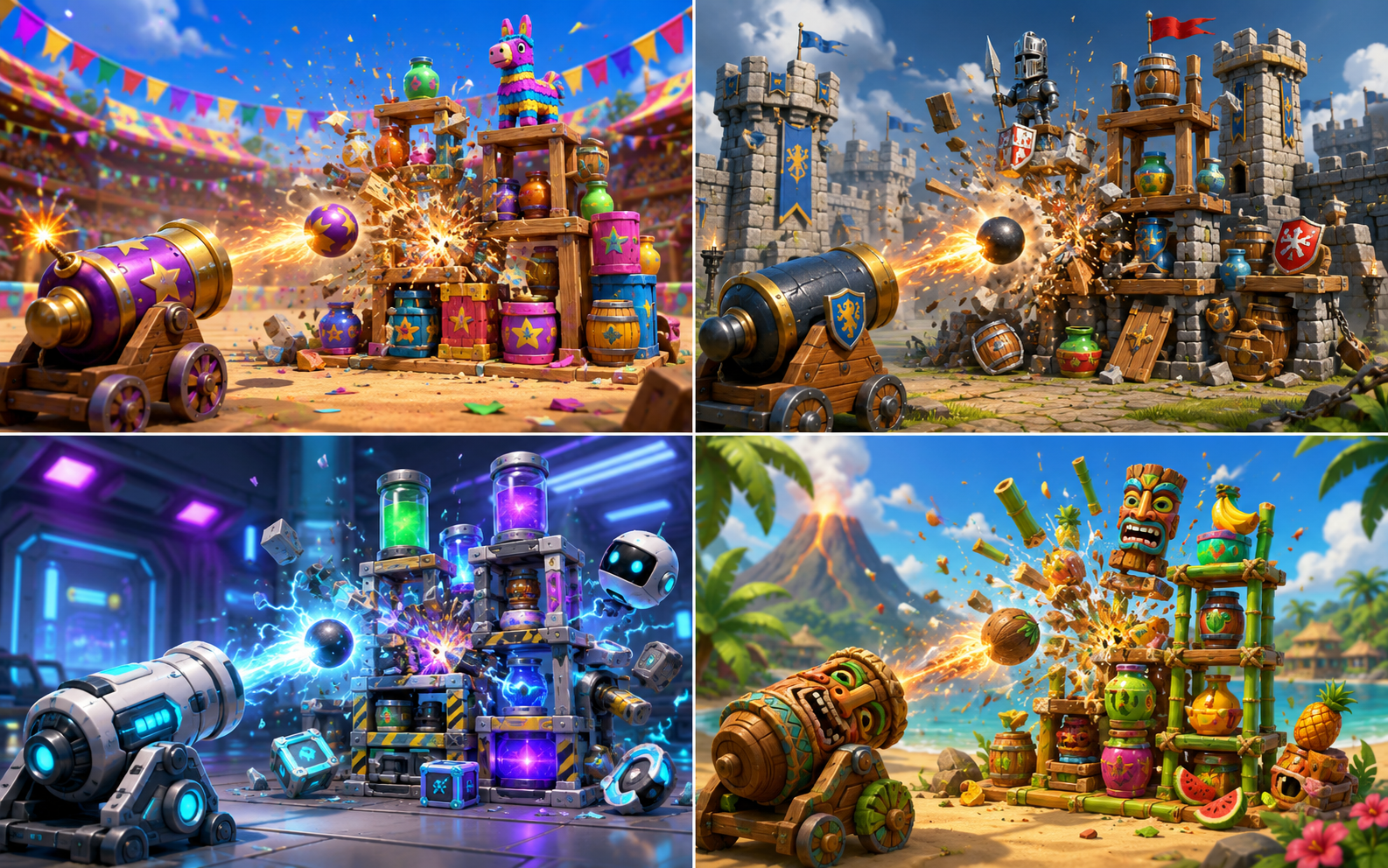
The genre has deep roots — it descends from the physics-projectile lineage of Angry Birds and the "oddly satisfying" destruction-video culture of social media. What's new in 2026 is the fusion of that satisfying destruction with hybrid-casual depth: progression, upgrades, events, and monetization layered on top of the pure smash. That combination is what turned a fun toy into a genre publishers can build a business on.
Why Smash Games Are Booming in 2026
Genres don't blow up by accident. Several forces converged to make smash games one of the year's hottest categories:
A smash game is the most screenshot-and-share-able genre imaginable. A 5-second clip of a tower exploding is perfect TikTok and Reels fuel — it's visually loud, instantly satisfying, and needs no explanation. This makes organic and paid creative cheap and effective, which is the single biggest lever in mobile UA. Games that are naturally shareable have a structural marketing advantage.
"Point at the thing, break the thing" is understood by everyone on Earth in one second — no language, no tutorial, no learning curve. That universality is why these games scale across every market and age group, from casual players in the US to first-time mobile gamers in emerging markets.
Smash games arrived exactly as hybrid-casual became the dominant profitable model. Hybrid titles earn 4–7x higher revenue per user than pure hypercasual by layering IAP and progression onto a simple hook. Smash Fest's stack — a no-ads unlock plus a coin-package ladder from $1.99 to $99.99, alongside ads — is textbook. The genre isn't just popular; it monetizes.
The core loop is simple enough to prototype quickly, so studios can test a smash concept, validate the feel, and start running ad creative fast. In a market where finding the right hook cheaply is everything, a genre that's quick to prototype and naturally viral is exactly what publishers want to bet on.
The Psychology: Why They're So Addictive
This is the heart of it. Smash games aren't addictive by accident — they're a near-perfect delivery system for the brain's reward chemistry. Here's exactly what's happening when someone can't put one down:
One tiny tap produces an enormous sensory payoff — an explosion of motion, sound, and color. The brain registers this as a huge win for almost no effort, releasing a hit of dopamine. That lopsided effort-to-reward ratio is the foundation of the compulsion: it feels great, and it's almost free to trigger again.
No two smashes are identical. Physics makes every shot slightly unpredictable — sometimes a piece clips just right and the whole tower comes down in a glorious chain reaction. This variable reward is the same mechanism that makes slot machines compelling: the uncertainty of how good the next smash will be keeps you firing "just one more."
You knock down 90% of the structure, and one stubborn piece survives. That near-miss is maddening in the best way — it creates an itch to immediately retry and get the perfect clear. Near-miss psychology is one of the most powerful re-engagement triggers in all of game design, and smash games generate it naturally on almost every level.
Screen shake, particle bursts, debris physics, layered impact sounds, haptic buzzes, slow-mo on big hits, escalating "SMASH!" praise text — this is called game juice, and it's what separates a satisfying smash from a flat one. The gameplay could be identical, but the juiced version feels ten times better and retains players who'd bounce off the dull one. In this genre, juice is the product.
Breaking things is cathartic. Destruction games tap a genuine emotional release — a safe, satisfying outlet that pairs perfectly with the calm, low-pressure sessions today's players seek to decompress. Many players describe these games as weirdly relaxing, which is exactly why they reach for them again during idle moments.
The mechanic is the easy part. The addiction lives in the feel — the juice, the variable reward, the near-miss tuning, the effort-to-payoff ratio. A smash game that nails the physics but skimps on feedback is just a physics demo. A smash game that obsesses over feel becomes something players open fifteen times a day. That's the whole game.
Anatomy of a Great Smash Game
Break a top smash game into its parts and you get a clear build checklist. Here's what actually makes one work:
               WHAT MAKES A SMASH GAME WORK

                       Physics
                     destruction
                          │
        Aim & skill ──────┤────── Game juice
                          │
                 ┌──────────────────┐
                 │  SATISFYING SMASH │
                 └──────────────────┘
                          │
     Upgrades & power ────┤──── Progression & levels
                          │
                      Combos
                    & scoring

   A satisfying smash at the center — everything else exists
to amplify and extend that one feeling.- Physics-based destruction — Structures that break, topple, and scatter believably. The realism (or stylized exaggeration) of the destruction is the core appeal.
- Aim & skill layer — Angle, power, and timing give players agency and a skill ceiling, turning random tapping into mastery. This is what separates a smash game from a smash toy.
- Game juice — Particles, screen shake, haptics, sound, slow-mo. The single biggest driver of "feel," and where the most tuning time goes.
- Combos & scoring — Chain reactions and multi-hit combos that reward a single perfect shot with escalating payoff and celebration.
- Progression & levels — A steady stream of new structures, materials, and challenges that keep the core loop fresh across hundreds of levels.
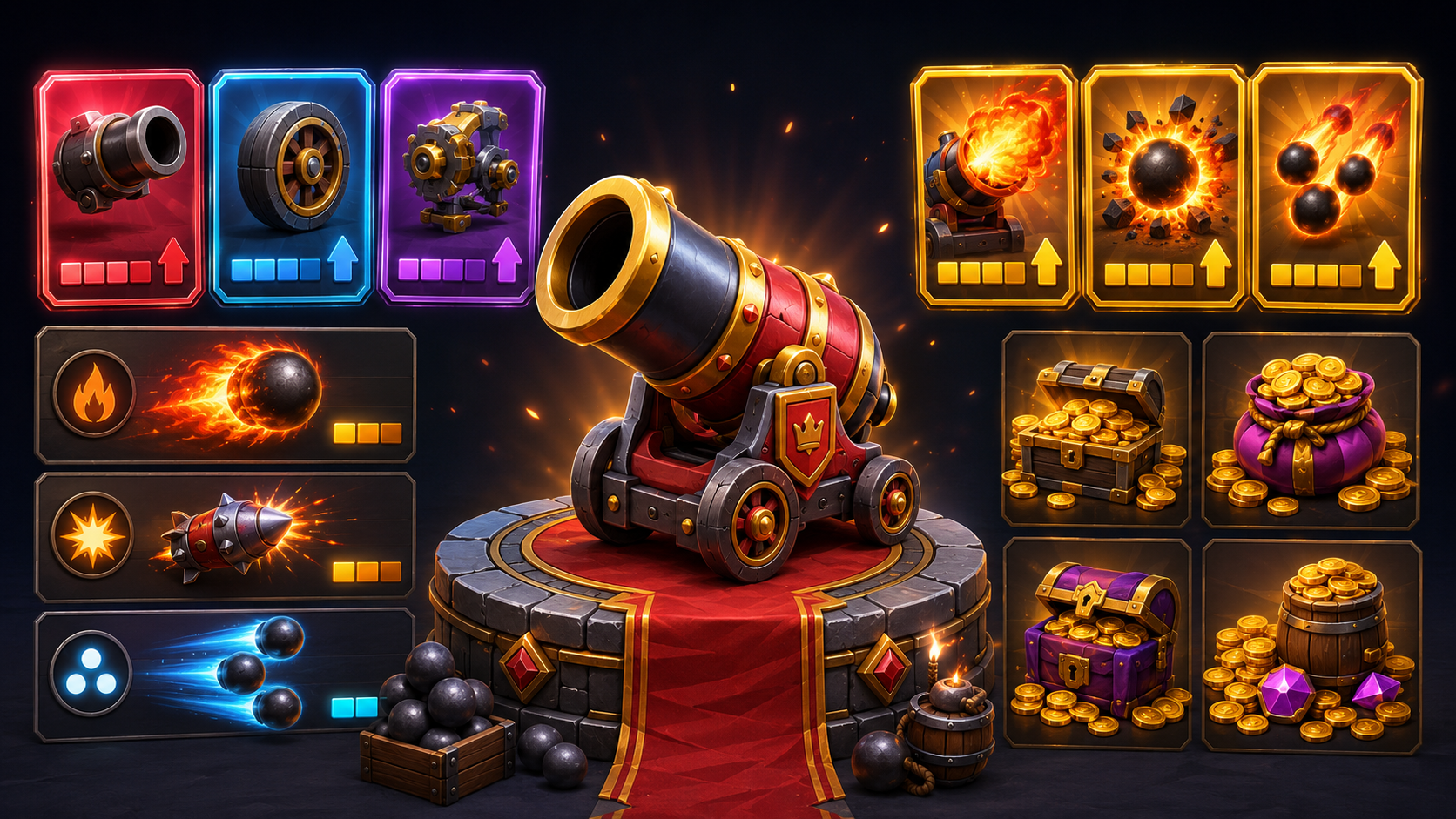
- Upgrades & power — Better cannons, explosive rounds, special projectiles — a sense of growing power that drives both retention and monetization.
How to Build One: Mechanics & Tech
Under the hood, a smash game is fundamentally a physics and feedback engineering challenge. The mechanic is simple; making it feelincredible while running smoothly on a cheap phone is the real work. Here's the stack we use:
Unity 2022 LTS or Unity 6with C#, Unity Physics (Rigidbody / DOTS), fracture & debris plugins, particle systems (VFX Graph), DOTween for juice and UI, native haptics, Firebase + Remote Config, and an ad mediation + Unity IAP stack.
The Core Engineering Challenges
- Destruction physics that feel great AND perform. Real-time fracturing is expensive. The craft is faking convincing destruction cheaply — pre-fractured meshes, debris pooling, and smart culling — so it looks explosive but never drops frames on a mid-range Android device. This balance is the heart of the build.
- Deterministic, tunable projectile control. Aim, power, and trajectory need to feel precise and fair. Players must believe every miss was their fault and every great shot was their skill.
- The juice layer as a first-class system. Screen shake, hit-stop/slow-mo on big impacts, layered particle bursts, camera punch, haptic patterns, and escalating audio — built as tunable, remote-configurable systems so feel can be A/B tested, not hard-coded.
- Level & structure authoring tools. A pipeline to quickly build and balance hundreds of destructible structures, so live-ops can keep shipping fresh content weekly.
- Combo & scoring engine. Detecting chain reactions, scoring multi-hits, and triggering the right celebration at the right intensity.
In most genres, content (levels, art) dominates cost. In smash games, a disproportionate share goes into physics tuning and juice — the invisible craft of making destruction feel perfect. It's also exactly where cheap clones cut corners, which is why so many smash games look right but feel dead. Getting the feel right is the entire competitive advantage.
How Smash Games Make Money
Smash games monetize through the hybrid-casual model — the reason the genre is a business and not just a viral toy. Three revenue streams work together:
Rewarded video is the star — players watch to double their coins, unlock a special cannon, or get a retry. Because the reward is player-chosen, it doesn't feel intrusive. Light interstitials between levels round it out. Rewarded ads fit the genre's short-session rhythm perfectly.
The coin-package ladder (Smash Fest runs $1.99 to $99.99), special projectiles, cannon upgrades, and cosmetic themes. IAP is what lifts revenue per user far above pure-ad hypercasual, and it's why the upgrade/power progression matters so much — it creates things worth buying.
A one-time purchase (around $5.99) to remove interstitials. Simple, popular with engaged players, and a reliable revenue floor. It also improves the experience for exactly the players most likely to keep playing — a smart retention-and-revenue combo.
What It Costs to Build One
Smash games are relatively cost-efficient to build — the content is systemic, and the cost concentrates in physics and feel rather than massive art or level libraries. Realistic 2026 budgets with an established studio (US/UK in-house adds 2–3x; see our outsourcing guide):
Budget: $15,000 – $30,000
Includes: Core smash physics + juice, aim/power/timing controls, 30–50 levels, basic combo & scoring, ads + simple analytics, iOS + Android.
Budget: $35,000 – $65,000
Includes: Polished destruction + full juice, 100+ levels & structures, upgrade & progression systems, full hybrid monetization, remote config + A/B testing, level authoring tools, localization.
Budget: $70,000 – $90,000+
Includes: Advanced destruction physics, seasonal events & themes, deep meta & collection systems, advanced ad + IAP optimization, ongoing live-ops content, full analytics & UA support.
Start with a Tier 1 MVP to validate the feel and test ad creative — smash games live or die on whether the destruction feels great and the videos perform. If the metrics are strong, scale to Tier 2 with the same team. This keeps risk low while the genre window is open.
Common Mistakes to Avoid
The #1 killer. Correct physics with no screen shake, weak particles, and thin sound produces a game that works but feels dead. In this genre, that's fatal — the feel is the entire product.
Over-ambitious real-time destruction that stutters on the cheap Android devices where most of the audience lives. Convincing-but-optimized beats realistic-but-laggy every time.
If every shot is trivially easy or purely random, mastery never develops and players leave. The aim/power/timing layer needs real depth so good players feel good.
A satisfying smash with no progression, upgrades, or monetization is a 3-day novelty. The hybrid meta-layer is what turns a viral moment into a lasting, earning game.
Smash Fest still climbs because it ships new content weekly. Treating launch as the finish line means watching your game fade a month later. Plan ongoing events and levels from the start.
How Raijin Can Build Yours
Smash and physics games are squarely in Raijin Studio's wheelhouse — and this is a genre where the difference between a studio that understands feel and one that just ships physics is everything. We build the whole package: the satisfying destruction, the obsessive juice tuning, the hybrid monetization, and the live-ops cadence that keeps a smash game climbing.
- Physics & juice expertise — We treat feel as a first-class engineering discipline: optimized destruction, tuned haptics, particles, and impact feedback that make every smash land.
- Fast prototyping — We can stand up a playable smash prototype quickly so you can validate the feel and test ad creative while the window is open.
- Full hybrid stack — Progression, upgrades, events, and monetization — the systems that turn a viral hook into durable revenue, the same engineering behind our block-puzzle and match-3 work.
- Original by design — Distinctive themes and original assets that stand out in a crowded genre and stay legally clean.
- 50–70% below US/UK cost — with the production quality to make the feel genuinely great, not just functional.


Want to Build a
Smash Hit?
Bring us your idea or a reference game. We'll prototype the smash, obsess over the feel, build the full hybrid game, and help you launch — under NDA. Free 60-minute consultation.
Frequently Asked Questions
What are smash games and why are they so popular?
Smash games are physics-based mobile games where players fire projectiles or a cannon at fragile structures and trigger satisfying chain-reaction destruction. They're booming in 2026 because the action is instantly understandable, endlessly shareable on TikTok and Reels, deeply satisfying to the brain's reward system, and monetizes well as a hybrid-casual title. Smash Fest reached a 4.7 rating from nearly 200,000 reviews within months of launch.
Why are smash and destruction games so addictive?
They deliver immediate, high-intensity sensory reward for a tiny, low-effort action. A single tap produces cascading visual chaos, sound, screen shake, and haptics — a dopamine hit the brain reads as a big win for minimal effort. Combined with unpredictable chain reactions (variable reward), short sessions, and constant near-miss "almost got it all" moments, this creates a compulsive one-more-shot loop.
How much does it cost to develop a smash game?
An MVP with core physics destruction and 30–50 levels costs $15,000–$30,000 over 5–7 weeks. A production hybrid-casual release with progression, monetization, and polish costs $35,000–$65,000. A premium title with advanced destruction physics, live-ops events, and deep monetization runs $70,000–$90,000+. Physics tuning and satisfying feedback are where most of the engineering effort goes.
What engine is best for building a physics smash game?
Unity is the standard choice. Its built-in physics engine, particle systems, and asset ecosystem are ideal for destruction gameplay, and specialized fracture plugins add realistic debris. The key engineering challenge is balancing convincing destruction physics against smooth performance on low-to-mid-range mobile devices.
How do smash games make money?
Through hybrid monetization: rewarded and interstitial ads plus in-app purchases. Smash Fest offers a no-ads unlock around $5.99 and a coin-package IAP ladder from $1.99 to $99.99, alongside ads. The hybrid model earns significantly more per user than pure ad-based hypercasual while keeping the game free to download.
How long does it take to build a smash game?
A playable prototype can be built in 1–2 weeks. A production-ready hybrid-casual smash game typically takes 8–14 weeks depending on the depth of destruction physics, number of levels, progression, and monetization. Ongoing live-ops with new levels and events is what keeps these games earning long after launch.