
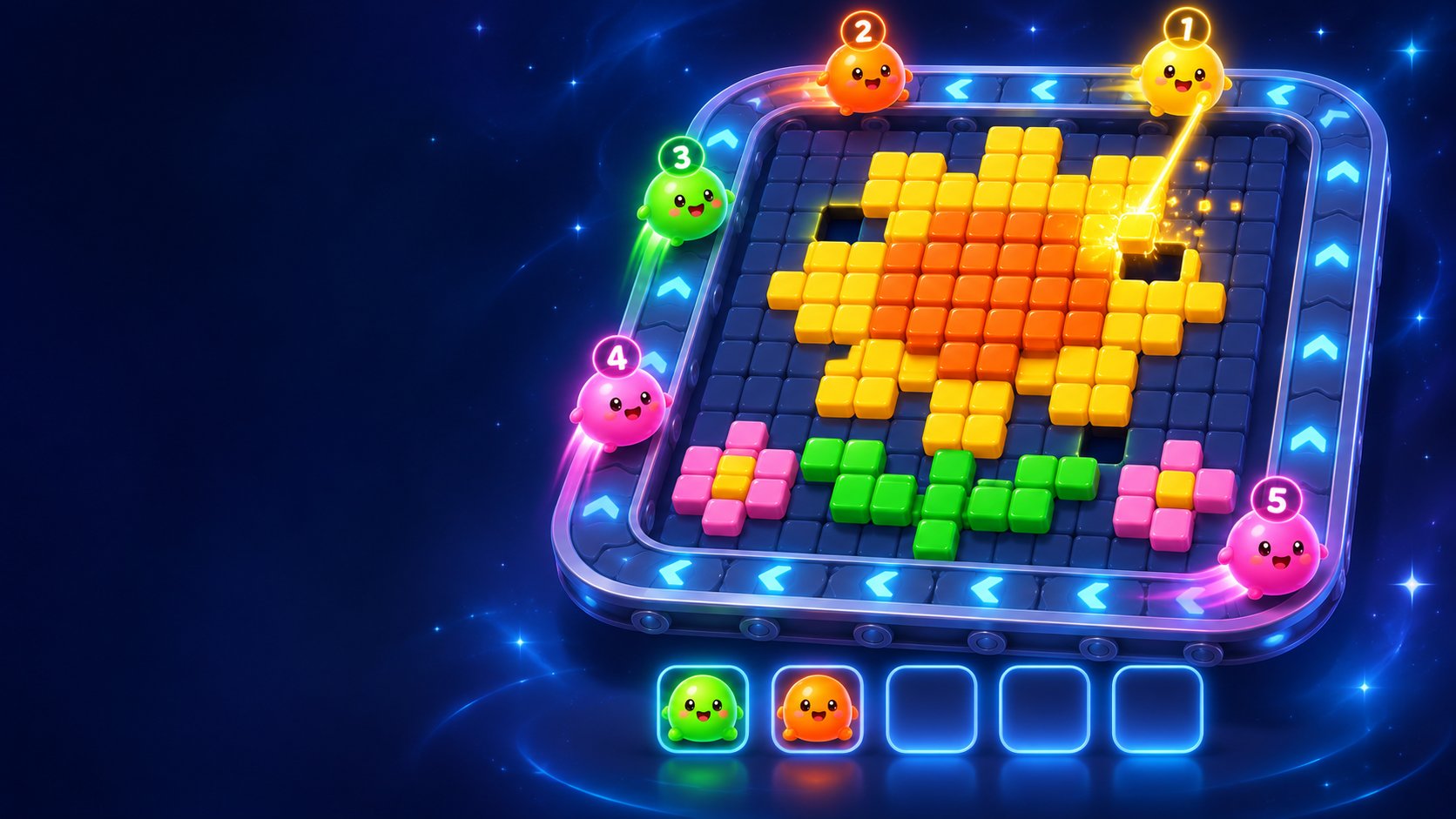
A pixel-art picture. A conveyor belt running around it. A handful of little shooters, each with a number above its head. Tap one, it rides the belt and clears every matching colour it can reach. Run out of space on the belt and you lose.
That is the whole of Pixel Flow!, and in 2026 it has become one of the most copied mobile games in the world. According to AppMagic, it earned about $31.3 million in in-app purchases in Q3 2026 with 28.9 million downloads, the most of any game in the top ten hybrid-casual puzzles. Six of those top ten games are now built on flow or conveyor mechanics, and in October a follower, Colony Flow!, which swaps the conveyor for colonies of ants, overtook it as the month's highest-grossing hybrid-casual puzzle.
A sub-genre was born in under a year. This guide breaks down why it works, how the core mechanic is built, how these games make money, and what it actually costs to build a flow puzzle that can compete, rather than another clone that disappears in a week.
~$31.3M Pixel Flow! in-app purchase revenue in one quarter
28.9M Pixel Flow! downloads in the quarter, #1 among top hybrid-casual puzzles
6 of 10 top-grossing hybrid-casual puzzles use flow or conveyor mechanics
+13% puzzle genre revenue growth in Q3, nearly matching strategy
Revenue and download figures are third-party estimates (AppMagic, Sensor Tower and industry press). They differ between sources and are not official publisher numbers.
What Is Pixel Flow, Exactly?
Pixel Flow! is a hybrid-casual puzzle game by Loom Games. Each level is a pixel-art image built from coloured blocks, and your job is to clear the image completely.
You do it with shooters: small characters that each carry a colour and a number, their "ammo". Tap a shooter and it goes onto a conveyor belt that runs around the image. As it travels, it fires at blocks of its own colour, using one ammo per block. When the ammo runs out, the shooter is done.
Shooters that can't be used yet wait in a small number of holding slots, and the belt has a hard capacity. Fill the slots and the belt with shooters that can't reach their colour, and the level is lost. The rules fit in one sentence, but every tap is a small plan: which colour is reachable now, which shooter should wait, and will this one block the belt for the next three moves?
Why Flow Puzzles Are Winning in 2026
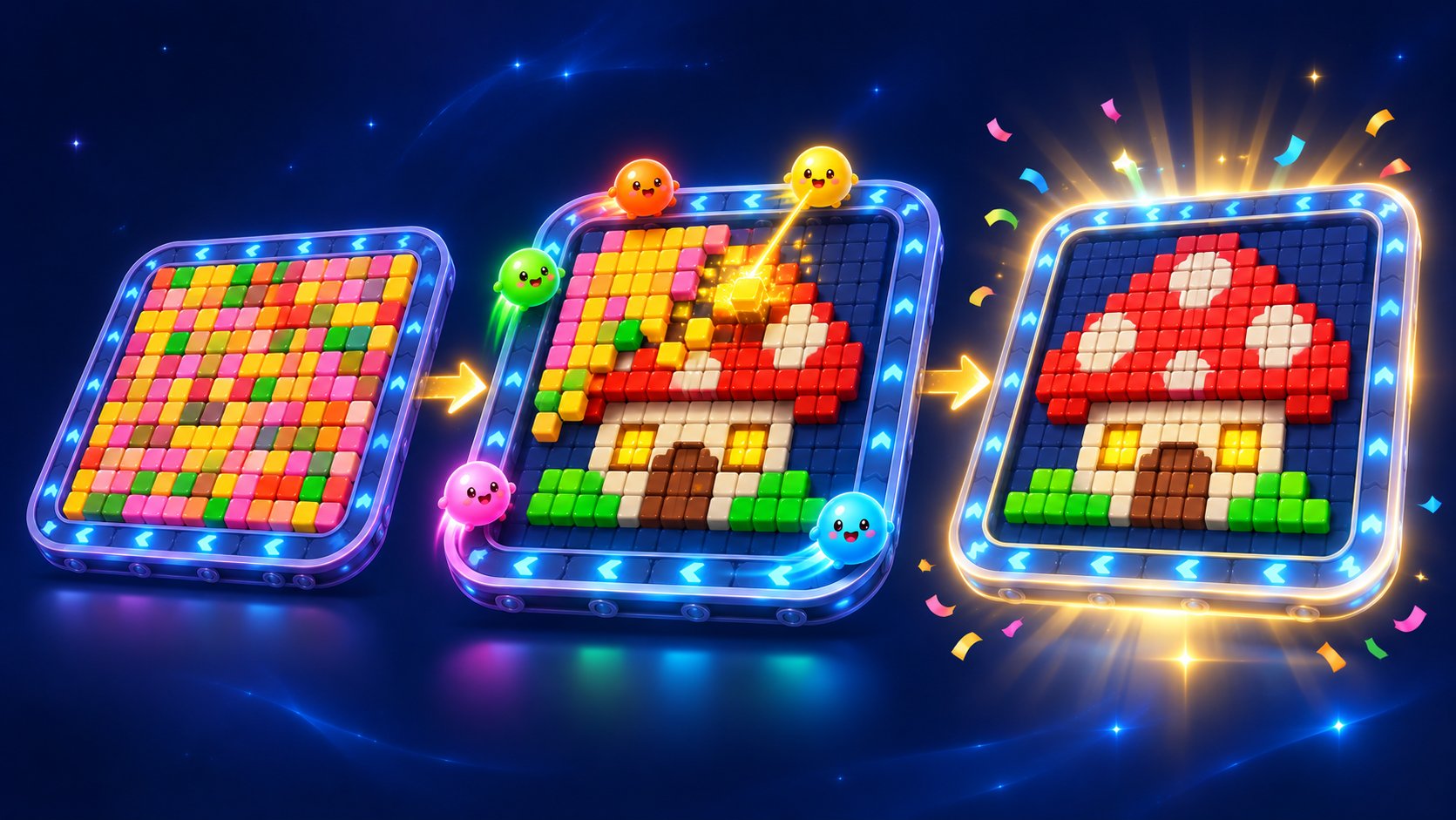
A picture and some colours. No tutorial wall, no text. That makes ads cheap to produce and the time from install to first win very short, which is exactly what hybrid-casual user acquisition needs.
Every tap removes part of the image. Watching a messy picture turn clean taps the same satisfaction loop as cleaning and organising videos, and it makes the game great to film for ads and short-form social content.
Analysts describe the core as essentially deterministic: the board doesn't shuffle on you. When you fail, it's because you parked the wrong shooter, and that keeps players retrying instead of quitting.
Any pixel image can become a level, and difficulty is controlled by a few numbers: colours, ammo counts, slot count and belt capacity. A small team can ship thousands of levels.
The loss state is a slow squeeze: the belt fills and the slots run out. That is the exact moment a player will pay for an extra slot, a booster or one more try.
And the genre is still moving. Colony Flow! kept the image-clearing goal but replaced conveyors with ants, and others have mixed in knitting or 3D boards. The mechanic is a template; the winners are the ones who add a twist.
The Core Loop, Built Properly
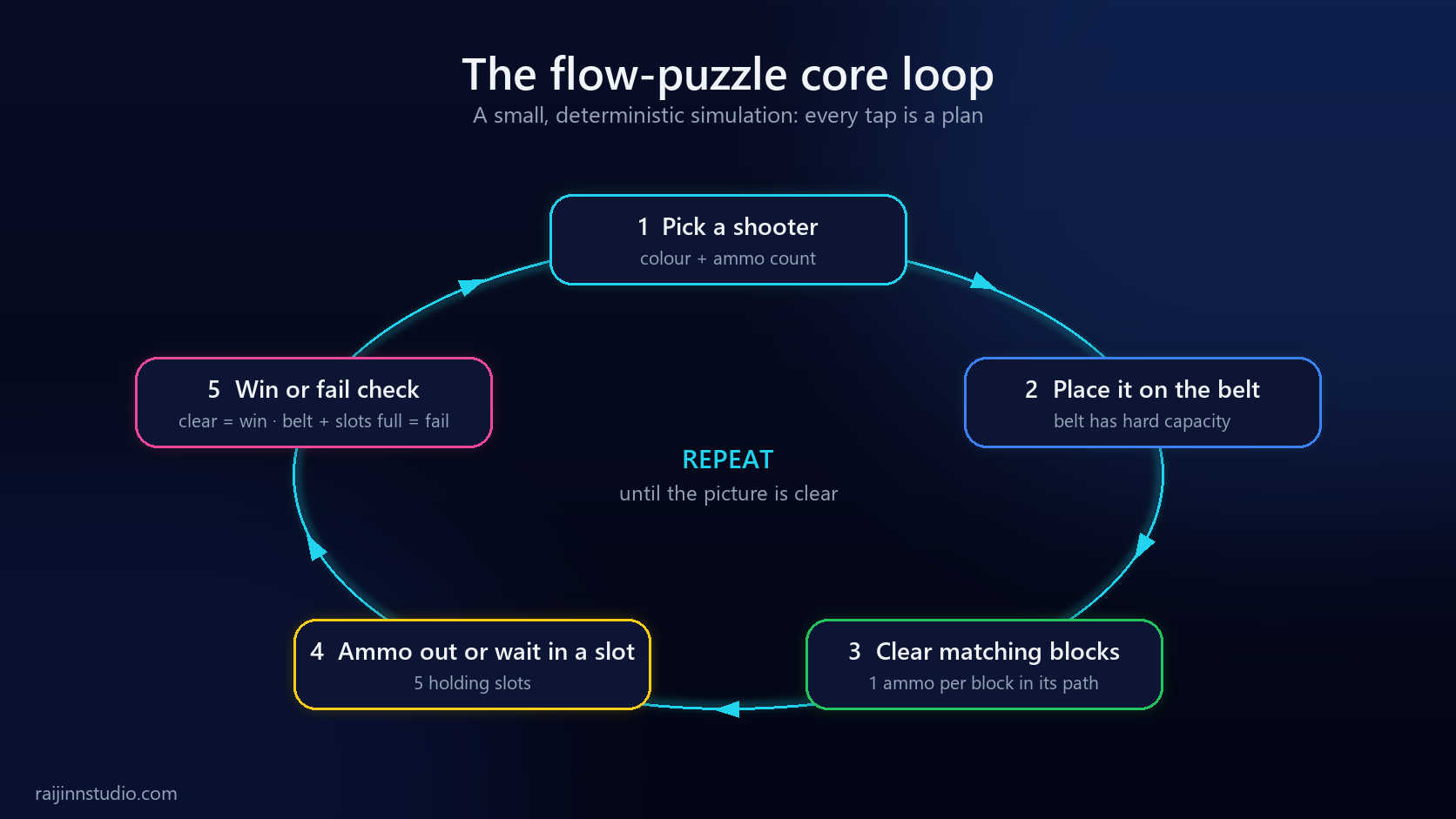
Under the art, a flow puzzle is a small, strict simulation. These are the parts you need to get right.
The Board
- A grid of coloured cells generated from a pixel image. Store levels as data, not scenes: colour per cell plus metadata.
- A level editor is not optional. Designers need to import an image, reduce it to a palette, set shooter colours and ammo, and test instantly.
The Conveyor, Shooters and Slots
- The belt is a fixed path with discrete positions and a capacity limit. Simulate it on a tick, not with physics, so it is deterministic and replays exactly the same way.
- Each tick, every shooter on the belt checks for reachable cells of its colour and spends ammo.
- Shooter = colour + ammo count. Slots = a small buffer (Pixel Flow uses five), with clear rules for what happens when ammo hits zero and when a shooter completes a lap without a target.
Win, Fail and Difficulty
- Win: all cells cleared. Fail: no legal move because the belt and slots are full of shooters that can't reach their colour. Detect it early and show it clearly: a confusing fail feels unfair; a clear one makes players hit retry.
- Difficulty levers: number of colours, how colours are layered (outer vs inner pixels), ammo totals vs cells, slot count and belt capacity.
- Build a solver that plays each level automatically. It confirms the level is beatable, measures how many wrong moves it tolerates, and gives every level a difficulty score, so hard levels land where you intend instead of by accident.
Juice
The genre lives on feel: the pop of each pixel, the belt's rhythm, the final picture reveal. Budget real time for effects, haptics and sound. It is the difference between "a clone" and "the one people keep playing".
How Flow Puzzles Make Money
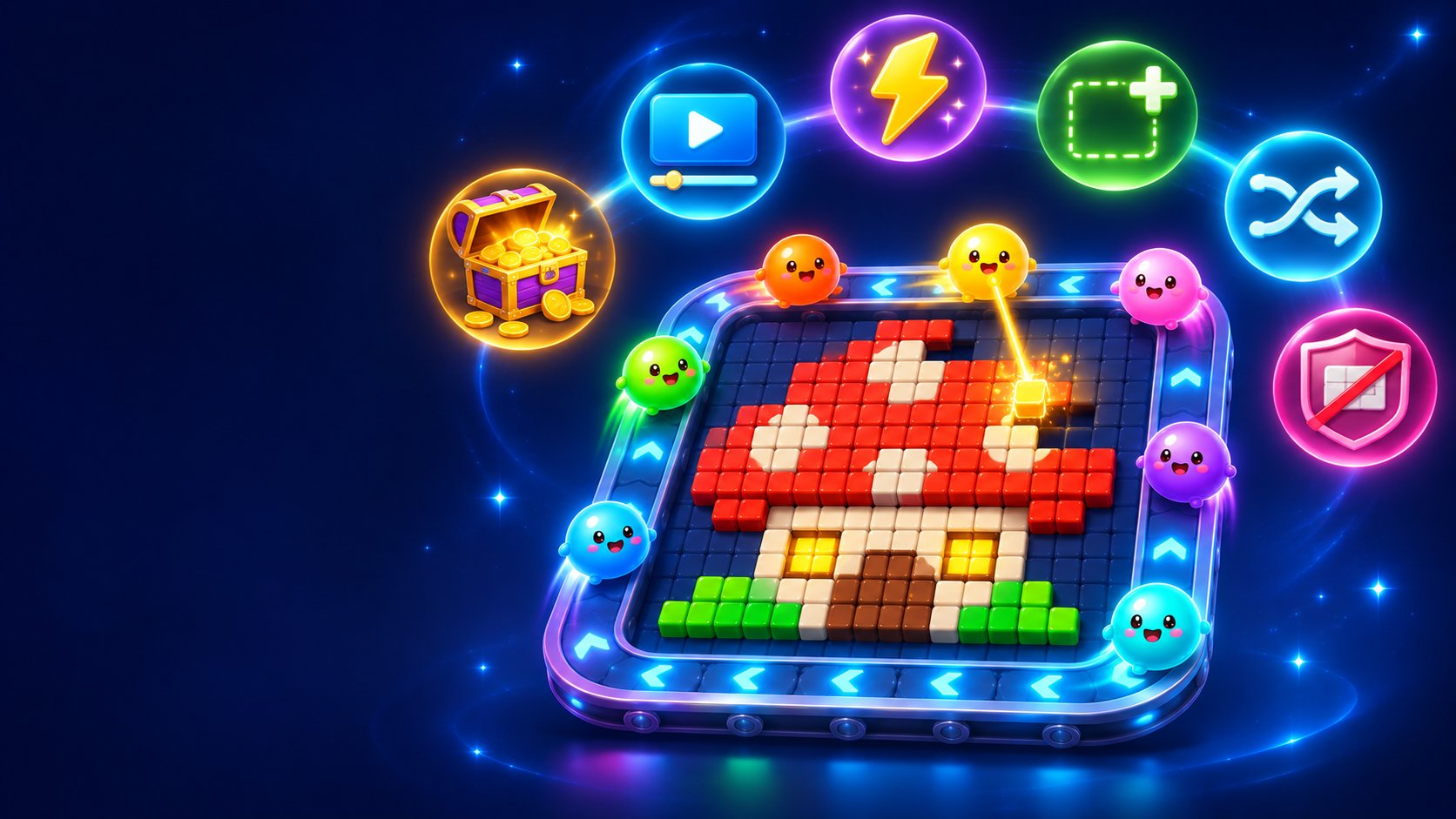
Flow puzzles are hybrid-casual: they earn from both ads and in-app purchases. Unlike pure-ads games such as Block Blast, the purchase side is serious. Pixel Flow's quarterly figure above is purchases alone.
- Continue and extra-slot offers at the fail moment: the highest-converting placement in the genre.
- Boosters: clear a colour, shuffle the belt, add a slot. Sold in packs or earned through play.
- Rewarded video: watch an ad for a booster or a continue. It serves non-payers and keeps them engaged.
- Interstitials between levels, tuned carefully. Too many early on and retention drops.
- No-ads purchase and starter bundles for players who stay past the first sessions.
- LiveOps: themed picture packs, weekly events, streaks and leagues to bring players back.
The design rule:make the fail state feel close. A player who loses with one cell left will pay; a player who was never close won't.
Tech Stack We'd Use
- Engine: Unity (2D or 2.5D), with a deterministic tick-based simulation for the belt and shooters.
- Tools: an in-editor level editor (image import, palette, shooter setup, play-test) plus the automated solver for difficulty scoring.
- Content pipeline: levels as JSON or ScriptableObjects, delivered remotely so you can add and rebalance levels without an app update.
- LiveOps and data: remote config, A/B testing, and analytics on every level: start, fail point, retries, booster use.
- Monetisation: an ad mediation SDK plus store billing, with offers driven by remote config.
- Platforms: iOS and Android first, plus an HTML5 build for playable ads.
What Does It Cost to Build a Game Like Pixel Flow?
Flow puzzles are lean on systems but heavy on levels and tools, because every level is designed and tuned. Typical ranges with an experienced outsourced team (Raijin estimates, 2026; see our full mobile game cost guide):
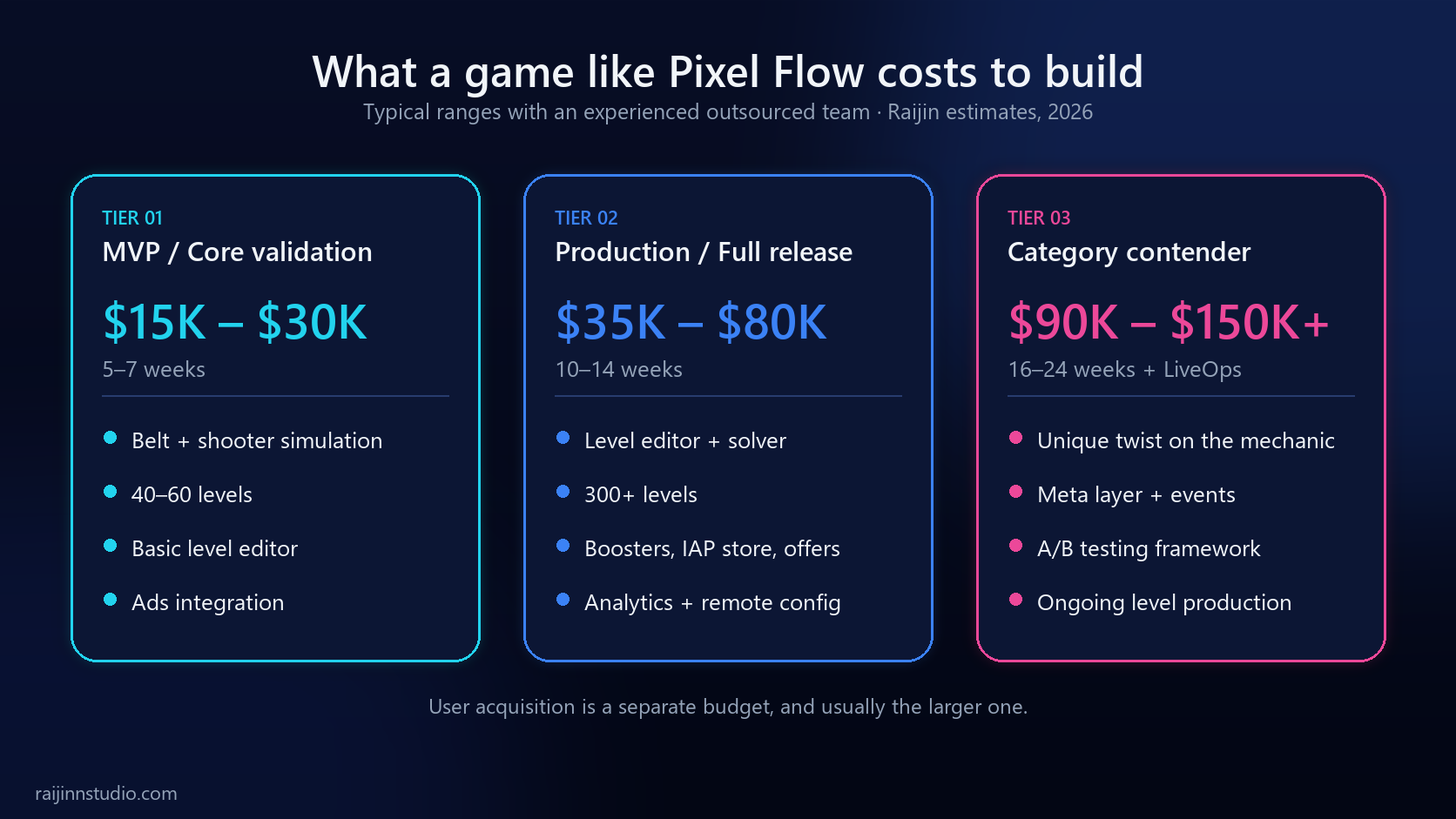
Budget: $15,000 – $30,000
Includes: belt and shooter simulation, 40–60 levels, a basic level editor, simple UI and ads integration. Enough to test retention and install cost with real players.
Budget: $35,000 – $80,000
Includes: full level editor and solver, 300+ levels, boosters, continue offers, IAP store, ad mediation, analytics, remote config and polished effects.
Budget: $90,000 – $150,000+
Includes: a unique twist on the mechanic, a meta layer (decorating, collections or story), events and leagues, an A/B testing framework, a large content pipeline and ongoing level production.
What moves the price: the number of launch levels, how custom the art style is, whether you need a meta layer, and how much LiveOps you plan after launch. User acquisition is a separate budget, and usually the larger one.
How to Stand Out Instead of Cloning
Hundreds of conveyor clones launched after Pixel Flow, and most vanished. The ones that broke through changed one big thing:
- A new delivery fantasy: ants instead of belts, yarn instead of shooters, 3D boards instead of flat pictures.
- A theme with its own audience: pets, fashion, food, famous art, regional culture.
- A meta layer that gives levels a purpose: restore a room, complete a collection, unlock a story.
- Social play: leagues, team events, sharing finished pictures.
Mechanics aren't protected, but names, art and code are: never reuse another game's branding, characters or assets. Prototype two or three original twists cheaply, test the ads before building the full game, and commit to the one players click.
Build Your Flow Puzzle With Raijin
Raijin is an end-to-end game studio. We build hybrid-casual puzzles in Unity from the first prototype to live operations, using the same engineering approach as our arrow puzzle and match-3 work: deterministic simulations, level editors and solvers, art and effects, monetisation and analytics.
Planning a
Flow Puzzle?
Tell us your twist, and we'll come back with a playable prototype plan and a cost estimate.
Frequently Asked Questions
How much does it cost to make a game like Pixel Flow?
An MVP typically costs $15,000–$30,000 over 5–7 weeks. A full production release with a level editor, 300+ levels and monetisation costs $35,000–$80,000, and a category-contender build with a meta layer and LiveOps runs $90,000–$150,000+.
What engine is best for a flow puzzle game?
Unity is the most common choice: it suits 2D and 2.5D puzzles, has mature ad and analytics SDKs, and makes custom level editors straightforward to build.
Why are flow and conveyor puzzles so popular in 2026?
They read instantly, show visible progress with every tap, feel skill-based rather than random, and create a natural moment to monetise when the belt fills up. AppMagic found that six of the top ten hybrid-casual puzzles in Q3 2026 use flow or conveyor mechanics.
How do games like Pixel Flow make money?
Hybrid monetisation: in-app purchases for boosters, extra slots and continues, plus rewarded and interstitial ads and a no-ads purchase.
How long does it take to develop a flow puzzle game?
About 5–7 weeks for an MVP, 10–14 weeks for a full release, and 16–24 weeks for a contender build, plus ongoing LiveOps.